What are those tiny curtained bars and street stalls, and can I actually go in?
Here is the honest answer: yes, you can go in, and the whole system runs on a short, learnable procedure. Some doors genuinely are closed to first-timers, and that is capacity, not hostility. This page defines what you are looking at, walks the ritual end to end, and routes you to eight deeper guides for each step.

The fear, named
Are you allowed in?
You have seen them. A lane barely a meter wide, red lanterns, a row of doorways hung with split fabric curtains, and behind each one a room the size of a walk-in closet with six stools and a person behind a counter. Or, in Fukuoka, a tarp-covered cart on the sidewalk with steam coming off a ramen pot and strangers eating shoulder to shoulder. Guidebooks call these the best nights in Japan. None of them answer the only question that matters: are you allowed in.
You are not alone in asking. A 73-year-old Australian traveling solo asked the TripAdvisor Tokyo forum whether Shinjuku’s Golden Gai was even safe for Westerners, citing door signs he read as “if you don’t speak Japanese don’t come in here.” His fear was not crime. It was being turned away at the door. An English teacher who had lived in Japan for six months wrote that she walked up and down the Fukuoka yatai street “a good number of times” before working up the courage to sit down. If residents hesitate, your hesitation is normal.
The ritual, in order
The whole night, end to end
Walk the whole row before you choose
Do not take the first stall or the first open door. Locals walk the line, judging by smell, crowd and the menu board. Two signals mean you are welcome: prices posted where you can see them, and an English menu or price list outside. One signal means walk away: no posted prices at all. That is the main rip-off risk in the entire scene. A sign reading 会員制 (“members only”) or 一見さんお断り (“first-timers refused”) is not an insult. Move on without offense.
Peek before you commit
The noren, the split curtain over the door, is the shop’s open sign. Hung outside means open; taken in means closed. In Golden Gai it is acceptable and expected to slide the door, put your head in, and assess. At a yatai, lifting the curtain or plastic sheet to check for seats is normal. If the room is full or clearly a regulars’ living room, apologize and withdraw. Nobody is offended by a peek.
State your number
Say “konbanwa,” then your party size: “hitori desu” (one), “futari desu” (two), or just hold up fingers. At a yatai, do not seat yourself. Hold up the fingers and wait for the cook’s nod. If there is a cover charge and it is not posted, ask now, before you sit, not when the bill comes.
Order a drink immediately
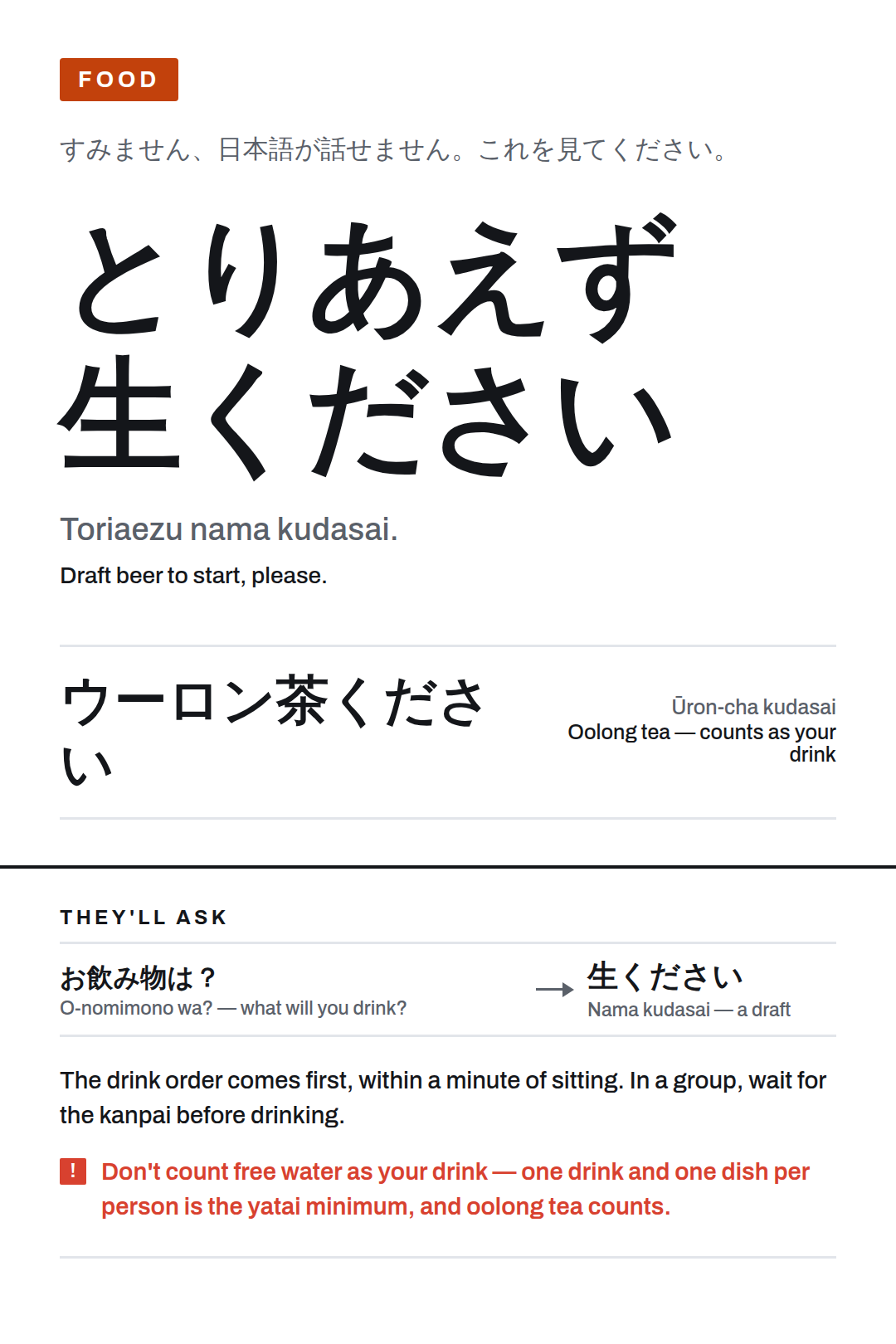
The first order is a drink, and it comes fast. The canonical opener is “toriaezu nama” — a draft beer to start. A drink per person is the minimum everywhere; at a yatai the polite minimum is one drink and one dish per person, and a non-alcoholic order counts (oolong tea is the standard not-drinking order). If you are in a group, wait and raise glasses together for kanpai before drinking.
Accept the small dish you didn't order
At seated bars and izakaya-style counters, a small dish lands in front of each person soon after the first drink. This is otoshi, typically ¥300 to ¥600 per person, and it functions as the seat charge. It is not a scam and it is not aimed at foreigners. Treat it as non-refusable at counter bars. Most Fukuoka yatai charge no otoshi at all; the one-drink-one-dish minimum does the same job. The full breakdown is in the cover charges guide.
Order in rounds, not all at once
Raise a hand and say “sumimasen” to call the master. That is expected, not rude. Order food in small waves, two or three things at a time, and keep at least one live order going while you sit. Pointing at the menu, the pot, or what your neighbor is eating all work. “Osusume wa nan desu ka?” (what do you recommend) is both an icebreaker and an ordering strategy.
Pay once, in cash
When you are done: “okaikei onegaishimasu,” or cross your index fingers in an X. That gesture is understood at yatai and izakaya alike. Pay the total at the end, put the money on the small tray rather than into a hand, and split evenly if you are a group. Assume cash only. Yatai are effectively all cash (only about 10% take cards), Golden Gai is overwhelmingly cash, and the fix is the Seven Bank ATM at the nearest 7-Eleven, which takes foreign cards.
Leave with gochisōsama
The exit phrase is “gochisōsama deshita” — thanks for the meal. It doubles as your leaving signal and it is the cheapest goodwill purchase in Japan. Then move to the next stall or bar. The local pattern is a crawl: roughly three yatai in a night, or one to two drinks per bar in Golden Gai, not four hours over one glass.
Phrases
The six phrases that do most of the work
The full phrasebook, with menu decoding, is in the ordering guide.
| Situation | Japanese | Romaji | Meaning |
|---|---|---|---|
| Claiming a seat | ここ、いいですか? | Koko, ii desu ka? | Can I sit here? |
| Stating party size | 一人です / 二人です | Hitori desu / futari desu | One person / two people |
| First drink | とりあえず生ください | Toriaezu nama kudasai | Draft beer to start |
| Before sitting | お通し/チャージ、ありますか? | Otoshi / chāji, arimasu ka? | Is there a cover charge? |
| The bill | お会計お願いします | Okaikei onegaishimasu | Bill, please |
| Leaving | ごちそうさまでした! | Gochisōsama deshita! | Thanks for the meal |
The taxonomy
Yatai, yokocho, tachinomi, izakaya: which thing you are looking at
Yatai (屋台) are mobile open-air food stalls, assembled at dusk and towed away before dawn. Fukuoka is the last major stronghold, with roughly 100 licensed stalls citywide (the city counted 98 in March 2025, with more opening that year), each seating about 7 to 10 people around a cooking counter. Food-first: ramen, yakitori, oden, with drinks alongside. No cover charge at most stalls.
Yokocho (横丁) means “alleyway”: a narrow lane packed with tiny bars and micro-izakaya, usually a postwar black-market remnant. Shinjuku’s Golden Gai holds about 280 bars packed into six narrow alleys, many seating only five customers. Omoide Yokocho crams 60 to 80 stalls into a block of 100 by 30 meters. Yokocho bars are drink-forward: the master owns the room, the kitchen is minimal, and conversation is the product.
Tachinomi (立ち飲み) are standing bars with chest-high counters. The cheapest format in Japan: beer ¥300 to ¥600, skewers from ¥100, a whole session for ¥1,000 to ¥1,500, and usually no otoshi, which is the structural difference from seated bars. At some, the spent skewer sticks on your plate are the bill. Do not throw them away.
Izakaya are the food-forward pubs with tables, covered in the izakaya guide. A yokocho bar is what remains when you shrink an izakaya to five stools and delete most of the kitchen. The noren curtain works the same at all of them: fabric out means open, fabric in means closed. The curtain is the shop’s reputation made physical, which is why nobody minds you lifting it to look.
Who it suits
Who these places suit
Solo is the optimized case. Single stools free up first, and the format was built for one person eating next to strangers. Two or three people is fine, and it is what Fukuoka’s own city guide recommends. Four is marginal. Five or more often won’t fit at a yatai and can fill an entire Golden Gai bar; the fix is splitting into pairs across two doors. Children are fine at open-air yatai early in the evening, and effectively barred from yokocho bars: forum locals are unanimous (“Bars in Golden Gai are not appropriate for kids”), and under-20s legally cannot enter the many tiny bars registered as smoking-permitted. Solo women report the scene as safe, including Golden Gai, which has a long history of women-run bars. The one hard rule: never follow a tout, anywhere near Kabukicho.
Where to start
The first-timer ladder
A neo-yokocho
Shibuya Yokocho or Ebisu Yokocho: the alley experience rebuilt indoors with English menus, card payments and no regulars-only doors. Training wheels, honestly useful.
Daytime-tolerant streets
Hoppy-dōri in Asakusa and the standing bars of Ameyoko in Ueno: open-air, cheap, zero intimacy pressure, drinking by day as well as by night.
Omoide Yokocho, early
Go early in the evening, when it is quietest, and walk past the tout-fronted entrance stalls to the deeper counters.
Golden Gai via a named first-timer bar
Albatross G, One Coin Bar Champion, Ace’s Bar and Bar Araku are regularly named as welcoming to first-timers. Check the cover on the door; Albatross G posts ¥500. One door like this converts the whole district.
The deep cuts
Nonbei Yokocho in Shibuya, Osaka’s Ura-Tenma, Naha’s Sakaemachi Ichiba. The city directory maps them. If even rung one feels steep, a small-group evening food tour absorbs the first-door awkwardness, covers handled and introductions made; then go alone the next night. GetYourGuide lists Tokyo night and food tours (affiliate).
The one mistake that actually costs money: following a tout. No legitimate Golden Gai bar sends someone into the street to invite you in. In a case SoraNews24 reported in December 2021, a diner looking for a cheap chain izakaya followed a friendly stranger to a lookalike bar in Kabukicho and paid ¥8,554 for a modest snack, padded with a seating charge, a "year-end charge" and a "weekend charge." The banter is the tactic; it keeps you from reading the menu until you are seated. Tokyo police tell visitors plainly: never follow a street tout. Anyone guiding you to a bar in or near Kabukicho is the scam.
Money and time
What a night costs, and when it happens
Budget per person, 2025–26: a yatai meal runs ¥1,500 to ¥3,000, and a three-stall crawl ¥4,000 to ¥6,000. Omoide Yokocho with drinks is ¥2,000 to ¥4,000. Golden Gai runs ¥2,000 to ¥4,000 per bar including a ¥500 to ¥1,500 cover at most doors, so a three-bar night is ¥7,000 to ¥10,000. Carry ¥10,000 to ¥15,000 in ¥1,000 notes; carry more cash than feels reasonable.
Clock: yatai are towed in around dusk and gone by morning, and some don’t open at all in rain. Omoide is food-first and gets going earlier; Golden Gai bars open in the evening and fill late. Hours and closing days vary door by door, so check the Google Maps link for tonight before you go. Last trains leave around midnight, which is why local nights crest well before then. If you would rather not do the last-train sprint, book search Booking.com for a bed near Shinjuku (affiliate).
Sources
Where these facts come from
- Fukuoka City — official yatai how-to guide (GO FUKUOKA) — groups of 2 to 3, few stalls taking bookings, one drink and one dish each, about 10% taking cards
- Fukuoka City — yatai data (yokanavi.com) — 39 stalls with foreign-language staff and 69 with foreign-language menus, December 2023
- Fukuoka City — press release on new yatai, March 2025 (Japanese) — 98 licensed stalls on 1 March 2025
- Shinjuku Golden Gai association — about 280 bars in the district
- Tokyo Metropolitan Police — entertainment-district rip-offs (Japanese) — never follow a street tout
Prices, rules and procedures on this page were checked against these sources on 5 October 2026. Where no official source exists, the page says the detail varies.
Questions
Yokocho and yatai questions
Is Golden Gai safe for Westerners, including older solo travelers?
Yes. The question that framed this page came from a 73-year-old solo Australian, and the forum consensus was to go. Street crime is a non-issue; the real risks are the touts of neighboring Kabukicho and overpaying at an unposted-price bar. Plenty of doors are regulars’ rooms, so expect a polite no or two before you land. Start with a bar known for first-timers, like Albatross G (¥500 cover, as posted).
Do I need a reservation?
Mostly, no. Almost every yatai seats you in arrival order; a few take bookings by phone or Instagram, but don’t count on one. Yokocho bars are walk-in: at Omoide, catch the cook’s eye, point at the empty stool, say “koko, ii desu ka?” and sit when they nod. Guided tours pre-reserve at partner bars. If you see a queue at a yatai, join the loose line beside the stall.
How much cash do I need for one night?
For a yatai night, ¥3,000 to ¥5,000 in small bills covers a two- or three-stall crawl. For Golden Gai, plan ¥3,000 to ¥5,000 per bar and ¥15,000 to ¥20,000 for a four- or five-bar night. Seven Bank ATMs in 7-Elevens take foreign cards. Japan Post ATMs keep post-office-style hours and many shut in the evening, so don’t count on one after dinner.
Can I bring my kids?
To a Fukuoka yatai early in the evening, yes; the stalls are open-air and food-first. To Golden Gai or Omoide at night, no. Locals are blunt about this, and under-20s are legally barred from the many tiny bars registered as smoking-permitted premises.
Do the staff speak English?
Spottily. In Fukuoka City’s December 2023 count, 39 of its roughly 100 yatai had staff who speak another language and 69 had foreign-language menus. An English menu posted outside is the reliable welcome flag everywhere. Pointing, fingers and ten phrases genuinely cover the rest.
Is it a tourist trap?
The format is not; specific doors are. The tells: English-only laminated picture menus with a tout out front at Omoide’s entrance mean inflated prices, and an unposted cover in Golden Gai (posted ones run ¥500 to ¥1,500) means walk away. Timing causes most disappointment. One forum poster found Golden Gai dead in the afternoon and called it fake; the first reply pointed out that the bars only open in the evening.
Can I pay by card?
Plan as if no. About 10% of yatai take cards, most of Omoide and Golden Gai is cash-only, and small counters everywhere are still mostly cash. Some newer stalls take PayPay. Pay once, at the end, cash on the tray.
What if I only drink, or don't drink at all?
In Golden Gai, drinks-only is the norm. At a yatai, the polite minimum is one drink and one dish per person, and oolong tea counts as the drink. What does not count: sharing one bowl between two stools, or free water as your order.
Take it with you
The ten night cards are in the free set
Getting in, the cover charge, the decoders, paying and leaving — images that open with no signal, in an alley, at night. All 23 cards are free.
Get all 23 cards free