How do I get a table at an izakaya, and what is the dish I didn't order?
A small dish arrives with your first drink that nobody ordered. It is the otōshi, it is the seat charge, and it will be on the bill at roughly ¥300–¥700 a head. It is not a scam, and almost every shop charges it whether you eat it or not. You order drinks first, then food in rounds, and one bill is paid for the whole table at the front.

The ritual, in order
What actually happens, from the door to the register
Say how many of you there are
The first thing said to you at the door is nan-mei sama desu ka? — how many people. Holding up fingers answers it completely. You may then be asked counter or table; either answer is fine, and the counter is usually free sooner.
Answer the all-you-can-drink question
Many izakaya offer nomihōdai — a fixed price for unlimited drinks, commonly ¥1,500–¥2,500 for 90 or 120 minutes, with last orders 20 or 30 minutes before the end. It is priced per person, and most shops make it all or nothing: everyone at the table takes it, or nobody does. Irimasen declines it.
Order a drink before you order any food
This is the convention that trips people up: everyone orders a drink first, the drinks arrive together, and food is ordered after. Toriaezu nama — 'a draft beer to start' — exists precisely because ordering the first round fast is the expected move.
The small dish that arrives is the otōshi
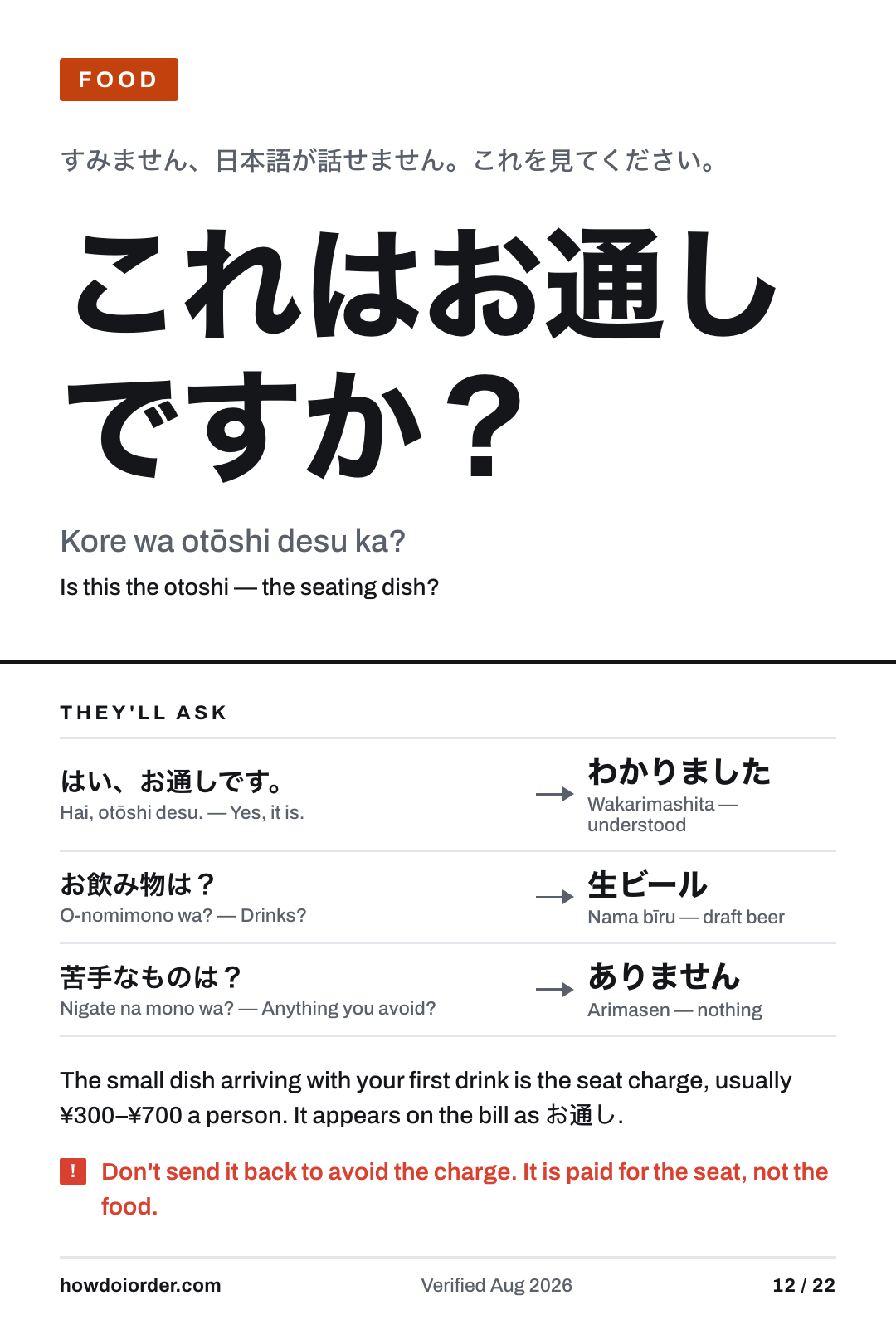
It comes unordered with the first drink and it is the seat charge. It is not a free appetiser, it is not a mistake, and it will appear on the bill as お通し. Assume it stays on the bill whether you eat it or not — that is how almost every shop runs it. If you have an allergy, say so when it lands; many shops will swap it.
Order in rounds, not all at once
Dishes are small, shared, and arrive whenever they are ready rather than in courses. Order three or four things, eat them, then order again. Raising a hand and saying sumimasen is how you get attention — some tables have a call button instead. At chains you will often order on a tablet at the table, or by scanning a QR code with your own phone (67.5% of diners in a 2025 Recruit Hot Pepper survey had done it); it usually has an English switch. If the QR page wants a Japanese phone number or LINE, say sumimasen and order out loud.
Ask for one bill and pay at the front
O-kaikei o onegai shimasu gets you a slip. The bill is per table, not per person, and you carry the slip to the register by the door. Splitting is possible but slow — it is easier to pay once and settle between yourselves outside.
What they will ask you
Four questions, all of them in the first two minutes
These come at the door and at the table, quickly, before you have taken your coat off. None of them are complicated once you know they are coming.
| You’ll hear | It means | Say |
|---|---|---|
| 何名様ですか?Nan-mei sama desu ka? | How many people? | 二人ですFutari desu — two of us |
| お飲み物は?O-nomimono wa? | What would you like to drink? | 生ビールNama bīru — draft beer |
| 飲み放題はいかがですか?Nomihōdai wa ikaga desu ka? | Would you like the all-you-can-drink deal? | いりませんIrimasen — no thanks |
| はい、お通しです。Hai, otōshi desu. | Yes, this is the otoshi — the seating dish. | わかりましたWakarimashita — understood |
The otoshi
The dish you didn't order, and why it is on the bill
Within a minute of your first drink arriving, a small dish lands in front of each person — pickled vegetables, a spoonful of stewed something, a cold tofu. Nobody ordered it and nobody explains it. It is the otōshi, and it is a seat charge dressed as food. Expect ¥300–¥700 per person, occasionally more in Tokyo, and expect it to be the line on the bill you cannot identify.
It is not a scam and it is not aimed at foreigners. Japanese customers pay it every night without comment, and the shop treats it as the cover charge that keeps a table from being occupied for two hours by one beer. Sending the dish back almost never removes the charge, because the charge is for the seat. Many shops will swap the dish if you have an allergy and say so when it lands, but assume the bill will look the same.
You can sometimes avoid it: standing bars and some chains skip it, and a growing number of shops have dropped it altogether. Look for お通しなし on the door or the menu. If you want certainty before you sit down, the card at the top of this page asks the question outright, and the answer will be a yes or a no rather than a conversation.
Don't send the otoshi back to get the charge taken off. You are paying for the seat, not the dish — refusing it almost always leaves you with an empty table and the same ¥300–¥700 on the bill.
Money and time
What the bill will look like
Carry more cash than feels reasonable. Card acceptance is far better than it was, but ticket machines, small counters and IC-card top-ups are still routinely cash-only, and the reliable foreign-card ATMs are in convenience stores and post offices.
An izakaya bill is per table and it is settled at the register by the door, the same pattern as paying at any restaurant. Budget ¥3,000–¥5,000 a head for drinks and a spread of small dishes, plus the otōshi. Some places add a percentage service or late-night charge, often 10%, on top of the otōshi; if they do, it is printed on the menu rather than announced.
There is no tipping anywhere in this. Not in restaurants, not in taxis, not for housekeeping. Money left behind is treated as money you forgot, and someone will come after you with it.
Sources
Where these facts come from
- Ministry of Health, Labour and Welfare — the small existing eatery exemption (Japanese) — smoking allowed only in small places open by April 2020 with 100 m² or less of seating
- Ministry of Health, Labour and Welfare — passive smoking rules (Japanese) — the sign at the door, and no under-20s where smoking is allowed
- Tokyo Metropolitan Government — the small eatery exemption in Tokyo (Japanese) — in Tokyo, smoking only where there are no employees
- Recruit Hot Pepper Gourmet — ordering survey, August 2025 (Japanese) — 67.5% of diners have ordered on their own phone by QR code
- Yakiniku King — drink menu (Japanese) — all-you-can-drink only when everyone in the group orders it
- Gurunavi Pro — restaurant trade magazine on otōshi (Japanese) — typical otōshi charges, most often ¥300–¥399
Prices, rules and procedures on this page were checked against these sources on 5 October 2026. Where no official source exists, the page says the detail varies.
Questions
The things people ask after their first izakaya bill
What exactly is otoshi, and can I refuse it?
It is a small dish that arrives unordered with your first drink, and it functions as a per-person seat charge of roughly ¥300–¥700. You can decline the food politely with irimasen, but the charge almost always stays on the bill because it is paid for the seat. If you have an allergy, say so when it lands; many shops will swap it. Anything far above ¥700 a head in a tourist district is worth checking on the menu before you sit.
Can I smoke in an izakaya, or bring children?
Most are non-smoking, but small old izakaya can still be smoking bars: places that existed before April 2020 with a seating area of 100 m² or less are exempt, and in Tokyo only if the owner works with no employees. They must post a sign by the door — look for 喫煙可 (smoking allowed). If smoking is allowed, nobody under 20 may come in, so that sticker is also the family question.
Do I have to order a drink first?
In practice, yes. Staff take the drink order before the food order, and food often will not be started until the drinks are in. Toriaezu nama — a draft beer to start — is the standard opener, and a soft drink or oolong tea works exactly the same way if you are not drinking.
What is nomihodai and is it worth it?
All-you-can-drink for a fixed period, usually ¥1,500–¥2,500 for 90 or 120 minutes. It is priced per person, and most shops require everyone at the table to take it or nobody. Last orders are called 20 or 30 minutes before the clock runs out. At ¥400–¥600 a drink, it starts paying for itself at about three or four drinks each; below that, order by the glass.
Will they make us leave after two hours?
Often, yes. A 90 or 120-minute table limit is common on busy nights and is usually stated when you sit down, not when time is up. Staff call last orders 20–30 minutes before your time is up, and that is your warning. This is standard practice rather than a complaint about you.
How do we split the bill?
The slip is per table and you pay it at the register by the door. Betsubetsu de asks to pay separately, and a small shop on a busy night may say no. The usual move is one card or one set of notes at the register and settling between yourselves afterwards — see paying the bill.
Should I tip for good service?
No. There is no tipping in an izakaya and money left on the table will be carried out to you in the street — the tipping page covers why. A service or late-night charge, where one exists, is a percentage of the bill — often 10% — on top of the ¥300–¥700 otōshi, and it is printed on the menu.
Can I eat here if I don't eat fish?
It is difficult. Dashi — fish stock — is in most savoury dishes including the vegetable ones, and the otōshi arrives before you can ask about it. Dashi wa haitte imasu ka? asks whether a dish contains it. The allergies page is the fuller answer.