Where else in Japan can I find these tiny bar alleys — Osaka, Kyoto, Sapporo and beyond?
Every city has one, but they are not interchangeable. The procedure you learned in one alley transfers to all of them. What changes is the local dish, the local price, and how deep the regulars' claim on the room goes. This is the directory: eight cities, access, prices, and one named door to start with.

The split
Not one experience
You did the Tokyo alleys, or you are skipping Tokyo entirely, and now you are standing in Osaka or Kyoto wondering where the equivalent is. The honest answer: every city has one, but they are not interchangeable. Osaka’s version is a covered arcade where kushikatsu counters have argued for seventy years about who invented the dish. Kyoto’s most famous “alley” is a working geisha district where the performers are not a photo opportunity. Sapporo’s is seventeen ramen shops in a 42-meter indoor corridor whose whole purpose is the bowl you eat after drinking, and Shizuoka’s is two lanes of oden bars ladling black broth that almost no tourist has heard of.
The fear that follows you from Tokyo — am I allowed in, is this door for regulars — follows for good reason, because the split between welcoming and regulars-first runs through every city on this page.
The ritual, in order
How to work an unfamiliar alley
Walk the whole lane once before committing
Same rule as everywhere: judge by smell, crowd, and the posted menu. No posted prices is the walk-away signal in any city.
Read the door before you touch it
English menu or picture menu outside means welcome. 「一見さんお断り」 (ichigen-san okotowari — first-timers refused) or “Members Only” means move on without offense — in Kyoto especially, this is an introduction-based system with teahouse roots, not hostility.
Peek, ask, and accept the answer
Slide the door, 「空いてますか?」 (aitemasu ka — is there space?). If you hear 「いっぱいです」 (ippai desu), it is full; say 「また来ます」 (mata kimasu) and try the next door. Being turned away from a regulars’ bar is normal, not discrimination.
Order a drink first, keep one live order
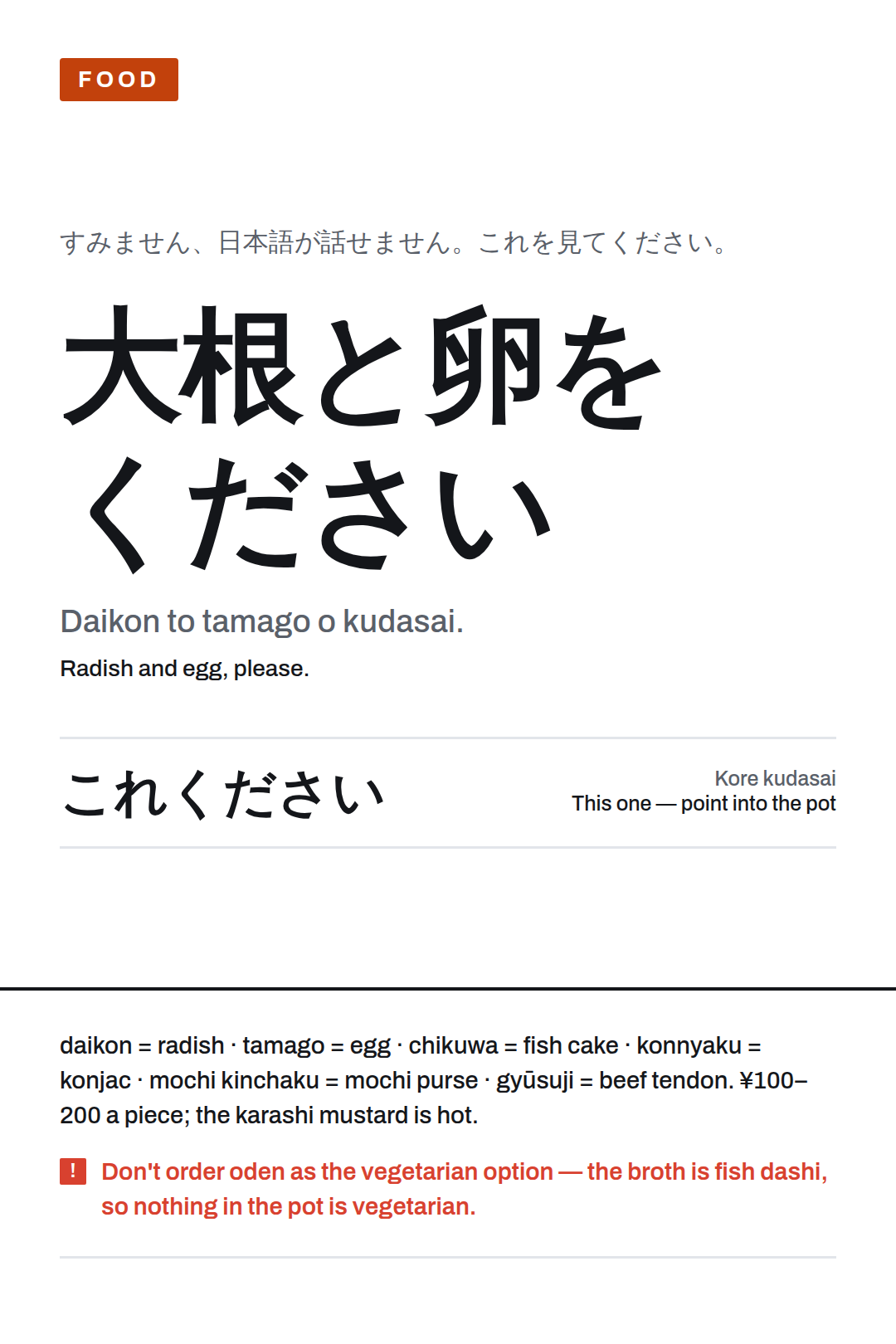
Drink on sitting, food in waves, one drink minimum per person per bar. In senbero territory the first order is 「とりあえず生で」; at an oden counter it is pointing into the pot.
Pay cash, hop, repeat
Assume cash-only everywhere except neo-yokocho and part of Pontochō. One or two drinks per door, then rotate — the hop is the format in every city.
Phrases
The phrases that work in every city
| Situation | Japanese | Romaji | Meaning |
|---|---|---|---|
| Peeking in | 空いてますか? | Aitemasu ka? | Is there space? |
| Party size | 二人です | Futari desu | Two people |
| Sitting down | ここ、いいですか? | Koko, ii desu ka? | Can I sit here? |
| Cover question | お通し、ありますか? | Otoshi, arimasu ka? | Is there a cover dish? |
| First drink | とりあえず生で! | Toriaezu nama de! | Draft beer to start |
| Oden pointing | 大根と卵ください | Daikon to tamago kudasai | Radish and egg, please |
| What locals drink | 芋をお湯割りで | Imo o oyuwari de | Sweet-potato shōchū, hot water |
| Refused | また来ます | Mata kimasu | I'll come again |
| The bill | お会計お願いします | Okaikei onegaishimasu | Bill, please |
| Leaving | ごちそうさまでした | Gochisōsama deshita | Thanks for the meal |
Osaka
Osaka — four alleys, four different rooms
Hozenji Yokocho (法善寺横丁) — one block south of Dotonbori, three minutes from Namba. About 60 shops along 80 meters of twin stone lanes flanking Hozen-ji temple, where the ritual is splashing water on the moss-covered Mizukake Fudō statue before dinner. This is the genteel yokocho: lantern-lit, date-night, kappo counters and okonomiyaki at mid-to-high prices. Reservations are advised for the kappo counters — the one alley on this page where booking ahead is normal. Map.
Jan-Jan Yokocho (ジャンジャン横丁), Shinsekai — a 180-meter covered arcade running from Dobutsuen-mae Station toward Tsutenkaku tower. Cheap, retro, working-class: kushikatsu counters, standing bars, shogi parlors, meals at ¥1,000–2,500 — among the cheapest eating in Japan. The one posted rule that matters: no double-dipping in the shared kushikatsu sauce. One bite, and the sauce vat is done with your skewer; some shops now use squeeze bottles, but where there’s a shared vat, dip once. Start at Yaekatsu, frying for over 70 years; Ganso Kushikatsu Daruma nearby claims the dish’s invention. Map.
Ura-Namba and the Misono Building — the backstreets east and southeast of Namba hold tiny izakaya and standing bars; the deep cut is the Misono Building at Sennichimae 2-3-9, where the second floor of a 1950s cabaret building has become a corridor of subculture micro-bars — punk, DJ, drag. This is Osaka’s Golden Gai, with the same physics: bars open in the evening, charges of ¥500–1,000 are common, and doors range from delighted to regulars-only. Map.
Tenma / Ura-Tenma — the alleys around JR Temma Station, one Loop Line stop from Osaka Station, beside Tenjinbashisuji, Japan’s longest shopping arcade at 2.6 km. This is Osaka’s biggest concentration of cheap standing bars spilling into the lanes, and the home of senbero culture — the “get drunk on ¥1,000” session. Drinks from ¥300–500, sessions ¥1,500–3,000, few English menus, regulars-first but rewarding. It swells during Tenjin Matsuri, July 24–25. Map.
Basing yourself in Namba puts Hozenji, Jan-Jan, and the Misono Building within one walkable night — search Booking.com for Osaka hotels (affiliate).
Kyoto
Kyoto — Pontochō's etiquette, and where locals actually drink
Pontochō (先斗町) — a 500-meter lantern-lit alley, 2.3 to 3 meters wide, running between the Kamo River and Kiyamachi from Shijō to Sanjō. About 80 restaurants. Pontochō is a public street, but it is a working geisha district: keep your voice down and don’t photograph geiko or maiko without asking. Gion’s private lanes are the place with ¥10,000 penalty signs, so stay out of them. Prices run in bands: ¥2,000–4,000 gets you yakitori or a standing bar, ¥15,000-plus is ochaya territory; know which band a door is in before opening it. Few menus are in English and many places are cash-only — carry ¥15,000–20,000 in cash. From May 1 to September 30 the kawadoko riverside decks open, and a deck seat costs more. No public toilets in the alley. Map.
Kiyamachi-dōri — the parallel canal street is Kyoto’s actual nightlife strip: student izakaya, dive bars, picture menus, very safe. Budget standing bars as of 2026: Suiba (four branches, ¥550 draft, plates ¥200–400), Kyoto Stand Kiyokiyo, Tachinomi Sharp. Map.
The honest note: Kyoto has no true postwar bar-alley on the Tokyo model. Pontochō is older and grander than a yokocho; the standing bars of Kiyamachi are the modern substitute for one.
Sapporo, Hiroshima, Sendai
The ramen corridor, Ekinishi, and the gyutan lanes
Ganso Sapporo Ramen Yokocho — ground floor of the N Grande Building in Susukino: a 42-meter indoor alley holding 17 ramen shops. The ritual here is specific: this is where Sapporo ends its drinking nights, with a miso-rich bowl as the closer, so the alley peaks late. Queues form at the famous doors — Ryuto, Teshikaga, Tenho, Misogin — and a copycat “Shin-Ramen-Yokocho” sits nearby; check which one you are in. Map Susukino’s micro-bar buildings stack the yokocho vertically: multi-tenant buildings where every floor holds six-seat bars. Accessible starts: THE NIKKA BAR and bar nano gould. Susukino is busy and well-policed; the usual rules apply, and solo women report it as fine. The side lanes off Tanuki Kōji, the 1873-vintage covered arcade, hold more small izakaya. Map.
Hiroshima — Ekinishi (エキニシ) — Osuka-chō, three minutes west of Hiroshima Station’s south exit: a grid of retro houses turned into dozens of small izakaya, Italian counters, and wine bars, boomed through the 2010s and 2020s. Busy in the evenings, solo-friendly, limited English. Note there are no street yatai in Hiroshima — Ekinishi is fixed bars, and it is the night zone. Start at Izakaya Baltan, pouring since 2004. Map.
Sendai — Iroha Yokocho (壱弐参横丁) — off the Sunmall Ichibancho arcade: two covered lanes born as a “temporary” postwar market about 70 years ago, now roughly 100 micro-units mixing bars, izakaya, and antique shops. Chie is a named starting door. Bunka Yokocho (文化横丁), one block over and named for a 1925 cinema, is food and drink only and lights up after dark — Nanbu Iroha for oden and sake, Hassen for gyoza. Order the regional things: gyutan (beef tongue), hoya, Tohoku sake. The rooms are regulars-heavy but polite-curious; cash; ¥2,000–4,000 a head. Iroha map · Bunka map.
Shizuoka, Naha, Nagoya
The oden lanes, the market that flips at night, and two names to explore
Shizuoka — Aoba Oden-gai (青葉おでん街) and Aoba Yokocho (青葉横丁) — two adjacent lantern lanes off Aoba-dōri in central Shizuoka City, 10–15 minutes’ walk from JR Shizuoka Station, filled with counter-only oden bars. Shizuoka oden is its own school: a black soy-and-beef-stock broth, everything on skewers, the signature kuro-hanpen (a dark sardine cake), and a finishing dust of dashi powder and aonori. An evening scene; ¥100–200 a skewer, sessions ¥1,500–3,000; almost zero English, and none needed — pointing at the pot works. Map.
Naha — Sakaemachi Ichiba (栄町市場) — beside Yui Rail Asato Station: a postwar market (1955) that transforms after dark, with drinking between the shuttered market stalls under bare bulbs — dozens of hole-in-the-wall bars, live shima-uta some nights, cheap awamori. No English menus; guided night tours exist for a reason. This is the deep Naha recommendation. Map Kokusai-dōri Yatai-mura is the easy option: a purpose-built 2015 food-stall village of about 20 mini-stalls (Agu pork gyoza, Ishigaki beef, umibudo) around a performance plaza, four minutes from Makishi Station, toilets on site. Naha’s neo-yokocho — despite the name, these are fixed stalls, not the towed carts of Fukuoka. Map.
Nagoya — the candidate districts are Endōji and Yanagibashi. Our research did not verify enough detail to promise specifics on either, so treat them as exploration with the five moves above, not as a plan. If you are stringing several of these cities into one trip, food-focused city tours are bookable across Japan and Asia via Klook (affiliate).
The one costly mistake: assuming these alleys are all the same room. They split cleanly. Genuinely welcoming, low anxiety: Jan-Jan Yokocho, the Sapporo ramen alley, Kokusai-dōri Yatai-mura, Kiyamachi's standing bars. Regulars-first, peek before entering: the Misono Building, Ura-Tenma, Sendai's lanes, Sakaemachi — the same living-room physics as Golden Gai, where most doors on a given night belong to the regulars. Walking into a Sendai six-seater with Jan-Jan energy is how you earn the polite refusal. Read the door, ask, and accept the answer.
Money and time
City by city, priced
Osaka: Jan-Jan meals ¥1,000–2,500; Tenma senbero sessions ¥1,500–3,000 with drinks from ¥300; Misono Building charges ¥500–1,000 plus drinks. Hozenji is the splurge. Kyoto: Pontochō ¥2,000–4,000 at the accessible end, ¥15,000+ at ochaya; kawadoko decks cost more May–September; carry ¥15,000–20,000 cash, since many places don’t take cards. Kiyamachi standing bars: ¥550 drafts, ¥200–400 plates. Sendai ¥2,000–4,000; Shizuoka oden ¥100–200 a skewer, ¥1,500–3,000 a session; Sakaemachi runs cheap on awamori.
Cash rule of thumb outside Pontochō: plan as if nowhere takes cards. Seven Bank ATMs in 7-Elevens take foreign cards; Japan Post ATMs keep post-office-style hours and many shut in the evening. Clock: most lanes light up around dusk and crest before the last trains around midnight; hours vary door by door, so check the Google Maps link for tonight. The Sapporo ramen alley is the exception — it peaks after the bars. Tenma is busiest early evening with the market crowd. The full entering procedure that transfers to every alley here: the entering guide.
Sources
Where these facts come from
- Ganso Sapporo Ramen Yokocho — official site (Japanese) — 17 shops in a 42 m alley in the N Grande Building, and the current shop list
- Tokyo Metropolitan Police — entertainment-district rip-offs (Japanese) — never follow a street tout
Prices, rules and procedures on this page were checked against these sources on 5 October 2026. Where no official source exists, the page says the detail varies.
Questions
Other-city questions, answered
Does Osaka have a Golden Gai equivalent?
Yes — the Misono Building at Sennichimae 2-3-9 in Ura-Namba, where the second floor of a 1950s cabaret building is now a corridor of punk, DJ, and drag micro-bars. Bars open in the evening, and ¥500–1,000 charges are common. Same etiquette as Golden Gai: peek, ask, accept refusal, cash.
What is the double-dipping rule at kushikatsu counters?
Shared sauce vats at Jan-Jan Yokocho counters serve every customer, so a skewer goes in once, before you bite — never again after. Some shops have switched to squeeze bottles, which removes the trap, but the rule is still posted and still enforced where vats survive. Use the free cabbage to scoop extra sauce instead.
Is Pontochō too expensive for a normal traveler?
Only if you open the wrong door. The alley runs in bands: yakitori and standing bars at ¥2,000–4,000, kaiseki in the middle, ochaya at ¥15,000-plus — and menus are posted, so check the band before entering. Carry cash: many places are cash-only, so bring ¥15,000–20,000.
Can I see geisha in Pontochō, and can I photograph them?
You may pass geiko or maiko in the alley in the evening — it is a working geisha district. Don’t photograph them without asking, and never block or follow one; the alley expects hushed behavior generally. The ¥10,000 penalty signs are in Gion’s private lanes, which are closed to tourists. Watch, step aside, and keep walking.
What is senbero?
A “¥1,000 drunk” — sen (thousand) plus bero-bero (sloshed): the working-class standing-bar formula of drinks from ¥300 and snacks priced to let ¥1,000 cover a session. Ura-Tenma in Osaka is its capital. Sessions realistically run ¥1,500–3,000 with food.
Is the Sapporo Ramen Yokocho worth the queue?
Yes, if you use it as locals do — the closing bowl after a Susukino night, not a dinner destination. It is 17 shops in a 42-meter indoor corridor, so queues at famous doors like Ryuto or Tenho move against a late peak. Make sure you are in Ganso (“original”) Ramen Yokocho, not the nearby copycat.
Are these alleys safe for a solo woman?
Yes, across the board — Susukino is busy and well-policed, and the tiny-counter format means the owner sees everything. The practical cautions are the universal ones: do not leave drinks unattended and never follow a street tout. Solo is arguably the optimal group size for every alley on this page.
Which city has the cheapest yokocho night?
Osaka. Jan-Jan Yokocho meals run ¥1,000–2,500 — among the cheapest eating in Japan — and a Tenma senbero session lands at ¥1,500–3,000 with drinks. Shizuoka’s oden lanes are the runner-up at ¥100–200 a skewer.
Take it with you
The ten night cards are in the free set
Getting in, the cover charge, the decoders, paying and leaving — images that open with no signal, in an alley, at night. All 23 cards are free.
Get all 23 cards free