How do the Fukuoka yatai work — where do I go, what do I order, and what are the rules?
The yatai are the most rule-governed street food in Japan. Fukuoka regulates its stalls under a 2013 city ordinance — prices must be displayed, raw food is banned, and every operator must arrange a toilet nearby and post where it is. In the city's 2023 survey, about 1.19 million people a year managed it, spending an average of ¥1,923 each.

The hesitation loop
The edge of the row
You have seen the photo: a row of glowing stalls along a black river, steam rising off ramen pots, ten strangers on stools under a tarp. Then you arrive at the edge of the Nakasu row and stop. There is a loose queue you do not understand, a plastic curtain you are not sure you may lift, and no way to know whether that stool is free, reserved, or somebody’s regular seat. An English teacher who had lived in Japan for six months wrote that she walked up and down the Fukuoka yatai street “a good number of times” before working up the courage to sit. The hesitation loop is real even for residents. This page covers the districts, the system, the food, the posted rules, and how to check what is actually open tonight.
The ritual, in order
How to do a yatai night
Pick your district before you leave the hotel
Nakasu for the postcard riverside row, Tenjin for variety and value, Nagahama for cheap classic ramen with no queue. Do not navigate to a specific stall pin on Google Maps — the pins mark empty daytime sidewalk and the hours data is unreliable. Navigate to the strip.
Use a toilet before you sit down
Yatai have no toilets. None. The rules make each operator arrange one nearby and post where it is, and you can ask — 「トイレはどこですか?」 — but the local ritual is to go before you sit: Seiryū Park or the Kawabata arcade near Nakasu, the Chikagai underground mall or a konbini near Tenjin.
Walk the whole row before choosing
This is what locals do. Judge by smell, crowd, and the menu board. Prices must be displayed by law — a licensed stall shows an official permit sticker and a visible price list. In the city’s December 2023 count, 69 stalls had foreign-language menus; an English menu outside is the welcome flag.
Hold up fingers and wait for the nod
Do not seat yourself. Catch the operator’s eye, hold up one or two fingers, or say 「二人です」 (futari desu — two people). Wait for the nod, then take the stool you are pointed to. If it is full you will hear 「いっぱいです」 (ippai desu) — say 「また来ます」 (mata kimasu, I’ll come again) and move down the row. If people are queuing, join the loose line beside the stall.
Order a drink immediately
The rule at a yatai is one drink and one dish per person — the drink order comes first, the moment you sit. 「とりあえず生で」 (toriaezu nama de — draft beer to start) is the canonical opener. Not drinking alcohol is fine: oolong tea or cola counts. Beer runs ¥500–600, highballs and shōchū ¥400–600.
Order at least one dish each
Splitting one bowl of ramen between two people on two stools is the classic violation — it is exactly why the official wording says “at least one drink and one dish per person.” If the menu defeats you, 「おすすめは何ですか?」 (osusume wa nan desu ka — what do you recommend?) is both an icebreaker and an ordering strategy.
Eat, chat, and keep it to 30–40 minutes
Lingering over an empty glass while people queue breaks the system. Thirty to forty minutes is the polite stay; the local pattern is a crawl of two or three stalls.
Pay cash, say the magic words, move on
Say 「お会計お願いします」 (okaikei onegaishimasu) or make the crossed-fingers X. Cash — only about 10% of stalls take cards, some newer ones take PayPay, and you should not count on either. Leaving, say 「ごちそうさまでした」 (gochisōsama deshita). It lands especially well with a taishō.
Phrases
The phrases you need at the counter
| Situation | Japanese | Romaji | Meaning |
|---|---|---|---|
| Asking for a seat | 空いてますか? | Aitemasu ka? | Is there space? |
| Party size | 一人です / 二人です | Hitori desu / futari desu | One person / two people |
| Sitting down | ここ、いいですか? | Koko, ii desu ka? | Can I sit here? |
| First drink | とりあえず生で! | Toriaezu nama de! | Draft beer to start |
| Ordering by pointing | これください | Kore kudasai | This one, please |
| Asking for guidance | おすすめは何ですか? | Osusume wa nan desu ka? | What do you recommend? |
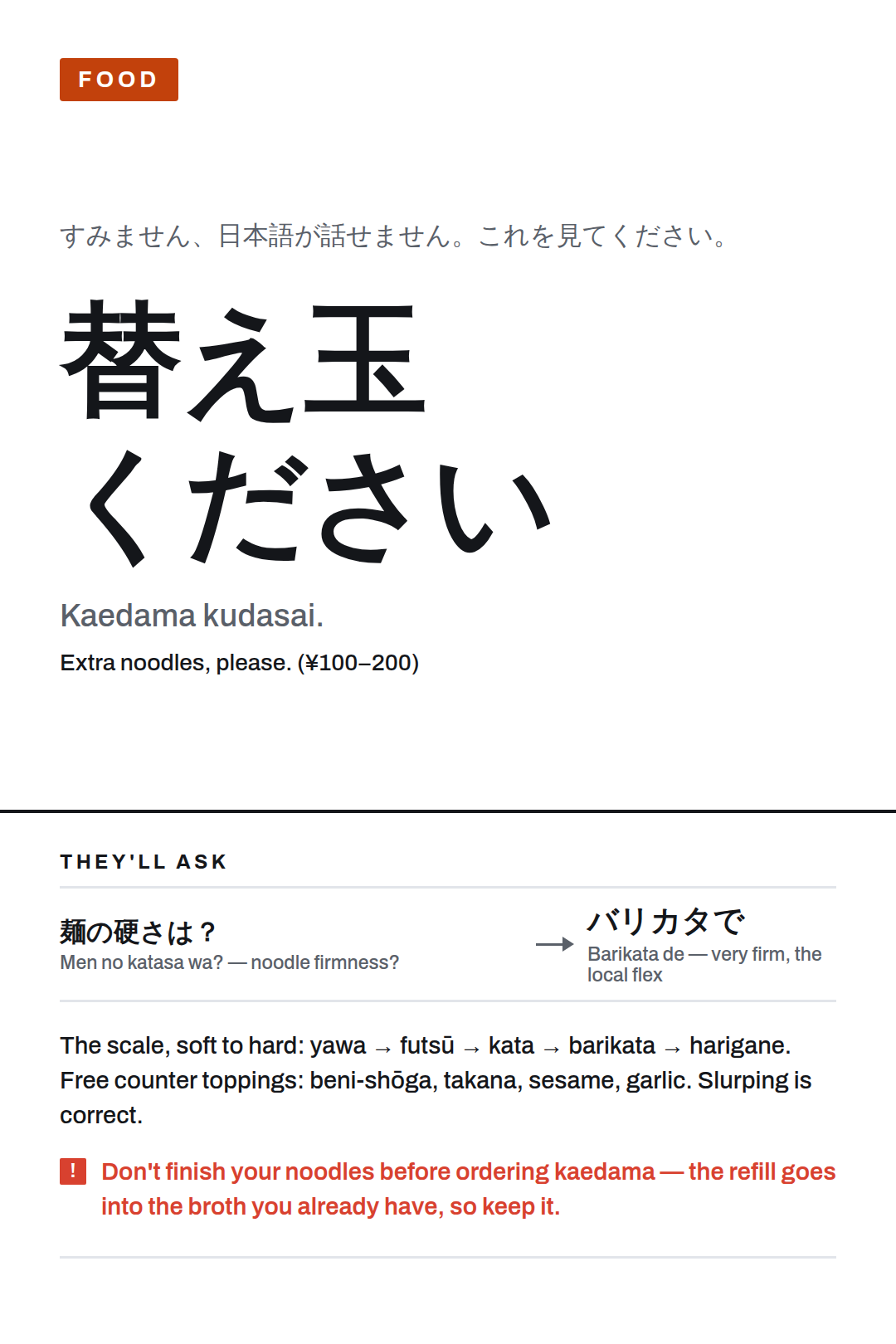
| Noodle refill | 替え玉ください | Kaedama kudasai | Extra noodles, please |
| Noodle firmness | バリカタで | Barikata de | Extra-firm (the local flex) |
| The toilet question | トイレはどこですか? | Toire wa doko desu ka? | Where's the toilet? |
| The bill | お会計お願いします | Okaikei onegaishimasu | Bill, please |
| Leaving | ごちそうさまでした | Gochisōsama deshita | Thanks for the meal |
The districts
Nakasu, Tenjin or Nagahama — which yatai district is for you
Nakasu (中洲) — the river row. About 20 stalls in a single line along the Naka River on the southern tip of Nakasu island, near Higashi-Nakajima Bridge. Eight minutes on foot from Nakasu-Kawabata Station, or five from Kushida-Jinja-mae (one stop, ¥210, from Hakata Station). This is the neon-on-water postcard shot, and it is priced like one: the highest bills and the longest queues — 20–45 minutes at weekend peaks is now normal. Locals will tell you Tenjin near Daimaru is better value. Go for the setting; a full Nakasu meal runs ¥2,000–3,500. Map.
Tenjin (天神) — the most stalls, the most variety, the salaryman-and-tourist mix. Stalls scatter across sub-zones: Shōwa-dōri (including the “Nichigin-mae” cluster in front of the Bank of Japan branch), Watanabe-dōri near Tenjin Loft and Daimaru, the bus-center area, and the Oyafukō-dōri end. Stations: Tenjin, Tenjin-Minami, Nishitetsu-Fukuoka. Queues are shorter (10–20 minutes on weekends), averages cheaper (¥1,500–2,500), and this is where the French stall, the Italian stall, and the cocktail bar live. If you only have one night, walk Tenjin. Map.
Nagahama (長浜) — the fishing-port original, quiet and ramen-focused. Next to the old wholesale fish market, a 10-minute walk from Akasaka Station. This is the birthplace of thin-noodle Nagahama ramen and of the kaedama refill — invented so fish-market workers could eat fast. The district shrank to two stalls before the city deliberately revived it: seven new stalls opened in June 2023, bringing the strip back to about nine. Near-zero queues and the cheapest classic bowl in the city — Wakadaishō sells ramen at about ¥500. Map.
The system
Why Fukuoka still has yatai when almost nowhere else does
Fukuoka had 400-plus stalls in the 1960s and, like every other Japanese city, watched them dwindle — to 103 citywide as of January 2024, around 104 after the 2025 intake. Most of Japan’s surviving street yatai are here, because Fukuoka did something no other city did: it passed the Fukuoka City Yatai Basic Ordinance in 2013, Japan’s first yatai ordinance and the legal basis for food stalls on its public roads.
The mechanics matter to you as a customer. Licenses are city-issued, non-transferable, capped at ten years, and awarded by competitive public recruitment — a written exam and a juried interview, not a lottery. Rounds since 2016 have created 56 new stalls, 44 still trading; the sixth round closed applications in June 2026, with results due in December 2026 and the new stalls opening from April 2027. The recruitment system made the Good Design Award Best 100 in 2025. Each stall has a fixed, city-assigned spot; the cart is towed in every evening and gone again by morning. Maximum footprint 3.0 by 2.5 meters. City data (2023 survey): 1.19 million users a year, ¥2.29 billion in annual sales, 252 operating days, owners aged 24 to 83.
The city rules are also your consumer protection. Every stall must show its prices where you can see them, and anything priced by the day’s market has to show today’s price, so you never get a mystery “market price.” And no raw food — sashimi at a yatai is not allowed, so everything is cooked.
Tonight
Rain, closures, and how to check what's open tonight
Yatai are an evening thing, not a lunch thing: the carts are towed in around dusk and gone by morning. There is no fixed closing day; every stall differs, and rain or strong wind means sudden closure, because a tarp-and-cart restaurant cannot operate safely in weather. July to September brings the most typhoon closures; winter is oden and ramen prime.
Check before you go: the city’s tourism site at yokanavi.com/yatai (English version at gofukuoka.jp), and the stall’s own Instagram or X, where stalls post closures. Arriving as the stalls set up, or late in the evening, beats the dinner-hour crush, which is worst Thursday to Saturday.
The food
What you eat, and what it costs in 2025–26
The core: Hakata tonkotsu ramen at ¥600–1,200 (¥500 at Wakadaishō), with kaedama noodle refills at ¥100–200 — order before your noodles run out, keep the broth. Yaki-ramen, grilled ramen, was invented at Kokinchan in Tenjin, founded 1968, and runs ¥800–900. Yakitori is ¥150–300 a skewer, and note that Fukuoka “yakitori” defaults to pork — butabara, pork belly, is the Hakata staple. Hitokuchi one-bite gyoza come ¥500–600 for a plate of eight to ten. Oden is ¥100–300 a piece and is the winter core. Mentaiko shows up everywhere: mentai tamagoyaki around ¥700, and Nagahama’s Mentai Chūdoku — the first mentaiko-specialist yatai, opened June 2023 — lists over 100 dishes.
Then the oddballs, which are the reason to walk Tenjin: Chez Rémy on Watanabe-dōri serves escargot and quiche at ¥500–1,200 under Japan’s first foreign yatai owner. Telas&mico, the blue cart in front of Tenjin Loft since 2017, pours natural wine at ¥500 with bruschetta at ¥250–350, from a chef who cooked at Zuma London. Yatai Bar Ebichan is a second-generation cocktail bar with about ten seats — in Tenjin, in front of the Bank of Japan on Shōwa-dōri, not in Nakasu, whatever the blogs say. Bar Kōno does Italian (peperoncino ¥1,320), Nagahama Shimin Kyūjō posts its menu on a baseball scoreboard, and Karasu Tengu ladles conger-broth ramen at ¥800.
Other named stalls tourists actually find: Yatai Mami-chan on Watanabe-dōri (roast-pork ramen, ox tongue, English menu), Yatai Kenzo on the Nakasu row (yakitori and ramen, ¥150–900), Kojima Shōten at Nakasu 1-8 (oden, mentai omelet ¥700), Genkai (seafood tempura, trading for over 70 years), Dogenya (kushikatsu, ¥220 a stick), and Under One Yane — female-run and explicitly marketed as solo-woman-friendly.
On the stool
What sitting down is actually like
Eight to ten stools around a U-shaped counter under a tarp, strangers shoulder to shoulder, the taishō cooking a meter from your face. The banter is the product; the official city guide instructs you to join it. Solo diners are explicitly welcome — single stools free up first. Slurping is encouraged. Hygiene is more organized than it looks: everything cooked by law, water tanked in, wet wipes standard. In winter the plastic sheets come down and hot shōchū — 「芋をお湯割りで」 — is the seasonal order.
Yatai beyond Fukuoka: a few street stalls survive elsewhere in Fukuoka Prefecture, in Kitakyushu’s Kokura and in Kurume, but nowhere else has rows of them. Hiroshima has no street yatai — its night zone, Ekinishi, is fixed bars. Okinawa’s “yatai villages,” like Kokusai-dōri Yatai-mura in Naha (about 20 stalls, opened 2015, toilets on site), are purpose-built fixed stalls, not carts. Fukuoka is the only city with its own yatai ordinance.
If you want the first night absorbed for you, a guided Fukuoka food tour (GetYourGuide Fukuoka (affiliate)) handles the seat-finding and ordering once; then go alone the second night. Staying near Tenjin or Nakasu keeps every district within a 15-minute walk — search Booking.com for Fukuoka hotels (affiliate).
The one costly mistake: planning your only Fukuoka night around yatai. Stalls do not open in heavy rain or strong wind, they close irregularly, and no app can promise you a specific stall on a specific night. If yatai are the reason you came, build in two evenings, check the stall’s own Instagram or X on the day, and always have an indoor backup — a Hakata izakaya or ramen shop within walking distance. The travelers who leave one-star reviews are usually the ones who bet a single evening on the weather.
Money and time
The numbers
Average spend, city data: ¥1,923 per person. Budget ¥1,500–2,500 per stall. Typical items: ramen ¥600–1,200, kaedama ¥150–200, yakitori ¥150–300 a skewer, gyoza ¥500–600, beer ¥500–600. A three-stall crawl: ¥4,000–6,000. Nakasu full meal ¥2,000–3,500; Tenjin ¥1,500–2,500.
Carry ¥3,000–5,000 per person in small bills. Roughly 10% of stalls take cards; treat the row as cash-only. Seven Bank ATMs in 7-Elevens near the Nakasu and Tenjin strips take foreign cards. No cover charge and no otoshi at most stalls — the one-drink-one-dish minimum is the seat rent. Some bar-type stalls do charge otoshi; prices are posted. Clock: hours vary stall by stall, so check the stall’s own Instagram or X for tonight. Arrive as the stalls set up, or late, to dodge the dinner-hour crush. Stay 30–40 minutes per stall.
Sources
Where these facts come from
- Fukuoka City — official yatai how-to guide (GO FUKUOKA) — groups of 2 to 3, few stalls taking bookings, no toilets, about 10% taking cards, no cover at most stalls
- Fukuoka City — yatai data (yokanavi.com) — 103 stalls in January 2024; 1.19 million users, ¥2.29 billion and ¥1,923 per person (2023); 69 menus and 39 staff, December 2023
- Fukuoka City — Yatai Basic Ordinance (Japanese) — the 2013 ordinance; licences cannot be transferred or sublet
- Fukuoka City — ordinance enforcement rules (Japanese) — a toilet arranged and its location posted; prices displayed, with the day's price for market-priced items
- Fukuoka City — 2026 yatai operator recruitment rules (Japanese) — exam and interview screening, results in December 2026, stalls from April 2027, 3.0 × 2.5 m, no raw food
- Fukuoka City — yatai how-to (yokanavi.com) — most stalls not taking reservations; check each stall's social media before going
Prices, rules and procedures on this page were checked against these sources on 5 October 2026. Where no official source exists, the page says the detail varies.
Questions
Fukuoka yatai questions, answered
Do I need a reservation at a Fukuoka yatai?
Mostly, no. Almost every stall seats you in arrival order, and a few take bookings by phone or Instagram — don’t count on one. Turn up, find the loose line beside the stall, and join the back of it; Tenjin waits run 10–20 minutes at weekend peaks. Arrive as the stalls set up, or late in the evening, for the shortest waits.
How much cash do I need for a yatai night?
¥3,000–5,000 per person in small bills covers a two-to-three-stall crawl comfortably; the citywide average spend is ¥1,923 per person. Only about 10% of stalls accept cards, so bring cash even if you normally tap everything.
Is there a cover charge at yatai?
Most stalls charge no cover and no otoshi — the official Fukuoka guide confirms it. The counterpart obligation is the minimum order: one drink and one dish per person. A few bar-type stalls do have an otoshi; prices must be displayed, so check the board.
What are the rules at a Fukuoka yatai?
The posted norms: one drink and one dish per person, queue in order, stay about 30–40 minutes when people are waiting, shift to make room, no seat-saving, no big luggage, and groups of two or three. Under the city’s rules, no stall may serve raw food, and prices must be displayed visibly.
Do yatai open in the rain?
Usually not. Heavy rain or strong wind means sudden closure — a cart with a tarp cannot operate safely. Check the stall’s own Instagram or X on the day, keep an indoor backup plan, and expect the most typhoon closures from July to September.
Which yatai district is best for a first-timer?
Tenjin. It has the most stalls, the most variety — French, Italian, cocktail-bar carts alongside classic ramen — shorter queues (10–20 minutes on weekends) and lower average bills (¥1,500–2,500) than Nakasu. Nakasu is the photo; Tenjin is the dinner.
Can I go to a yatai alone, or as a solo woman?
Yes — the format is optimized for solo diners, and single stools free up first. Under One Yane is female-run and markets itself specifically to solo women. Groups are the ones who struggle: the city’s own guide recommends twos and threes, and bigger groups often won’t fit.
Are yatai vegetarian-friendly?
Not really. The menus are built on pork broth, pork skewers, and fish-dashi oden — even “vegetable” dishes usually stand on fish stock. Eat something substantial first, or treat the yatai as a drinks-and-atmosphere stop; oolong tea satisfies the drink minimum. See our allergy and vegetarian phrase cards.
Where do I go to the toilet?
Not at the stall — yatai have none. The rules make each operator arrange one nearby and post where it is, so ask: toire wa doko desu ka? Near Nakasu use Seiryū Park or the Kawabata arcade; near Tenjin the Chikagai underground mall or a konbini. Go before you sit.
Take it with you
The ten night cards are in the free set
Getting in, the cover charge, the decoders, paying and leaving — images that open with no signal, in an alley, at night. All 23 cards are free.
Get all 23 cards free