How do I get into one of those tiny bars — and what if they turn me away?
The real fear is not the price or the language but the three seconds where you commit to a five-stool room and the person behind the counter looks up. The good news is that those three seconds run on a script. Both sides know it. Once you know it too, the door stops being a wall.

The fear, named
Pacing past the door
An English teacher who had lived in Japan for six months wrote about walking up and down the Fukuoka yatai row “a good number of times” before she found the nerve to sit down. Not a tourist. A resident, with working Japanese, pacing past steam and lantern light because she didn’t know the procedure for a doorway with no door. On a Tokyo forum, a 73-year-old solo Australian asked whether Golden Gai was even “safe for Westerners” — his worry wasn’t crime, it was being turned away at the threshold.
This page covers the whole entry sequence: how to choose a bar or stall from the alley, how to peek without offense, exactly what to say, what every possible reply means, and how to be refused gracefully — because sometimes you will be, and it costs you nothing.
The ritual, in order
The entry sequence
Walk the whole row before you commit
Locals do this and so should you. At the Nakasu yatai row in Fukuoka or in Shinjuku Golden Gai, walk end to end once. You’re reading four signals: the smell (open-fronted grills let you see the food and the cook before you commit), the crowd (a half-full counter of locals is the best review there is), the posted prices, and whether there’s an English menu outside. An English menu or price list by the door is the welcome flag — it means the shop has decided it wants you.
Read the door
Posted prices, in any language, mean an honest shop. No posted prices at all means walk away — that is the main rip-off risk in these alleys. Two other signs to recognize: 会員制 (“members only”) and 一見さんお断り (ichigen-san okotowari — “first-time visitors refused”). These come from an old introduction-based system, not hostility toward you specifically. Move on without taking offense; there are two hundred other doors.
Peek
Peeking is allowed and expected. In Golden Gai, slide the door open, put your head in, and look — if it’s full or clearly a regulars’ room, apologize and withdraw. At a yatai, lifting the noren curtain or the plastic sheeting to check for free stools is completely normal. The curtain being out at all means the shop is open. Nobody has ever been angry at a polite peek followed by a polite retreat.
Say the line
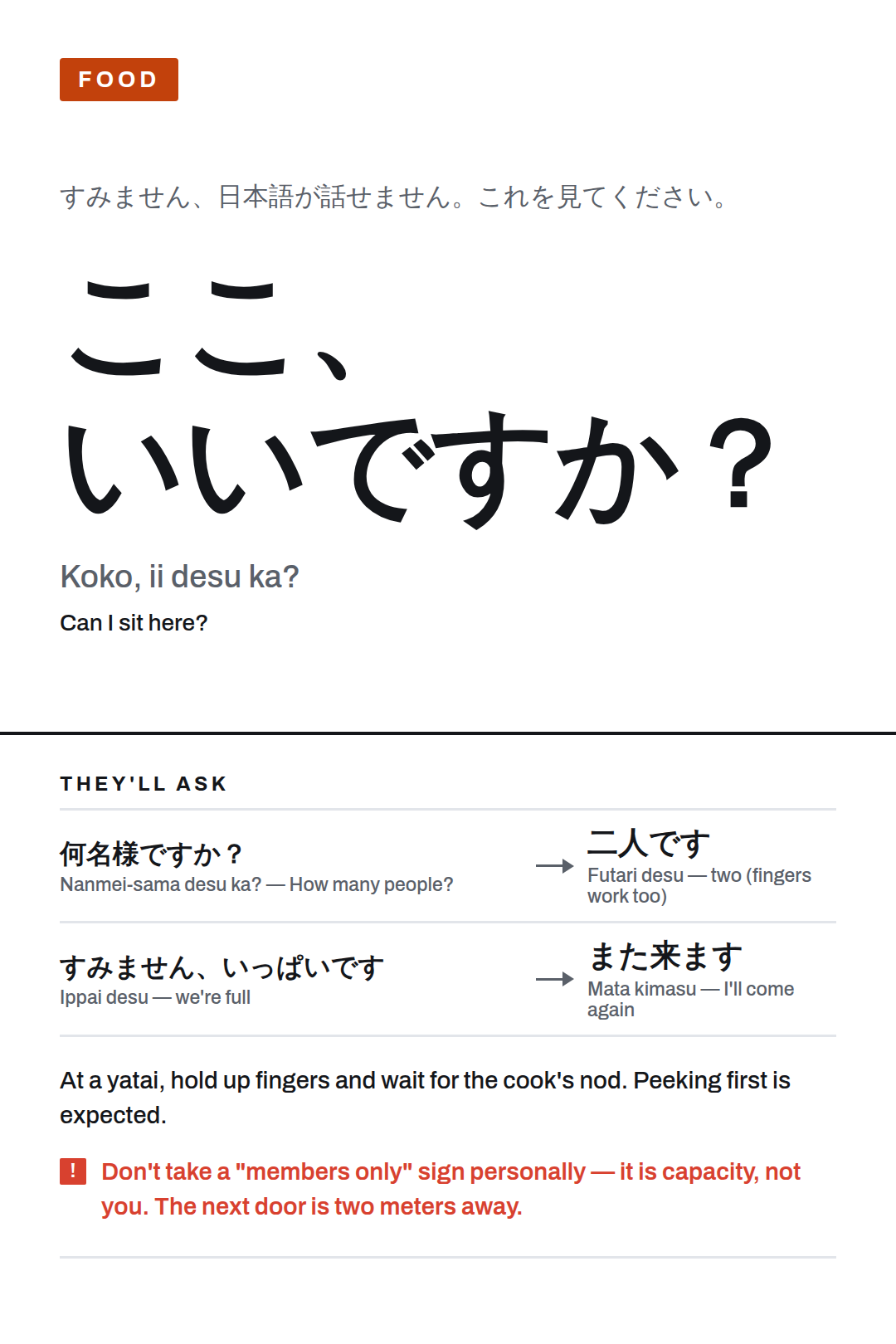
The whole entry script is one greeting and one number. “Konbanwa” (good evening), then your party size: hitori desu (one), futari desu (two), sannin desu (three). Holding up fingers works exactly as well and every master understands it. The most useful single phrase at a counter with visible empty stools: 「ここ、いいですか?」 — Koko, ii desu ka? — “Can I sit here?”
Decode the reply
You’ll get one of a small set of answers. 「いらっしゃいませ」 (irasshaimase) or 「こちらへどうぞ」 (kochira e dōzo) means you’re in. 「何名様ですか?」 (nanmei-sama desu ka?) means “how many?” — answer with your number or fingers. 「満席です」 (manseki desu) or 「すみません、いっぱいです」 (ippai desu) means full. One trap worth knowing: ippai desu at the door means “we’re full.” It is the same sound as 一杯, “one glass,” with a different pitch. If the master says it at the door while shaking his head, he is not offering you a drink.
At a yatai, wait for the nod
Do not seat yourself at a food stall. Stand at the edge, hold up fingers, and wait for the cook to nod you in. If there’s a queue, it’s a loose line beside the stall — join the back of it. Stools free up fast because the system runs on 30–40 minute turnover.
If refused, say the exit line and move on
「また来ます」 — Mata kimasu — “I’ll come again.” Smile, withdraw, next door. This is the entire cost of a refusal: four syllables and ten steps.
Phrases
What to say at the door
| Situation | Japanese | Romaji | Meaning |
|---|---|---|---|
| Announcing a pair | すみません、二人ですけど、大丈夫ですか? | Sumimasen, futari desu kedo, daijōbu desu ka? | Excuse me, two of us — is that OK? |
| Checking for space | 空いてますか? | Aitemasu ka? | Is there space? |
| Pointing at a stool | ここ、いいですか? | Koko, ii desu ka? | Can I sit here? |
| Party size | 一人です / 二人です / 三人です | Hitori desu / futari desu / sannin desu | One / two / three people |
| The welcome test | 英語のメニュー、ありますか? | Eigo no menyū, arimasu ka? | Is there an English menu? |
| Softer version | 英語、大丈夫ですか? | Eigo, daijōbu desu ka? | Is English OK? |
| Drinks only | 飲み物だけでもいいですか? | Nomimono dake demo ii desu ka? | OK if we just have drinks? |
| Before you sit | お通し/チャージ、ありますか? | Otoshi / chāji, arimasu ka? | Is there a cover charge? |
| Being refused | また来ます | Mata kimasu | I'll come again |
The replies
And what you'll hear back
| They say | Romaji | It means |
|---|---|---|
| いらっしゃいませ | Irasshaimase | Welcome — you're in |
| 何名様ですか? | Nanmei-sama desu ka? | How many people? |
| こちらへどうぞ | Kochira e dōzo | This way, please |
| 満席です | Manseki desu | We're full |
| すみません、いっぱいです | Sumimasen, ippai desu | Sorry, full |
| 会員制 | Kaiin-sei | Members only |
| 一見さんお断り | Ichigen-san okotowari | No first-time walk-ins |
Refusal
Being refused is room math, not racism
Residents who explain these alleys to visitors keep landing on the same phrase: it’s not racism, it’s room math. A six-seat bar that hosts camera-first tourists for 45 minutes loses a third of its night’s capacity. “Members Only” and even “Japanese only” signs are mostly polite shorthand for capacity and language-barrier problems, not a judgment of you. Plenty of Golden Gai bars are regulars’ living rooms that happen to have public-facing doors, so expect a few polite no’s before you land. You can spot a regulars’ room from the doorway: a shelf of bottle-keep bottles labeled with names in felt-tip is the archaeology of people who come every week.
So the refusal script matters more than the entry script. Manseki desu, a bow of the head, mata kimasu, and you’re back in the alley having lost nothing. The travelers who report bad nights in Golden Gai are overwhelmingly the ones who arrived in the afternoon to shuttered doors, or pushed into a full room, or took a refusal personally and let it end the evening. The ones who report the best nights took the first bar that could physically fit them — one couple, four hours off the plane, did exactly that and ended up drinking Hakushu next to a kabuki director while a saxophonist air-played to the bar’s jazz.
Group size
Group size: the math that decides before you knock
The rooms decide your party size, not the staff. Golden Gai bars seat roughly 4–8 people; a group of five can fill an entire bar, and groups of 5+ are likely to be turned away everywhere in these alleys. Yatai stools run 7–10 around the counter, and Fukuoka City’s own guide says come in twos or threes. Bigger groups often won’t fit, so split up.
The fix is simple: split up. Two pairs get seated in adjacent bars in minutes; a five reads as an occupation. Agree on a meeting point, take different doors, and swap stories after. Solo is genuinely the optimal configuration — single stools free up first, and the format was built around one person at a counter.
Reservations
Reservations barely exist — and the one workaround
Mostly, you can’t book. Almost every yatai seats you in arrival order; a few take bookings by phone or Instagram, but don’t count on one. Golden Gai bars are walk-in. The reliable exception: guided food and bar tours pre-reserve seats at partner bars. If the first-door moment is the thing genuinely keeping you out, a small-group night tour (browse Tokyo night tours on GetYourGuide (affiliate)) absorbs that awkwardness once: covers handled, introductions made, procedure demonstrated. Then go back alone the next night. That’s the honest use of a tour — training wheels, not the bike.
Refused in ≠ invited in. Being turned away at a door is normal, costs you nothing, and says nothing about you. Being invited in off the street is the opposite situation entirely. No legitimate Golden Gai or yokocho bar sends someone into the street to charm you inside — that person is working for a rip-off bar, usually steering you toward Kabukicho, and the friendliness is the mechanism. Tokyo police warn visitors never to follow a street tout, and arrested a tout in Kabukicho in July 2026 for luring tourists. The rule has no exceptions: never follow a tout. The bars worth entering are the ones you have to ask.
Money and time
When to go, and what it costs
Golden Gai: bars open in the evening and the locals arrive late, so a first-timer does best after dinner but before the room fills. Closing days vary bar by bar. Budget ¥2,000–4,000 per bar (cover ¥500–1,500 at most charging bars, plus drinks), ¥6,000–10,000 for a 3–4 bar night. Cash.
Omoide Yokocho: food-first, so it gets going earlier than the bars, and early in the evening is the quietest time to find a stool. Closing days vary stall by stall. ¥2,000–3,000 covers dinner and two drinks.
Fukuoka yatai: stalls are towed in around dusk. Arriving as a stall sets up, or late in the evening, beats the dinner-hour crush, which is worst at weekends. Nakasu weekend queues run 20–45 minutes as of 2026; Tenjin is 10–20. Closed suddenly in rain — always have a backup. For any named door, check the Google Maps link for tonight’s hours before you set out. Carry ¥5,000+ per person in ¥1,000 notes wherever you’re headed; these are cash rooms.
Sources
Where these facts come from
- Fukuoka City — official yatai how-to guide (GO FUKUOKA) — groups of 2 to 3, and some yatai taking bookings but not many
- Fukuoka City — yatai how-to (yokanavi.com) — most stalls not taking reservations; check each stall's social media before going
- Shinjuku Golden Gai association — about 280 bars in the district
- Tokyo Metropolitan Police — entertainment-district rip-offs (Japanese) — never follow a street tout
Prices, rules and procedures on this page were checked against these sources on 5 October 2026. Where no official source exists, the page says the detail varies.
Questions
Door questions, answered
Is Golden Gai safe for Westerners?
Yes — the alleys themselves are safe, including for solo women, and many bars are actively welcoming. The realistic “risk” is social, not physical: plenty of bars are regulars-focused, so expect a few polite refusals before you land. Posted covers run ¥500 to ¥1,500. Start at a named welcoming door like Albatross G or Ace’s Bar and the success rate jumps.
Can I just walk in, or do I need a reservation?
Walk in. Almost every yatai seats you in arrival order, though a few take bookings by phone or Instagram. At Omoide Yokocho, catch the cook’s eye, point at the empty stool, say koko, ii desu ka? and sit when they nod. The only reserved seats in Golden Gai are held by guided tours at their partner bars.
What do I actually say when I open the door?
“Konbanwa,” then your number: futari desu for two, or just hold up two fingers. If you can see an open stool, koko, ii desu ka? covers everything else. The entire exchange takes five seconds and the master has done it ten thousand times.
What if they say something I don't understand?
It’s almost always one of three things: nanmei-sama desu ka? (how many? — answer with fingers), manseki/ippai desu (full — say mata kimasu and move on), or kochira e dōzo (this way — follow). If you’re truly lost: sumimasen, nihongo ga wakarimasen — I don’t understand Japanese — and fingers.
Why did a bar have a "Japanese only" sign? Is that legal hostility?
It’s mostly capacity and language shorthand from tiny rooms that can’t host a conversation they can’t have — “room math, not racism,” as residents put it. A five-seat bar loses real income hosting a 45-minute look-around. Don’t argue it; the alley has hundreds of other doors, and the ones with English menus posted want you specifically.
Do they speak English?
Spotty. The reliable signal is the door: an English menu or price list posted outside means yes, or at least means they’re practiced at fingers-and-pointing. Some bars advertise “no charge for travellers” in English — one blogger braced for hostility found exactly those signs instead.
Can a solo woman go alone?
Yes — this is one of the most-asked questions and the consensus from residents and visitors is consistent. Golden Gai has a long history of women-run bars with watchful owners, and the intimacy of a five-stool room increases oversight rather than risk. Standard precautions apply: keep your drink in sight, and never follow a street tout.
Can I bring my kids to Golden Gai?
No. The forum consensus is unanimous, and there’s a legal edge too: under-20s can’t enter premises registered as smoking-permitted, which covers most of these tiny bars as of August 2026. Fukuoka’s open-air yatai, early in the evening, are the family-friendly version of this experience instead.
What time should I go?
Later than you think for bars, earlier than you think for food. Golden Gai is dead in the afternoon — a classic tourist mistake — and only warms up after dinner. Omoide Yokocho and yatai run on food time, and the first hour after they open is the calmest. Hours vary door by door, so check the Google Maps link for tonight, and remember last trains leave around midnight.
Take it with you
The ten night cards are in the free set
Getting in, the cover charge, the decoders, paying and leaving — images that open with no signal, in an alley, at night. All 23 cards are free.
Get all 23 cards free