Which Tokyo yokocho should I actually go to first — Omoide, Golden Gai, or somewhere calmer?
The mistake is treating "yokocho" as one experience. Tokyo has a ladder of them, from a covered food hall where the staff hand you an English menu, to alleys where the correct move is to peek, apologize, and withdraw. Start on the right rung and the whole system opens up.

The fear, named
Partly true, worth taking seriously
A 73-year-old Australian traveling alone asked the TripAdvisor Tokyo forum whether Golden Gai was “safe for Westerners.” He was not worried about crime. He was worried about the signs he had read about — the ones he paraphrased as “if you don’t speak Japanese don’t come in here” — and about pushing open a door to a five-seat bar and being told to leave. That is the real fear with Tokyo’s alleys, and it is worth taking seriously, because it is partly true: plenty of Golden Gai bars are regulars’ living rooms with public-facing doors, and you should expect a few polite no’s before you land.
This page is the ladder, then a directory: where each alley is, what it costs, which doors welcome you by name, and the specific traps.
The first-timer ladder
In order of nerve required
Night one: a neo-yokocho or Ebisu Yokocho
Ebisu Yokocho — an indoor covered alley in a former public market, opened 2008 — is the best training-wheels yokocho in Tokyo: translated menus, staff used to foreigners, loud and packed. The developer-built recreations (Shibuya Yokocho, Toranomon Yokocho) go one step further: cards accepted, order apps, no regulars-only doors. You lose the mama-san intimacy; you gain a frictionless rehearsal of the format.
Daytime recon: Hoppy-dōri or Ameyoko
Both run in daylight, which removes the intimidation entirely. Ameyoko’s standing bars under the Ueno viaduct pour by day and carry zero intimacy pressure — Tachinomi Takioka is the classic. Hoppy-dōri in Asakusa has open-air benches and beef-tendon stew by day, busiest at weekends. You practice ordering, paying, and leaving with nothing at stake.
Early evening: Omoide Yokocho, deep stalls
Go early in the evening, when it is quietest, and walk past the entrance stalls to the deeper ones. Food-first, grill smoke everywhere, counters of four to eight stools. This is the rung where you first share elbows with salarymen.
Golden Gai, via a named first-timer bar
Do not wander and push random doors. Go after dinner to a bar from the welcoming list below, where the cover is posted or zero and the staff speak some English. One drink, pay, then try a second door. Peeking — sliding a door open, poking your head in, assessing — is acceptable and expected here.
The deep cuts: Nonbei, Yanagi Kōji, Sangenjaya
Once refusal no longer stings, Shibuya’s Nonbei Yokocho, Nishi-Ogikubo’s Yanagi Kōji, and Sangenjaya’s Sankaku Chitai are the quieter, regulars-first alleys where the format is still doing its original job.
Phrases
The phrases that get you through a door
If the master says 「いっぱいです」 (ippai desu), the bar is full — it is the same word as “one glass” (ippai) with different pitch, and at the door it always means full, not an offer.
| Situation | Japanese | Romaji | Meaning |
|---|---|---|---|
| Peeking in | 空いてますか? | Aitemasu ka? | Is there space? |
| Party size | 二人ですけど、大丈夫ですか? | Futari desu kedo, daijōbu desu ka? | Two of us — is that OK? |
| The cover question | チャージはいくらですか? | Chāji wa ikura desu ka? | How much is the cover? |
| Checking English | 英語、大丈夫ですか? | Eigo, daijōbu desu ka? | Is English OK? |
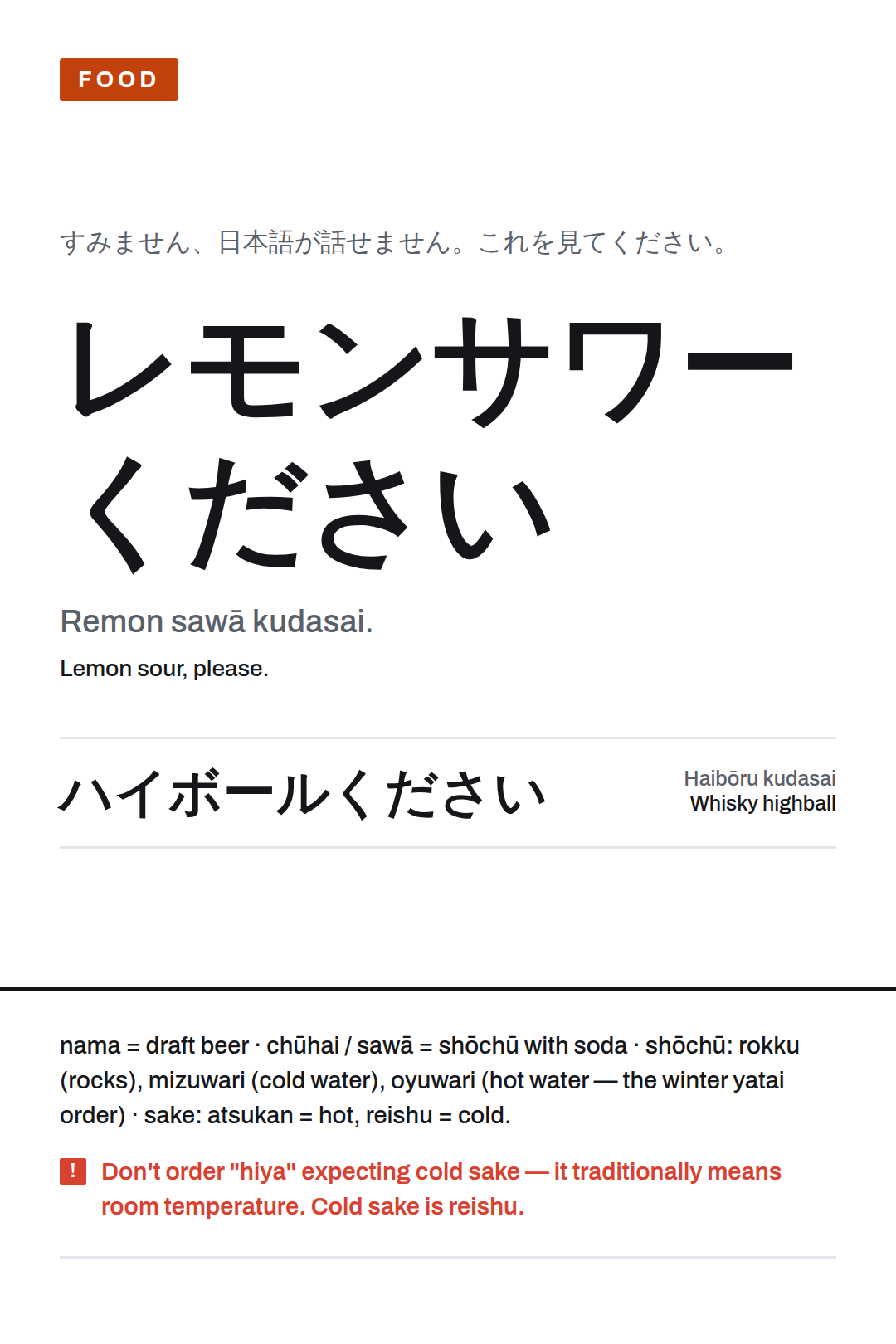
| First drink | とりあえず生ください | Toriaezu nama kudasai | Draft beer to start |
| Refused at the door | また来ます | Mata kimasu | I'll come again |
| The bill | お会計お願いします | Okaikei onegaishimasu | Bill, please |
| Leaving well | ごちそうさまでした | Gochisōsama deshita | Thanks — the goodwill purchase |
Omoide Yokocho
The food alley by Shinjuku's tracks
Immediately northwest of JR Shinjuku Station’s West Exit, hugging the Yamanote tracks — about 30 seconds’ walk left along the rails. Map · Reviews on TripAdvisor (affiliate).
Sixty to eighty tiny stalls across two parallel alleys, counters of four to eight stools, founded 1946 as the black market “Lucky Street.” A fire on 24 November 1999 burned about a third of the alley; it was rebuilt within months in the original cramped style, which is why a 2026 alley looks like a 1950s one. Street smoking is banned in the alley; smoke only inside shops that allow it. The alley sits beside, but outside, the Shinjuku West Exit mega-redevelopment — no demolition announced as of mid-2026.
Food-first: yakitori and yakiton (pork offal), motsu nikomi, soba at Kameya, infamous offal at Asadachi. Skewers ¥100–350 at honest stalls; some charge a legitimate ¥300–500 table charge with a small appetizer. Total ¥2,000–4,000 with drinks. The alley’s own site put about 60% of shops at cash-only in 2021 — bring ¥5,000 in small bills anyway. Hours and closing days vary stall by stall, so check the Google Maps link for tonight. Counter seats carry roughly a 90-minute expectation.
The tourist-trap tells are specific: English-only laminated picture menus plus touts near the station entrance mean two-to-three-times prices. Walk deeper in. Foreigner-friendly names: Albatross (the Omoide branch of Golden Gai’s Albatross G), Asadachi, Kameya, Suzuya.
Golden Gai
Cover charges, photography rules, and which bars welcome you
Kabukicho, five minutes east of Shinjuku Station’s East Exit, beside Hanazono Shrine. Map · Reviews on TripAdvisor (affiliate).
About 280 bars packed into six narrow alleys, most seating four to eight people. Drinks-only, themed micro-bars — punk, film, horror, 8-bit — on postwar black-market fabric with a literary pedigree. The bartender usually owns the bar; you are in their living room, and “Members Only” signs are room math, not hostility: a six-seat bar hosting camera-first tourists for 45 minutes loses a third of its night.
The cover charge is the system, not the scam. ¥500–2,000 per person, usually with a snack; budget ¥2,000–3,000 per bar. Charges must be posted or explained — the trap is the unposted cover, so ask 「チャージはいくらですか?」 before sitting. Doors often named as welcoming, with prices as last posted (check the door; they change): Albatross G (¥500 cover, bilingual), La Jetée (film bar, ¥1,000–2,000), One Coin Bar Champion (no cover, ¥500 drinks, ¥100 karaoke), Ace’s Bar (no cover, English), Bar Araku (no cover, Australian-owned), Cambiare, Bar Asyl, Deathmatch in Hell (¥666 drinks), Hair of the Dog (punk, ¥800).
Photography is the number-one offense. The business promotion association prohibits alley photography and video without permission — signs are posted — and being seen shooting inside a bar gets you ejected immediately. Patrons include celebrities and professionals protecting anonymity. Ask first: 「写真いいですか?」
Bars open in the evening and fill late; closing days vary bar by bar, so check the Google Maps link for tonight. Showing up in the afternoon and calling it a tourist trap is a documented forum genre. Groups of five or more usually won’t fit — split up. Cash only; the 7-Eleven on Yasukuni-dōri is a short walk away.
Nonbei Yokocho
Shibuya's quiet two-story alley
Two rows of two-story wooden buildings against the JR tracks just north of Shibuya Station (Hachiko exit, three to four minutes), opposite Miyashita Park; set up in the early 1950s as a relocation site for black-market stalls. Map.
About 40 bars of four to eight seats, drink-forward, mama-san counters, far quieter than Golden Gai — bartenders close enough to hand you a drink without standing. The otoshi here is ¥500–1,000, mandatory, and legit: it is the seat rent that keeps a six-stool business alive, not a foreigner tax. Drinks ¥500–1,200; a two-drink visit runs ¥1,800–2,800. Bars open in the evening and closing days vary, so check the Google Maps link for tonight; midweek is usually calmer than Friday. Start at Tight — a rock bar with an English-speaking owner and the highest first-bar success rate — then Buri for sake or Otako, the sumo-themed bar upstairs. Nonbei survived the Shibuya redevelopment because the bar owners bought the land under it decades ago; in 2025 they turned their cooperative into a company to keep it.
Low stakes
The daytime and low-stakes alleys
Ebisu Yokocho — two minutes from Ebisu Station, 15–20 shops in a covered former market. Loud, young, heavily touristed, and the best first yokocho in Tokyo. Kato Shoten does horse-meat sushi. Loud late into the night, with queues on Friday evenings; ¥3,000–5,000 per person. Map.
Ameyoko, Ueno — standing bars under the Yamanote viaduct between Ueno and Okachimachi; Tokyo’s daytime-drinking capital and its least intimidating yokocho-adjacent drinking. Daitōryō has poured horse-meat stew since 1950, motsuyaki from ¥90; Fukushin does a ¥260 happy-hour draft. Sessions ¥1,000–2,500. Map.
Hoppy-dōri, Asakusa — an 80-meter street of open-air benches west of Senso-ji, drinking by day and busiest at weekends. The signature is gyūsuji nikomi with Hoppy, the postwar near-beer you cut with shōchū (「ナカください」 gets you the shōchū refill). Watch for table and otoshi charges added to street seating. Names: Okamoto, Motsukushi, Suzuyoshi. Map.
Harmonica Yokocho, Kichijoji — a hundred micro-shops in five lanes directly outside the station’s North Exit; daytime market, red-lantern bars at night. A good dusk recon target where pointing works. ¥2,000–5,000 evenings. Map.
Deep cuts
The deep cuts and the neo-yokocho
Yanagi Kōji, Nishi-Ogikubo — 50-plus shops, the local-and-expat “anti-Golden Gai”: Korean at Toyaji, Thai at Handsome Shokudō, Taiwanese at Chinmitei. Map Sankaku Chitai, Sangenjaya — yakitori and snack bars in a triangle of lanes; on redevelopment watch. Map Further out: Asagaya’s Star Road (jazz, oden), Kagurazaka’s upscale Kakurenbo Yokocho, the Yurakucho viaduct arches.
The neo-yokocho, honestly. Shibuya Yokocho (Rayard Miyashita Park, a 100-meter indoor “alley” of 19 regional-Japan stalls, opened 2020, map) and Toranomon Yokocho (26 branch counters of famous restaurants, premium, map) are developer-curated recreations. What you gain: cards, English menus, order apps, no ambiguity, no refusal. What you lose: the mama-san, the regulars’ bottle-keep shelf, the sense that the room belongs to someone. Use them as night one, not as the destination.
If you would rather have the first door opened for you, a small-group night tour (GetYourGuide Tokyo (affiliate)) exists precisely to absorb the first-door awkwardness — covers handled, introductions made — then go alone the next night. And since these nights end near last train at best, a bed within stumbling distance of Shinjuku is the honest luxury: search Booking.com for Tokyo hotels (affiliate).
The one costly mistake: confusing Golden Gai with Kabukicho, its neighbor. No legitimate Golden Gai bar sends touts into the street — anyone friendly who offers to guide you to a bar in or near Kabukicho IS the scam. The canonical case, reported by SoraNews24 in December 2021: a diner looking for a cheap chain followed a helpful stranger and paid ¥8,554 for a modest snack, itemized with ¥990 for two otoshi, a ¥1,000 seating charge, a ¥1,000 "year-end charge," and a ¥1,000 "weekend charge." Tokyo police warn visitors never to follow a street tout; one was arrested in Kabukicho in July 2026 for luring tourists. A posted ¥500–1,500 cover inside Golden Gai is not this.
Money and time
The numbers on one page
Omoide Yokocho: ¥2,000–4,000 per person with drinks; skewers ¥100–350; bring ¥5,000 in small bills (about 60% of shops were cash-only in 2021). Golden Gai: ¥2,000–3,000 per bar including cover; a three-bar hop ¥7,000–10,000; four to six bars ¥15,000–20,000. Cash only. Nonbei: two drinks plus otoshi, ¥1,800–2,800. Ameyoko sessions ¥1,000–2,500. Ebisu Yokocho ¥3,000–5,000. How legitimate charges differ from the scam: the charges guide.
ATMs at night: Seven Bank machines in 7-Elevens take foreign cards; Japan Post ATMs keep post-office-style hours and many shut in the evening. Clock: Omoide is food-first and quietest early in the evening; Golden Gai wakes up after dinner and fills late. Hours vary door by door — check the Google Maps link for tonight. Last trains ~00:00–00:30; taxis +20% surcharge 22:00–05:00; stranded options run manga café ¥1,500–3,000 to capsule ¥2,500–6,000.
Sources
Where these facts come from
- Omoide Yokocho — official site — the 24 November 1999 fire, about 60% of shops cash-only in 2021, no street smoking
- Shinjuku Golden Gai association — about 280 bars; photo and filming permission contact
- GO TOKYO (Tokyo Convention & Visitors Bureau) — Shinjuku Golden Gai (Japanese) — about 280 shops in six blocks
- Tokyo Shimbun — Nonbei Yokocho, 20 February 2026 (Japanese) — the owners bought the land; about 40 shops; the cooperative became a company
- Tokyo Metropolitan Police — entertainment-district rip-offs (Japanese) — never follow a street tout
Prices, rules and procedures on this page were checked against these sources on 5 October 2026. Where no official source exists, the page says the detail varies.
Questions
Tokyo alley questions, answered
Is Golden Gai safe for Westerners?
Yes — the danger is next door in Kabukicho, not inside the alleys. Golden Gai’s risks are social (regulars-only doors, photography rules), and being turned away is normal, not hostile. Solo women report it as safe, with a long history of women-run bars; the standing advice is simply never to follow a street tout and not to leave drinks unattended.
Do all Tokyo bars have a cover charge, and how do I avoid it?
Most tiny bars charge either an otoshi (¥300–600 with a small dish) or a cover (¥500–1,500 in Golden Gai), and it is rent for the seat, not a scam — drinks are cheap because it exists. You cannot argue it off the bill, but you can avoid it: One Coin Bar Champion, Ace’s Bar, and Bar Araku advertise no cover, and neo-yokocho venues generally have none. Ask 「チャージはいくらですか?」 before sitting.
Which yokocho is best for a first-timer?
Ebisu Yokocho, then Omoide early in the evening, then Golden Gai via a named first-timer bar such as Albatross G (¥500 cover, as last posted) — in that order. Each rung teaches the skills the next one assumes: ordering at Ebisu, counter etiquette at Omoide, door-reading at Golden Gai.
Is Omoide Yokocho cash only?
Mostly. The alley’s own site put about 60% of shops at cash-only in 2021 and asks visitors to bring cash; the register is usually by the door. Bring ¥5,000 in small bills; the nearest foreign-card ATM is a Seven Bank machine at a 7-Eleven a short walk away.
Can I take photos in Golden Gai or Omoide Yokocho?
Not freely. Golden Gai prohibits alley photography without permission from the promotion association — signs are posted, and shooting inside a bar without asking gets you ejected. In Omoide, exterior alley shots are tolerated but ask before interiors or close-ups of customers: 「写真いいですか?」 (shashin ii desu ka?).
When should I go, and are some places closed?
Omoide is food-first, gets going earlier than the bars and is quietest early in the evening. Golden Gai wakes up after dinner and fills late. Closing days vary door by door, so check the Google Maps link for tonight, and remember last trains leave around 00:00–00:30. An empty Golden Gai in the afternoon is a timing error, not a tourist trap.
Can I bring kids to a yokocho?
Not to the bar alleys — forum destination experts are unanimous that Golden Gai bars are not appropriate for kids, and under-20s legally cannot enter premises registered as smoking-permitted, which covers most tiny bars. Daytime Ameyoko, Hoppy-dōri, or Harmonica Yokocho’s market hours are the family-viable versions.
How long can I stay in one bar?
In Golden Gai, one or two drinks and 30–60 minutes per bar is the local pattern — nursing one cocktail all night in a six-seat room is the actual rudeness. Omoide counters carry roughly a 90-minute expectation, and some shops post limits or drink caps. The hop is the point: rotate, and say ごちそうさまでした on the way out.
Take it with you
The ten night cards are in the free set
Getting in, the cover charge, the decoders, paying and leaving — images that open with no signal, in an alley, at night. All 23 cards are free.
Get all 23 cards free