How do I pay at a yatai — and how long am I allowed to stay?
The rules exist, and they are simpler than the silence suggests. You pay once, when you leave, in cash, using one phrase or one hand gesture. You stay as long as the unspoken turnover clock allows — which is shorter than most visitors think. And the whole night has a hard outer boundary: the last train.

The moment
11:40 PM, queue forming
It’s 11:40 PM. You’ve had two drinks and five skewers, there’s a queue forming behind the plastic curtain, and you realize three things at once: you don’t know how to ask for the bill, you’re not sure your card works here, and you have no idea whether you were supposed to leave forty minutes ago. Nobody hands you a check. Nobody tells you the rules. This page is the money-and-clock half of the ritual. Read it before your first night and the bill moment becomes the easiest part.
The ritual, in order
The paying sequence
Confirm how you'll pay before you sit down
Ask カード使えますか (kādo tsukaemasu ka — “do you take cards?”) before committing. Expect 現金のみ (genkin nomi — cash only): only about 10% of Fukuoka yatai take cards, Golden Gai and the yokocho are overwhelmingly cash-only, and the sensible planning assumption for any tiny counter in 2026 is zero card acceptance. Some newer stalls take PayPay (ペイペイ使えますか) — a bonus, never a plan.
At a Golden Gai bar, confirm the cover and the tally system on entry
Covers run ¥0–2,000, most ¥500–1,500, often posted on the door — ask チャージはいくらですか (chāji wa ikura desu ka) if not. Also worth knowing which way the bar settles: most tally everything when you leave, but some run pay-per-round. Confirming on entry is normal customer behavior, not suspicion.
Ask for the bill — words or the X
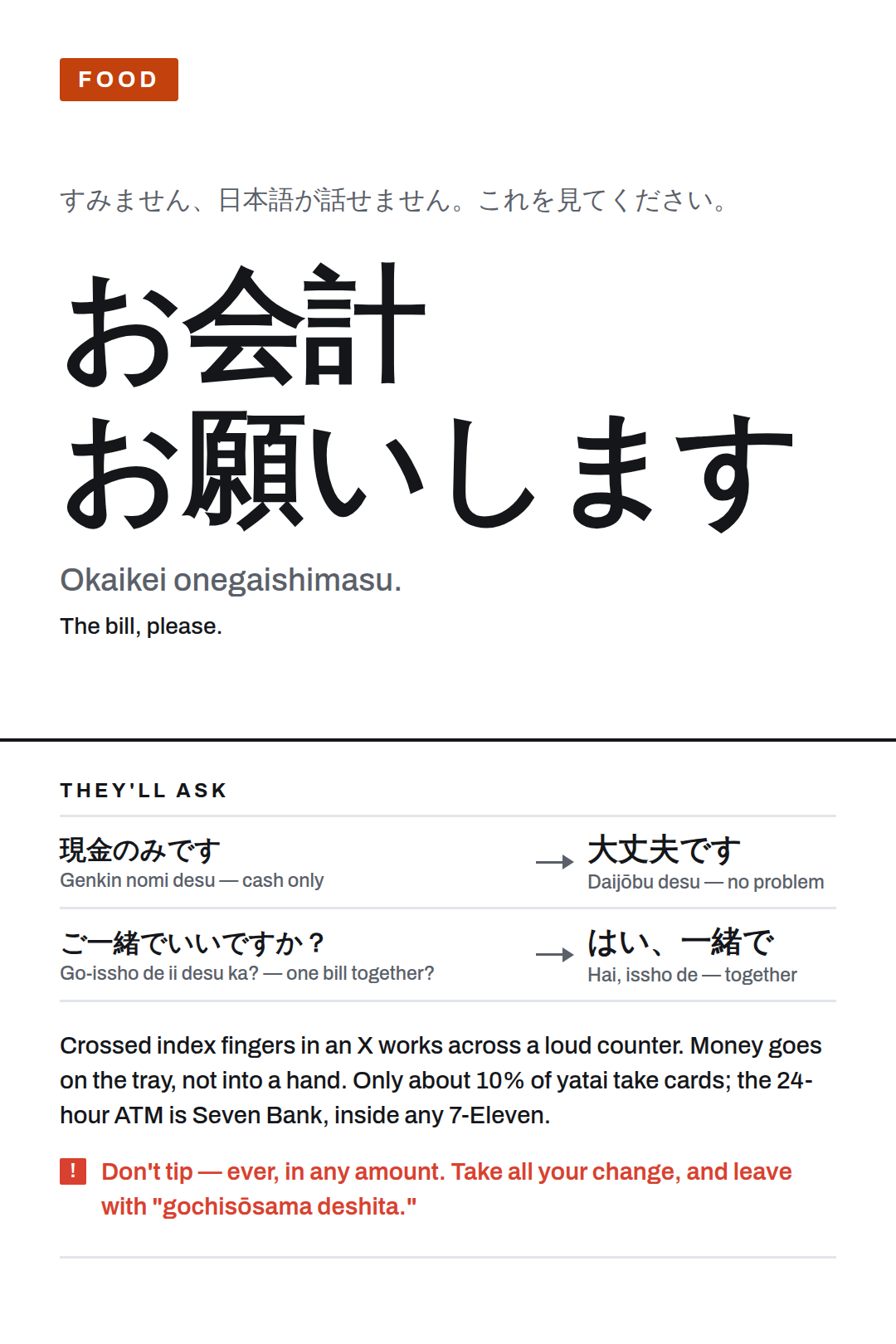
When you’re done: お会計お願いします (okaikei onegaishimasu). That’s the default and it is never wrong. Across a loud counter, the crossed-index-fingers X gesture means the same thing and is fully accepted at izakaya and yatai. You may hear old-timers say お勘定 (okanjō — same meaning, older word) or おあいそ (oaiso) — recognize that last one, but don’t say it; it’s trade slang for staff and regulars.
Money goes on the tray, not into hands
A small tray arrives with the total. Notes and coins go on the tray, change comes back on the tray. Hand-to-hand is not offensive at a yatai counter where the master takes cash directly, but if there’s a tray, use it.
Take all your change — tipping does not exist
Take every yen. There is no tipping in Japan — not at a yatai, not at a Golden Gai bar, not rounded up, not “for the nice master.” Leaving coins behind causes confusion, sometimes a staff member chasing you down the alley. The seat charge and drink prices already are the service model; the full logic is on our tipping page.
Say the exit phrase — ごちそうさまでした
As you stand: ごちそうさまでした (gochisōsama deshita) — “thank you for the meal.” It doubles as a leaving signal and, said toward the counter, is the cheapest possible goodwill purchase. Add おいしかったです (oishikatta desu — “it was delicious”) and a taishō will remember you. This one phrase is textbook Japanese and street Japanese at the same time — it is always right.
Check the clock on your way out
Last trains run around 00:00–00:30 (the Yamanote line manages roughly 00:30). If you’re hopping to another stall or bar — the local pattern — count backward from that.
Phrases
The paying phrases
| Situation | Japanese | Romaji | Meaning |
|---|---|---|---|
| Bill, please | お会計お願いします | Okaikei onegaishimasu | The default — never wrong |
| Bill (older style) | お勘定お願いします | Okanjō onegaishimasu | Same meaning, old-school |
| Card? | カード使えますか? | Kādo tsukaemasu ka? | Do you take cards? |
| PayPay? | ペイペイ使えますか? | Peipei tsukaemasu ka? | Do you take PayPay? |
| Cash only (you'll hear) | 現金のみ | Genkin nomi | Cash only |
| Separate bills? | 別々にできますか? | Betsu-betsu ni dekimasu ka? | Can we pay separately? |
| Cover charge? | チャージはいくらですか? | Chāji wa ikura desu ka? | How much is the cover? |
| Last call (you'll hear) | ラストオーダーです | Rasuto ōdā desu | Last orders |
| Until when open? | 何時までですか? | Nanji made desu ka? | Open until what time? |
| Leaving | ごちそうさまでした | Gochisōsama deshita | Thanks for the meal — also the exit signal |
| Extra credit | おいしかったです | Oishikatta desu | It was delicious |
| If turned away | また来ます | Mata kimasu | I'll come again |
Splitting
Separate bills, and why the counter can't
別々にできますか is the phrase, but many small counters simply can’t split. The local solution is warikan — one person pays the total, the group evens up outside. At a six-stool bar with one master and no register to speak of, this is kindness, not laziness.
Cash at 1 AM
The ATM that works late, and the one that doesn't
The fix for the cash economy is knowing exactly one brand: Seven Bank. The ATMs inside 7-Eleven stores take Visa, Plus, Mastercard, Maestro, Cirrus, UnionPay, Amex and JCB. There are 7-Elevens a short walk from Golden Gai (the machine on Yasukuni-dōri is the classic mid-crawl stop), Omoide Yokocho, and the Nakasu and Tenjin yatai strips in Fukuoka. Lawson and FamilyMart ATMs often work too, but not all of them — Seven Bank is the certainty.
The trap: Japan Post ATMs keep post-office-style hours, and many shut in the evening. If your mental model of “there’s always an ATM” was built on a post office, it fails at exactly the hour you need it.
Withdraw before the night starts, in ¥1,000 notes if the machine offers a choice — a ¥10,000 note for a ¥1,400 yatai bill works but wins no friends. Two practical notes: your phone is doing real work tonight — Google Maps to the nearest 7-Eleven, a translation app at the bill — so make sure it has data; an Airalo eSIM (affiliate) sorted before you land covers it. And if it all goes wrong, the konbini itself is the backup plan — cash out, buy tissues, use the toilet the yatai doesn’t have (konbini survival guide).
The clock
How long am I actually allowed to stay?
Nobody will hand you a time limit, but the economics are strict and locals obey them without being told. The seat is the whole business. Yatai: 30–40 minutes when there’s a queue. Fukuoka’s official etiquette guidance is explicit — don’t linger when people are waiting. Eat, pay, go. Lingering over an empty glass while a queue forms is the one thing that genuinely breaks the system. Golden Gai: one or two drinks per bar. A bar with six stools that hosts you for three hours has lost a third of its night. Budget ¥2,000–3,000 per bar (cover plus two drinks) and rotate. Staying for hours is fine only if the bar isn’t full and the master is enjoying you. Omoide Yokocho counters: about 90 minutes is the accepted expectation at a food-first stall; some shops post explicit limits or drink caps — check the wall.
The crawl is the local way. Three stalls or bars in a night is the standard pattern — Fukuoka officially recommends roughly three-stall hopping. Moving on isn’t cutting the night short; it is the night. Also keep one live order going. An empty glass and an empty plate with no order incoming reads as “I’ve finished but won’t leave.” Order, or say the exit phrase.
Reading the master’s signals. Turnover is managed politely, never announced. The signals: ラストオーダーです (last orders) called down the counter; your bill slip quietly placed in front of you; the noren curtain being taken in. Any of these means one more round at most, then ごちそうさまでした. Responding to the signal promptly — rather than needing a second one — is what separates a good guest from a tolerated one.
Last trains
The night ends when the trains do
Local nights crest well before midnight for a structural reason: last trains leave around 00:00–00:30, and the first ones don’t run until about 05:00. Miss the window and your options, priced: taxi — meters carry a roughly 20% surcharge from 22:00 to 05:00, and a cross-Tokyo ride costs more than the night did (how the meter and doors work: taxi page); manga café — ¥1,500–3,000 for a reclining booth until morning, the standard salaryman fallback; karaoke box — ¥2,000–4,000 for a night rate, and you don’t have to sing; capsule hotel — ¥2,500–6,000, an actual bed and a bath.
Plenty of stalls and bars outlast the trains — some Golden Gai bars are quietly at their best long after the last one has gone — so the question is never “is anything open,” it’s “how am I getting home.” Decide before the second bar, not after the fourth.
The costly mistake: getting cash-stranded at 1 AM. The sequence writes itself: you budgeted ¥5,000, the third bar's cover was ¥1,000, and now the bill is bigger than your wallet. The bar cannot take your card — most genuinely have no terminal — and the Japan Post ATM you remembered shut hours ago. Now you're apologizing through a translation app while a master waits, then hunting a 7-Eleven at 1 AM to come back and settle. Prevent it with one habit: withdraw ¥10,000–15,000 in ¥1,000 notes from a Seven Bank ATM before the first drink, and treat every venue as cash-only until proven otherwise.
Money and time
What a night actually costs, 2025–26
| Venue / night | Yen |
|---|---|
| Yatai dinner, per person | ¥1,500–3,000 (Nakasu ¥2,000–3,500; Tenjin ¥1,500–2,500) |
| Yatai three-stall crawl | ¥4,000–6,000 |
| Omoide Yokocho dinner + drinks | ¥2,000–3,000 (two drinks, 5–6 skewers, otoshi ¥300–500) |
| Golden Gai, per bar | ¥2,000–3,000 (cover ¥500–1,500 + two drinks) |
| Golden Gai three-bar hop | ¥7,000–10,000 |
| Golden Gai big night, 4–6 bars | ¥15,000–20,000 |
| Otoshi (seat snack, per person) | ¥300–600 typical, to ¥1,000 upscale — effectively non-refusable |
| Cash to carry | ¥10,000–15,000 in ¥1,000 notes |
The fine print
Covers and the clock
Most yatai charge no otoshi — the one-drink minimum is the de facto seat charge instead. What the otoshi is and why it isn’t a scam: the charges page. The clock: hours vary door by door, so check the Google Maps link for tonight; yatai are food-first and get going earlier than Golden Gai, which fills late. Last trains ~00:00–00:30; taxis +20% until 05:00; first trains ~05:00.
Sources
Where these facts come from
- Fukuoka City — official yatai how-to guide (GO FUKUOKA) — about 10% of yatai taking cards; no cover or otoshi at most stalls
- Omoide Yokocho — official site — about 60% of shops cash-only (2021) and 90-minute limits at some shops
Prices, rules and procedures on this page were checked against these sources on 5 October 2026. Where no official source exists, the page says the detail varies.
Questions
Paying questions, answered
Can I pay by card?
Plan as if no. Only about 10% of Fukuoka yatai take cards, Golden Gai and the traditional yokocho are overwhelmingly cash-only, and small counters everywhere are still mostly cash — too patchy to rely on. Ask カード使えますか before sitting if it matters, and carry cash regardless.
How much cash do I need for a night?
Carry ¥10,000–15,000 in ¥1,000 notes. A yatai night runs ¥1,500–3,000 per person (¥4,000–6,000 for a three-stall crawl), Omoide ¥2,000–3,000, and a Golden Gai three-bar hop ¥7,000–10,000. The buffer above your plan is what saves you when a cover is higher than posted memory suggested.
Do I tip?
Never, anywhere, in any amount. Take all your change — coins left on the tray cause confusion, not gratitude. The cover charge and drink margins are the service model; the thank-you that actually registers is ごちそうさまでした on your way out.
Can we split the bill?
Usually not at these places — ask 別々にできますか, but expect a tiny counter to decline. Do what locals do: one person pays the total, the group settles up outside (warikan, an even split). Full detail on group payment: paying the bill in Japan.
How long can I stay?
With a queue at a yatai: 30–40 minutes. Golden Gai: one or two drinks per bar, then hop. Omoide counters: about 90 minutes, with some shops posting explicit caps. None of this is hostility — a six-stool room is the entire business, and the three-stop crawl is how locals experience these places anyway.
When do I pay — per drink or at the end?
At yatai and most bars, once, when you leave. Some Golden Gai bars run pay-per-round instead, and some only tally at the end — which is why you confirm the cover and the system when you walk in. If a bill slip appears in front of you unasked, that’s the polite signal that your visit is concluding.
What if I miss the last train?
You won’t get a train again until about 05:00, and taxis carry a ~20% night surcharge from 22:00. The cheap answers: a manga café booth at ¥1,500–3,000, a karaoke night rate at ¥2,000–4,000, or a capsule hotel at ¥2,500–6,000. All three cluster near the same stations the alleys do.
What if the ATM won't take my foreign card?
You’re at the wrong machine. Seven Bank ATMs in 7-Eleven stores take Visa, Plus, Mastercard, Maestro, Cirrus, UnionPay, Amex and JCB — and there’s one a short walk from Golden Gai, Omoide and the Fukuoka strips. Japan Post ATMs keep post-office-style hours and many shut in the evening, so don’t count on one after dinner.
Take it with you
The ten night cards are in the free set
Getting in, the cover charge, the decoders, paying and leaving — images that open with no signal, in an alley, at night. All 23 cards are free.
Get all 23 cards free