What are the rules in a Japanese tiny bar, and which ones actually get people thrown out?
Most of the rules are not mysterious, they are room math: a six-seat bar cannot absorb behavior that a 200-seat pub shrugs off. Break most of them and you get a polite signal, not a scene. Only a short list gets people ejected, and one offense sits alone at the top: photography.

The fear, named
The invisible rulebook
You have read that Japan runs on invisible rules, and now you are about to enter the most concentrated version of it: a bar with five stools, an owner behind the counter, and regulars whose named bottles line the shelf behind you. The fear is specific. You will do something wrong, everyone will see it, and you will not know what it was.
Being seen taking photos inside a Golden Gai bar without asking is, in one guide’s words, a quick way to get chucked out, and the ejections are immediate. This page lists the rules in the order the night will test them, with the real incidents behind each one, so you know which are courtesies and which are tripwires.
The rules, in order
In the order the night tests them
Before you leave the hotel: no luggage, no perfume, no group of five
Leave suitcases in a locker or at the hotel; a bag never gets its own stool. Skip strong perfume, which at a counter where you sit elbow-to-elbow is anti-social. Wear clothes you do not mind smelling of charcoal and cigarettes, because you will. Keep the group to two or three, which is what Fukuoka’s own city guide recommends; bigger groups often won’t fit at a yatai, and five can fill an entire Golden Gai bar. The fix is splitting into pairs across two doors.
At the door: peeking is legal, refusal is not about you
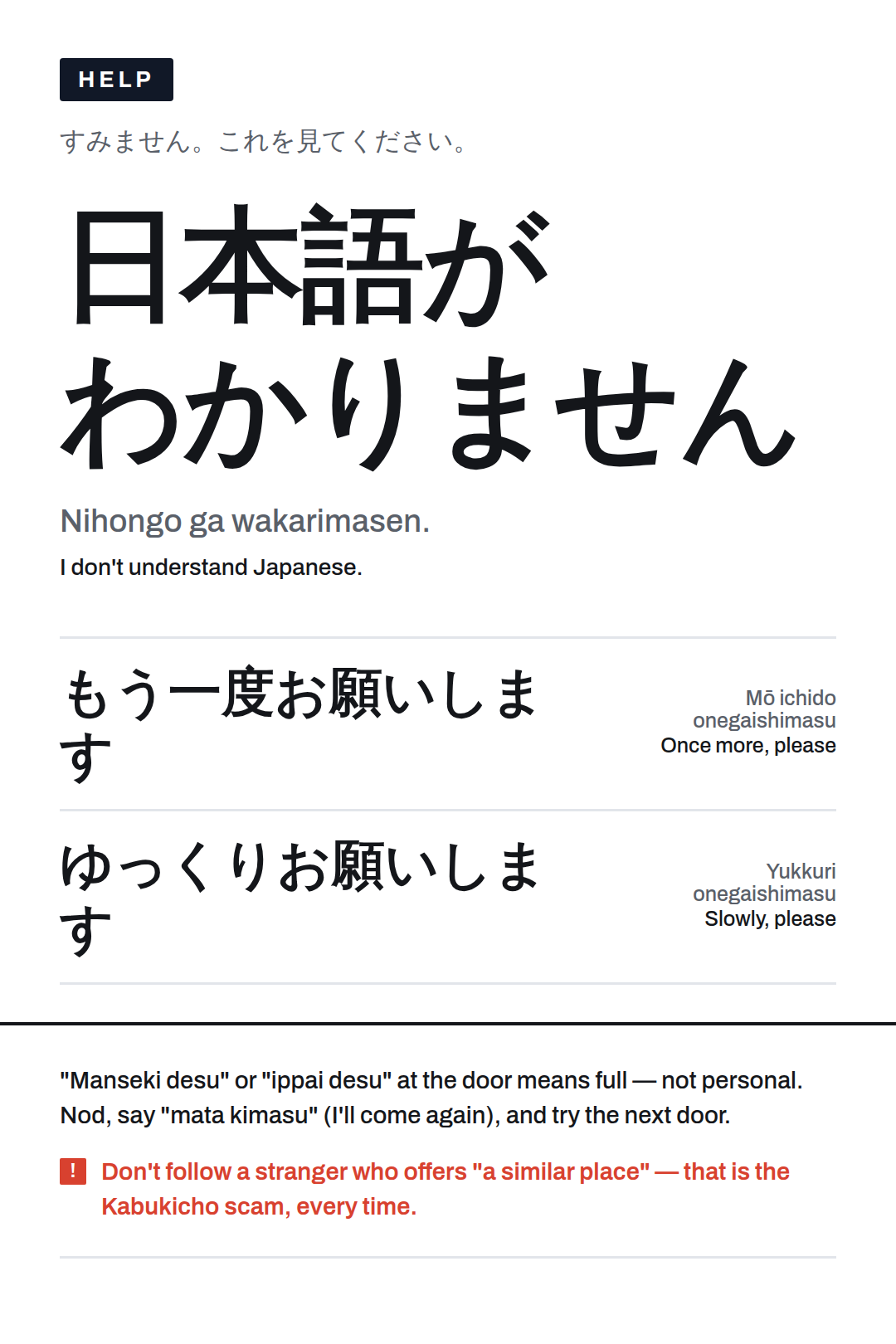
Sliding a door open to look is expected. If you see 会員制 (members only) or 一見さんお断り (no first-time customers), or the master says “ippai desu” (we’re full), say “mata kimasu” (I’ll come again) and move on. Note the pronunciation trap: “ippai desu” at the door means full, not one drink.
Sitting down: the stool you take is the stool you keep
Do not switch seats mid-visit; regulars have unspoken ones, and the shelf of name-tagged bottles tells you whose room this is. Do not spread across two stools, and if you hear “tsumete” (squeeze up), slide over and say “hai.” Do not come in “just to look around” in a five-seat room.
The order: one drink and one dish per person, and water is not a drink
This is the seat rent. At a yatai the official Fukuoka wording is at least one drink and one dish per person; at yokocho bars it is minimum one drink per person per bar. A 2023 one-star review of Omoide Yokocho reported being told to leave for not ordering alcohol; that is the economics working as designed, and an oolong tea would have solved it.
Phone and camera: the counter is not content
No phone calls at an eight-seat counter; step outside. No photos of anything, anywhere inside, without asking the master first: “shashin ii desu ka?” In Golden Gai, even the alleys are covered by a posted photography prohibition. Music and no outside food or drink go without saying, but they are on the official lists because tourists have done both.
During: pour for others, keep volume conversational, slurp freely
If you drink sake or share bottled beer with company, fill your neighbors’ glasses and let them refill yours; receive a pour with both hands or a raised glass. Keep to conversational volume; sound carries in a room three meters wide. And slurping your ramen is encouraged, the one rule that runs opposite to home.
Paying and leaving: no tipping, and do not outstay your glass
Pay cash, on the tray, when leaving. Never tip; it causes confusion, not gratitude, and the otoshi or cover already does that job. When your glass is empty and people are queueing, order another or leave; lingering over an empty glass breaks the system. Exit with “gochisōsama deshita.” How to time all this is covered in paying, staying and leaving.
Phrases
The phrases that keep you inside the rules
| Situation | Japanese | Romaji | Meaning |
|---|---|---|---|
| Before taking a stool | ここ、いいですか? | Koko, ii desu ka? | Can I sit here? |
| Checking the charge first | お通し/チャージ、ありますか? | Otoshi / chāji, arimasu ka? | Is there a cover charge? |
| Drinking without eating | 飲み物だけでもいいですか? | Nomimono dake demo ii desu ka? | OK if we just have drinks? |
| Joining a shared bench | ご一緒してもいいですか? | Go-issho shite mo ii desu ka? | May we join you? |
| Asking someone to scoot over | 詰めてもらえますか? | Tsumete moraemasu ka? | Could you scoot over? |
| Turned away at the door | また来ます | Mata kimasu | I'll come again |
| Leaving well | ごちそうさまでした! | Gochisōsama deshita! | Thanks for the meal |
The tripwire
Photography: the number one offense
Golden Gai is explicit about this in a way almost nothing else in Japan is. The business promotion association prohibits photography and video in the alleys themselves without permission, with posted signs. Inside a bar, the rule is simpler: ask the master before any shot. The clientele includes celebrities and professionals protecting their anonymity, which is why, per a widely cited Tokyo guide, being seen shooting photos inside a bar gets you ejected on the spot, not warned.
Omoide Yokocho is one notch softer: exterior alley shots are tolerated, but ask before interior shots or close-ups of customers. At a yatai, the tarp is open to the street and the mood is more relaxed, but the same ask-across-the-counter applies. In Kyoto’s Gion, the private side lanes are closed to tourists and carry ¥10,000 penalty signs; on any street, never photograph a geiko or maiko without asking, and never block or follow one. The pattern across all of them: the alley is someone’s workplace and the bar is someone’s living room, and the camera treats both as scenery.
The economics
One drink, one dish, one seat: the economics behind the "rules"
Most of the list above compresses into one fact: the room has five to ten seats and each seat must earn its keep every hour. The classic violation, the reason the official Fukuoka wording exists, is two people splitting one bowl of ramen across two stools. A Japanese local writing about tourist patterns described the same family of moves: several people sharing one dish, counting free water as a “drink,” or one person ordering while three sit.
The otoshi belongs to the same economics. In a documented incident, six tourists charged ¥3,600 for six otoshi servings shouted “No! No! Crazy!” at staff, assuming the little dishes were free; translation apps and a manager sorted it out. As one Tokyo magazine framed it, the problem isn’t the charge, it’s the lack of context: the otoshi is rent in a no-tipping country with brutal property costs, and drinks are cheap because the seat fee exists. The full anatomy of covers and the difference from actual scams is in the charges guide.
The other half of seat economics is time. The local pattern is one or two drinks per bar, then rotate; nursing one cocktail all night in a six-seat room is rude even though no sign says so. Some Omoide shops enforce roughly 90-minute limits, and masters everywhere signal politely: a last-order call, a bill placed on the counter. Turnover is not rudeness. It is the business model.
The sign that stings
"Members only" is room math, not racism
The sign that stings, 会員制 or “Japanese only,” is almost never about you. A six-seat bar that hosts camera-first tourists for 45 minutes loses a third of its nightly capacity, and a master who cannot manage the room in English protects the regulars who pay the rent year-round. “Members only” is polite shorthand for that math. Plenty of Golden Gai bars are regulars’ living rooms with public-facing doors, so expect a few polite no’s before you land.
The regulars’ infrastructure is visible once you know it: the shelf of shōchū and whisky bottles tagged with names in felt-tip is the bottle-keep system, where a customer buys a whole bottle and the bar shelves it for their next visit. A wall of named bottles means you are in somebody’s second home. You are still welcome at many such counters, on the understanding that you are a guest in a room with its own gravity. Being turned away from one is normal, costs you nothing, and the next door is two meters away. How to read doors before you commit is the subject of the entering guide.
2026 reality
Smoking, minors and the 2026 reality
Expect smoke. The 2020 Health Promotion Act banned indoor smoking in principle but exempted existing small venues, roughly, pre-April-2020 businesses with small capital and a customer floor of 100 square meters or less that register and post signage. That describes almost every Golden Gai and Omoide unit, so as of August 2026 smoking indoors remains legal and common in these bars. Door stickers tell you: 喫煙可 (smoking OK) or 禁煙 (non-smoking). A March 2026 five-star review of the alleys still flagged heavy cigarette smoke; the smell is part of the price.
Two consequences follow. Under-20s cannot legally enter premises registered as smoking-permitted, which is one more reason the kids question gets a flat no. And the alleys themselves are no-smoking: smoking on the street is banned everywhere in Shinjuku, Omoide included, so smoke only at designated spots or inside a bar that allows it. Shinjuku issues no fine, but some other Tokyo wards, Shibuya among them, do fine you on the spot. Fukuoka yatai are open-air with ashtrays common.
On drunkenness, the line is consistent: tipsy and talkative is the point of the place; vomiting, passing out in the alley, or aggression are the lines that end nights and bring police.
The tripwire: shooting first, asking never. Photography is the one rule where the penalty arrives without warning. Reviews and guides agree that raising a camera inside a Golden Gai bar without asking gets visitors ejected immediately, and the alleys outside carry a posted association-level prohibition. Every other mistake on this page earns you a polite correction. This one earns you the door. Ask "shashin ii desu ka?" first, every time, and accept a no.
Money and time
What the rules cost to follow — and to break
What the rules cost to follow, per person, 2025–26: the minimum honest spend at a Golden Gai bar is the cover (¥500 to ¥1,500 at most doors, some free, a few to ¥2,000) plus one drink, so ¥1,000 to ¥2,500; a comfortable two-drink visit runs ¥2,000 to ¥4,000. Otoshi at seated counters is ¥300 to ¥600 per person, effectively non-refusable. At a yatai the seat rent is the order itself: one drink (¥300 to ¥600, oolong tea included) and one dish each.
What they cost to break: the ¥3,600 otoshi standoff above ended in embarrassment, not a refund, and the tout-led Kabukicho version of “no rules explained” ended at ¥8,554 for a snack. On time: 30 to 40 minutes per yatai stall, 30 to 60 minutes per Golden Gai bar, up to about 90 minutes at an Omoide counter. Masters call last order before closing; bars empty toward the roughly 00:30 last trains.
Sources
Where these facts come from
- Shinjuku City — street smoking ordinance (Japanese) — street smoking banned throughout the ward, with no fine
- Shinjuku Golden Gai association — the association's photo and filming permission contact
- Omoide Yokocho — official site — no street smoking in the alley; time limits and one-drink-one-food rules at some shops
- Fukuoka City — official yatai how-to guide (GO FUKUOKA) — groups of 2 to 3; one drink and one dish per person
Prices, rules and procedures on this page were checked against these sources on 5 October 2026. Where no official source exists, the page says the detail varies.
Questions
Rules questions, answered
Can I take my kids to these places?
To open-air Fukuoka yatai early in the evening, yes. To Golden Gai and similar bar alleys, no; forum locals answer the question unanimously (“Bars in Golden Gai are not appropriate for kids”), and under-20s are legally barred from the many bars registered as smoking-permitted premises.
Can I take photos if I'm discreet?
Discretion is not the standard, permission is. Golden Gai’s alleys carry a posted photography prohibition from the business promotion association, and inside any bar you ask the master first: “shashin ii desu ka?” At Omoide, exterior alley shots are tolerated; interiors and customer close-ups need a yes.
Will I be able to avoid cigarette smoke?
Mostly no. The 2020 law exempts exactly this class of tiny pre-2020 bar, so as of 2026 most Golden Gai and Omoide units still allow smoking, marked 喫煙可 at the door. Yatai are open-air, which helps. If smoke is a dealbreaker, look for 禁煙 stickers or choose a neo-yokocho instead.
Is there a dress code?
No. These are counters that seat welders next to film directors. The two real clothing rules: skip strong perfume, which is anti-social at elbow distance, and wear things you are willing to have smell of charcoal and tobacco afterward.
How do I know which seat belongs to a regular?
You mostly can’t, so ask: “koko, ii desu ka?” before sitting, and then stay on the stool you were given rather than migrating. The name-tagged bottle-keep shelf tells you regulars exist; the master will steer you to the right seat if you let them.
What actually happens if I break a rule?
For almost everything, a polite signal: a word from the master, a bill placed in front of you, a last-order call. Ejection is reserved for the short list: unpermitted photography, refusing the one-order-per-person economics, aggressive drunkenness. Apologize, pay, and leave; the next door holds no memory of it.
Should I tip to smooth things over?
Never, anywhere in Japan. The otoshi and cover already perform the function a tip performs at home. The currency that actually works is “gochisōsama deshita” on the way out, which one account called the cheapest possible goodwill purchase.
Is slurping my noodles rude?
The opposite; slurping ramen is encouraged and reads as enthusiasm. The noise rules run the other way at these counters: phone calls and shouting are the problems, appreciative eating is not. If the bowl came from a yatai or an alley stall, slurp it hot.
Take it with you
The ten night cards are in the free set
Getting in, the cover charge, the decoders, paying and leaving — images that open with no signal, in an alley, at night. All 23 cards are free.
Get all 23 cards free