What do I order at a yatai or tiny bar when I can't read anything?
These places don't really run on menus. They run on a short spoken ritual — a drink ordered in the first thirty seconds, food in small rounds, and a lot of pointing. You can learn the entire system in the time it takes to drink one beer, and the vocabulary for everything on the wall fits in four small tables.

The moment
The wall of paper strips
The menu is a row of handwritten paper strips on the wall. No photos, no romaji, no English. The taishō is looking at you, seven strangers are eating things you can’t name, and the only word you recognize is ビール — which you are not even sure you’re pronouncing right. This is the moment most first-timers dread more than finding a seat.
One grammar note before the tables, because it does more work than anything else on this page: the particle で (de). It means, roughly, “make it this way.” Salt, not sauce: shio de. Firm noodles: barikata de. Shōchū with hot water: oyuwari de. One particle covers nearly every preference you will ever need to state.
The ritual, in order
How ordering actually works
Order a drink immediately — とりあえず生で
Before you look at any food, before you settle your bag on your lap, order a drink. The canonical opener is とりあえず生で (toriaezu nama de) — “draft beer, to start.” It works because it signals you know the system: the drink is the seat rent at a yatai (most stalls charge no cover, but one drink and one dish per person is the stated minimum), and it buys you time to read the wall. If you don’t drink alcohol, ウーロン茶 (ūron-cha, oolong tea) is the standard order and counts fully.
Wait for the kanpai — and nod to strangers
If you’re in a group, nobody drinks until glasses are raised together: 乾杯 (kanpai). Don’t sip early. With strangers at a shared counter, a raised glass and a nod is enough — you don’t need to clink with the whole row. If someone pours for you, receive it with both hands or a raised glass, and refill their glass in return. You never pour your own in company.
Ask what's good — おすすめは何ですか
おすすめは何ですか (osusume wa nan desu ka, “what do you recommend?”) is both an ordering strategy and the standard icebreaker — the official Fukuoka yatai guide explicitly tells visitors to talk to the staff. At a yakitori counter, the stronger version is おまかせで (omakase de) — “I’ll leave it to you.” The taishō sends what’s best that night, and you’ve just paid the cheapest possible compliment.
Point — これください
Everything visible is orderable by pointing. これください (kore kudasai, “this one”) at the menu strip, the oden pot, the skewer case. The advanced version, and the single most effective move at a counter: point at your neighbor’s plate and say あれと同じものをください (are to onaji mono o kudasai) — “the same as what he’s having.” Nobody has ever been offended by it.
State preferences with で
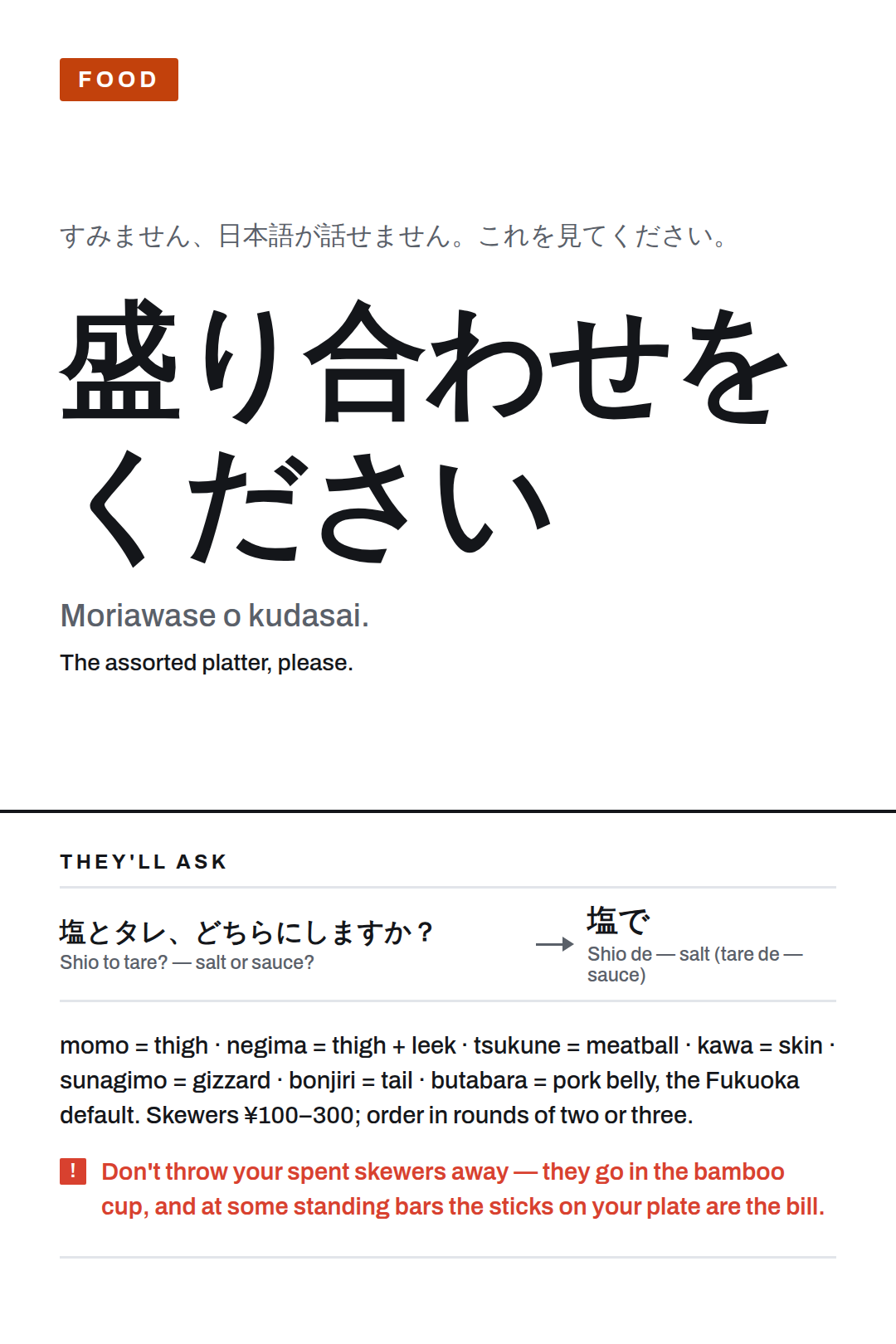
The yakitori master will ask 塩とタレ、どちらにしますか — salt or sauce? Answer 塩で (shio de) or タレで (tare de). At a Hakata ramen stall: バリカタで (barikata de) for firm noodles. Winter shōchū: お湯割りで (oyuwari de). The pattern is always noun + de. It is the closest thing Japanese ordering has to a cheat code.
Order food in rounds, not all at once
Two or three skewers, a couple of oden items, then order again when they land. すみません、注文いいですか (sumimasen, chūmon ii desu ka) reopens the channel; 同じの、もう一つください (onaji no, mō hitotsu kudasai) repeats a hit. A raised hand and sumimasen is expected, not rude. Keeping one live order going is also how you signal you’re still a customer and not just occupying a stool.
Phrases
The phrases, on one table
| Situation | Japanese | Romaji | Meaning |
|---|---|---|---|
| First drink | とりあえず生で | Toriaezu nama de | Draft beer to start |
| Recommendation | おすすめは何ですか? | Osusume wa nan desu ka? | What do you recommend? |
| Chef's choice | おまかせで(お願いします) | Omakase de (onegaishimasu) | I'll leave it to you |
| Pointing | これください / これ一つください | Kore kudasai / kore hitotsu kudasai | This one / one of these |
| Copying a neighbor | あれと同じものをください | Are to onaji mono o kudasai | Same as what he's having |
| Safe first order | 焼き鳥の盛り合わせをください | Yakitori no moriawase o kudasai | Assorted yakitori platter |
| Seasoning | 塩で / タレで | Shio de / tare de | Salt / sauce |
| Ordering again | すみません、注文いいですか? | Sumimasen, chūmon ii desu ka? | Can I order? |
| Repeat a dish | 同じの、もう一つください | Onaji no, mō hitotsu kudasai | Another of the same |
| Same drink again | おかわりください | Okawari kudasai | Refill, please |
| One more glass | もう一杯ください | Mō ippai kudasai | One more |
| Water | お水ください | Omizu kudasai | Water, please |
| Praise | おいしい / うまい | Oishii / umai | Delicious (umai = casual) |
| English menu | 英語のメニュー、ありますか? | Eigo no menyū, arimasu ka? | Is there an English menu? |
Pronunciation
Two traps worth knowing
一杯 (ippai) means “one glass,” but いっぱいです (ippai desu) from the master at the door means “we’re full,” not “one drink.” Same sound, different pitch: from the doorway it always means full. And ビール (bīru, long vowel) is beer; ビル (biru) is a building.
Yakitori decoder
What the skewers actually are
Skewers run ¥100–200 in Omoide Yokocho and ¥150–300 at Fukuoka yatai. Order in rounds of 2–3, eat straight off the stick, and drop spent skewers in the bamboo cup — at some standing bars the sticks are counted as the bill, so never bin them yourself. Count with いっぽん・にほん・さんぼん (ippon, nihon, sanbon) or just hold up fingers and say kudasai.
| Japanese | Romaji | What it is |
|---|---|---|
| もも | momo | Thigh — the juicy default |
| ねぎま | negima | Thigh and leek |
| つくね | tsukune | Meatball, often with a raw quail yolk to dip |
| 皮 | kawa | Skin, crisped |
| 砂肝 | sunagimo | Gizzard (called zuri in Kyushu) |
| 軟骨 | nankotsu | Cartilage, for the crunch |
| ぼんじり | bonjiri | Tail — "chicken toro" |
| せせり | seseri | Neck, well-worked and flavorful |
| レバー | rebā | Liver |
| ハツ | hatsu | Heart |
| ささみ | sasami | Tenderloin, lean |
| 手羽先 | tebasaki | Wing |
| 豚バラ | butabara | Pork belly |
Regional notes
Fukuoka pork, Tokyo yakiton
Two regional notes. In Fukuoka, “yakitori” defaults to pork: 豚バラ (butabara, pork belly) is the Hakata staple, and locals order it first. In Tokyo, the pork line has its own name — やきとん (yakiton), pork offal skewers, the signature of Omoide Yokocho alongside motsu nikomi stew.
Oden decoder
Pointing into the pot
Winter is oden season at the yatai — ¥100–200 per item, simmering in view, and entirely orderable by pointing: 大根と卵ください (daikon to tamago kudasai, “radish and egg, please”). The condiment is からし (karashi, hot mustard); in Kyushu, yuzu-koshō.
| Japanese | Romaji | What it is |
|---|---|---|
| 大根 | daikon | Radish — the king of the pot |
| 卵 | tamago | Boiled egg |
| ちくわ | chikuwa | Tube-shaped fish cake |
| こんにゃく | konnyaku | Konjac jelly |
| しらたき | shirataki | Noodle knots |
| 餅巾着 | mochi kinchaku | Mochi in a fried-tofu purse |
| がんもどき | ganmodoki | Tofu fritter |
| はんぺん | hanpen | Fluffy white fish-air cake |
| さつま揚げ | satsuma-age | Fried fish cake |
| 厚揚げ | atsuage | Thick fried tofu |
| つみれ | tsumire | Fish balls |
| 牛すじ | gyūsuji | Beef tendon on a skewer |
| 昆布 | konbu | Kelp roll |
The broth
One thing the pot hides
The broth is fish dashi. The daikon, the konnyaku, the tofu — every “vegetable” item has simmered in it for hours. Nothing in an oden pot is vegetarian. More on this below.
Hakata ramen
The hardness scale and the kaedama ritual
At a Fukuoka ramen yatai (¥800–1,200 a bowl on the Nakasu row, cheaper in Nagahama), you will be asked how firm you want your noodles. This is a real question with a real scale, softest to hardest.
| Japanese | Romaji | Meaning |
|---|---|---|
| やわ | yawa | Soft |
| 普通 | futsū | Normal |
| カタ | kata | Firm |
| バリカタ | barikata | Very firm — the local flex |
| ハリガネ | harigane | "Wire" |
| 粉落とし | konaotoshi | Barely cooked |
Kaedama
The refill that separates visitors from locals
Order with the de pattern: バリカタで. Then the ritual that separates visitors from locals: 替え玉 (kaedama), a refill of noodles for your remaining broth, ¥100–200 (¥150–200 at yatai). The timing matters — order it before you finish your noodles, and keep your broth, because the fresh noodles go into the bowl you already have: 替え玉ください (kaedama kudasai). It only exists with thin Hakata-style noodles; it was invented at the Nagahama stalls for fish-market workers on short breaks. Toppings on the counter are free: 紅生姜 (beni-shōga, pickled ginger), 高菜 (takana, mustard greens), sesame, garlic. Slurping is fine. If you’ve only used ticket-machine ramen shops, note the difference: at a yatai you order everything out loud.
Drinks decoder
What everyone around you is drinking
| Japanese | Romaji | What it is |
|---|---|---|
| 生ビール(中) | nama bīru (chū) | Draft beer; chū jōki ~400ml is the default size (dai large, shō small). "Nama chū." ¥500–600 at yatai |
| ハイボール | haibōru | Whisky and soda, ¥400–600 |
| チューハイ/サワー | chūhai / sawā | Shōchū, soda and flavor — lemon is the yokocho classic at ¥400–500; also grapefruit, ume, yuzu, Calpis |
| 焼酎 ロックで | shōchū rokku de | Shōchū on the rocks (imo = sweet potato, mugi = barley) |
| 水割りで | mizuwari de | Shōchū with cold water |
| お湯割りで | oyuwari de | Shōchū with hot water — the winter yatai standard. Full order: 芋をお湯割りで |
| 熱燗 | atsukan | Sake, hot |
| 冷酒 | reishu | Sake, chilled |
| ホッピー | Hoppy | Tokyo shitamachi ritual: 0.8% near-beer mixed with shōchū. ナカ (naka) = shōchū refill, ソト (soto) = new Hoppy bottle; one soto carries 2–3 naka. Order: ナカください |
| ウーロン茶 | ūron-cha | Oolong tea — the standard not-drinking order, and it counts as your seat-rent drink |
The sake trap
Hiya is not cold
冷や (hiya) traditionally means room temperature, not cold. If you want cold sake, say 冷酒 (reishu). And nomihōdai, the all-you-can-drink deal, exists at chain izakaya — never at a yatai or a Golden Gai counter, so don’t ask.
Dietary
Vegetarian, allergies, and the one raw thing to think twice about
The honest version first: these are hard places to be vegetarian. The forum consensus on Omoide Yokocho is blunt — eat something substantial before you arrive. The specific trap is だし (dashi): the fish-based stock underneath oden, simmered dishes, and most things described as “vegetable.” A “no meat, no fish” request routinely fails on dashi because staff don’t count stock as fish. The phrases: ベジタリアンです。肉と魚は食べられません。 (Bejitarian desu. Niku to sakana wa taberaremasen — I’m vegetarian, I can’t eat meat or fish); the dashi line, だしも魚介もダメです (Dashi mo gyokai mo dame desu — no dashi or seafood either); 豚肉は食べられません (Butaniku wa taberaremasen — I can’t eat pork); 〇〇アレルギーがあります (〇〇 arerugī ga arimasu — I have a 〇〇 allergy); これに〇〇は入っていますか? (Kore ni 〇〇 wa haitte imasu ka? — does this contain 〇〇?); 〇〇抜きでお願いします (〇〇 nuki de onegaishimasu — without 〇〇, please); 同じ油で揚げていますか? (Onaji abura de agete imasu ka? — is it fried in the same oil?).
Restaurants have no legal allergen-disclosure obligation in Japan (labeling law covers packaged goods only — nine mandatory allergens as of April 2026, cashew being the newest, with labels required in full from 2028). A written card the staff can carry to the cook is the mechanism that actually works — our vegetarian and allergy cards are built for exactly this.
Then there is 鶏刺し (torisashi) — raw or seared chicken sashimi, a real regional specialty, especially in Kyushu. It carries a documented Campylobacter risk: roughly 200 outbreak events and around 2,000 patients a year, with a Guillain–Barré syndrome risk of 0.2–1.7 per 1,000 infections. As of August 2026 the health ministry is drafting Japan’s first national hygiene guidelines for it — standardizing, not banning. Skip it, or order it knowing exactly what the numbers are.
The costly mistake: ordering raw chicken because it looked local. Torisashi is legal, traditional, and genuinely risky — Campylobacter is the country's leading cause of bacterial food poisoning, and a small share of infections end in Guillain–Barré paralysis. One useful cross-check: Fukuoka yatai are prohibited by the city’s rules from serving any raw food. Everything at a legitimate stall is cooked — so raw anything at a yatai is a red flag by law, not a hidden find.
Money and time
The order-of-play, priced
Yatai dinner: ¥1,500–3,000 per person — a bowl of ramen ¥800–1,200, skewers ¥150–300 each, beer ¥500–600, kaedama ¥150–200. A three-stall crawl runs ¥4,000–6,000. Omoide Yokocho: ¥2,000–3,000 for two drinks, five or six skewers and a ¥300–500 otoshi. Skewers ¥100–200 at honest stalls; ¥400–600 with an English-only laminated menu and a tout out front means walk deeper in. Oden ¥100–200 per item; chūhai ¥400–500; highball ¥400–600.
Yatai hours vary stall by stall, so check the Google Maps link for tonight. Order your first drink within a minute of sitting; food in rounds of 2–3 items; kaedama before your noodles run out; and at 30–40 minutes with a queue behind you, settle up. Paying and leaving is its own ritual — covered in how to pay and when to leave.
Sources
Where these facts come from
- NHK — health ministry to draft first raw-chicken hygiene guideline (Japanese) — the first national guideline for chicken eaten raw, and about 2,000 Campylobacter cases reported in 2025
- Fukuoka City — 2026 yatai operator recruitment rules (Japanese) — no raw food at yatai
- Fukuoka City — yatai data (yokanavi.com) — 69 stalls with foreign-language menus and 39 with foreign-language staff, December 2023
Prices, rules and procedures on this page were checked against these sources on 5 October 2026. Where no official source exists, the page says the detail varies.
Questions
Ordering questions, answered
Do the staff speak English?
Spotty, and it doesn’t matter much — the pointing system carries you. In Fukuoka the city counted 69 stalls with foreign-language menus and 39 with staff who can manage a foreign language, out of roughly 103 (city count, December 2023). An English menu posted outside is the reliable welcome flag.
What should I order first if I panic?
とりあえず生で for the drink, then 焼き鳥の盛り合わせをください — the assorted yakitori platter. It’s the safest first order in the country: the master picks the cuts, you learn what you like, and you’ve bought ten minutes to study the wall.
What does "toriaezu nama" actually mean?
Literally “for now, a draft.” It’s what Japanese customers say within seconds of sitting down, and it works because the first drink is structurally the seat charge — most yatai have no cover, but one drink and one dish per person is the stated minimum.
Do I have to order alcohol?
No. ウーロン茶 (oolong tea) is the standard non-drinking order and fully counts toward the one-drink minimum. What you can’t do is count free water as your drink — that’s the specific violation locals complain about.
What does barikata mean, and how do I order extra noodles?
Barikata is “very firm” on the Hakata noodle-hardness scale — the local default flex. For extra noodles, order 替え玉 (kaedama, ¥150–200 at yatai) before you finish your first serving, and keep your broth — the refill goes into your existing bowl.
Is there anything vegetarian at a yatai?
Very little, honestly. Even the vegetable items in oden simmer in fish dashi, and “no meat” requests fail on stock unless you say だしも魚介もダメです. Eat beforehand and treat the stall as a drinks-and-atmosphere stop, or carry a written card — see vegetarian and allergy cards.
Shio or tare?
Salt (shio) shows off good chicken; tare is the sweet soy glaze. When the master asks 塩とタレ、どちらにしますか, answering 塩で for the delicate cuts (sasami, seseri) and タレで for tsukune is a respectable default. Ordering おまかせで sidesteps the question entirely.
Is the raw chicken safe to eat?
It carries real, documented risk — around 2,000 Campylobacter patients a year, and Japan is only now (August 2026) drafting its first hygiene guidelines for it. If you see it at a Fukuoka yatai, something is wrong: raw food at yatai is banned by the city’s rules. Elsewhere it’s a knowing gamble, not a safe adventure.
Take it with you
The ten night cards are in the free set
Getting in, the cover charge, the decoders, paying and leaving — images that open with no signal, in an alley, at night. All 23 cards are free.
Get all 23 cards free