Why is there a charge for a dish I didn't order — and how do I not get scammed in Shinjuku?
Two jobs, because you need both. First, the legitimate charge system — what otoshi, seat fees and covers actually are, and what they should cost in 2025–26. Second, the actual scam — which is real, lives mostly in Kabukicho, and looks nothing like a ¥400 dish of pickles once you know its anatomy.

The scene
"No! No! Crazy!"
Six tourists sit down at a Tokyo izakaya. Within minutes, six small dishes arrive that nobody ordered. When the bill lands with ¥3,600 they didn’t expect — ¥600 a head — they shout “No! No! Crazy!” at the staff, certain they’re being robbed. Translation apps come out, a manager arrives, and eventually everyone understands: the dishes were the otoshi, the seat charge every Japanese customer at every counter in the country pays without comment. As Tokyo Weekender put it when it reported the incident: the problem isn’t the charge. It’s the lack of context.
Getting this distinction right matters in both directions. Pay a ¥500 cover without flinching, and walk out of any bar that matches the scam pattern. The travelers who get burned are usually the ones doing the opposite.
The ritual, in order
How not to be surprised by a bill
Know the legitimate charges before you go out
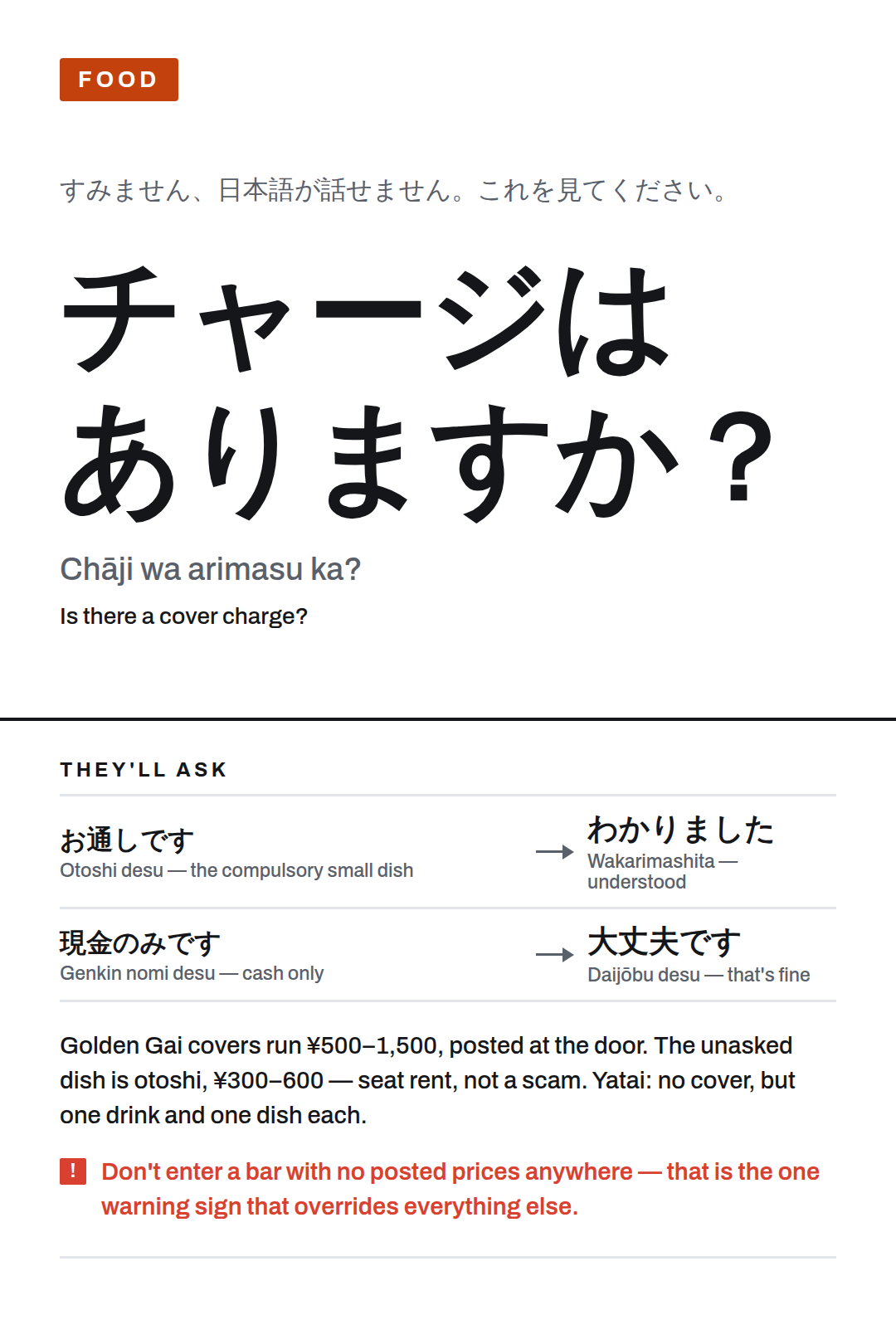
Three exist. Otoshi (お通し; tsukidashi in Kansai): a small compulsory appetizer that lands when you sit at an izakaya or bar counter, ¥300–600 per person, up to ¥1,000 somewhere upscale. Seki-ryō (席料): a bare seat fee, ¥500–1,000 at bars, which should be disclosed on the menu or signage. Cover charges: Golden Gai runs ¥500–1,500 per person, usually including a snack; some bars charge nothing. That’s the entire legitimate universe. Anything outside it needs a very good explanation.
Read the door before you commit
Honest bars post their charges. In Golden Gai, covers are disclosed on door signs — Albatross G has posted ¥500, La Jetée ¥1,000. Covers drift, so trust the sign on the door tonight over any list. A door with no prices posted anywhere is the one warning sign that overrides everything else: walk away.
Ask the one question before you sit
「チャージはいくらですか?」 — Chāji wa ikura desu ka? — “How much is the cover?” Asking before sitting is normal, not rude; travelers report using “Otoshi wa ikura desu ka?” up front with zero friction. Thirty seconds of mild awkwardness buys total certainty about the bill.
Recognize the otoshi when it lands
A small dish per person, arriving with or just after the first drink, unordered and unexplained. That’s it. That’s the seat charge in edible form. Eat it or don’t — you pay it either way. The izakaya version of this ritual, in full, is covered at our izakaya guide.
Know what the total should look like
Golden Gai: cover plus two drinks lands at ¥2,500–4,000 per bar. Omoide Yokocho: ¥2,000–3,000 for two drinks, five or six skewers and a ¥300–500 table charge at the stalls that levy one. Fukuoka yatai: ¥1,500–3,000 for a full feed. If your mental arithmetic and the bill disagree by thousands of yen, something is wrong — see the anatomy below.
Never follow anyone into a bar
The legitimate system never comes to find you on the street. Every step above assumes you chose the door. When the door chooses you, leave.
Phrases
The phrases that settle money questions
| Situation | Japanese | Romaji | Meaning |
|---|---|---|---|
| Before sitting | お通し/チャージ、ありますか? | Otoshi / chāji, arimasu ka? | Is there a cover charge? |
| The price check | チャージはいくらですか? | Chāji wa ikura desu ka? | How much is the cover? |
| Drinks only OK? | 飲み物だけでもいいですか? | Nomimono dake demo ii desu ka? | OK if we just have drinks? |
| The bill | お会計お願いします | Okaikei onegaishimasu | Bill, please |
| Card check | カード使えますか? | Kādo tsukaemasu ka? | Can I pay by card? |
| The answer you'll get | 現金のみ | Genkin nomi | Cash only |
| Splitting | 別々にできますか? | Betsu-betsu ni dekimasu ka? | Can we pay separately? |
Why it exists
Why the seat fee exists: cheap drinks, expensive floor space
The otoshi is rent, not a scam. It grew up as local custom in a no-tipping country with brutal urban property costs: the small compulsory dish keeps a counter stool from being occupied for two hours by one ¥500 beer. Drinks in these alleys are cheap because the seat fee exists — remove it and every drink price rises to cover the same rent. Japanese customers pay it nightly without comment.
At counter bars, treat it as non-refusable. Chains sometimes waive it on request, and some Golden Gai bars now skip the otoshi for foreign guests and fold it into drink prices instead — but at a traditional five-stool counter, asking to refuse the otoshi reads like asking to refuse the rent. Consumption tax (10%) is included in displayed prices, and service charges are a hotel thing, not a yokocho thing.
The rate card
What each venue legitimately charges, as of August 2026
Golden Gai: ¥500–1,500 covers at most charging bars, disclosed at the door, usually with a snack included. Named honest doors, with covers as last posted: Albatross G (¥500, bilingual), Kenzo’s Bar (¥500), La Jetée (¥1,000). Check the door; covers change. Genuinely no-cover: One Coin Bar Champion (¥500 drinks, ¥100 karaoke), Ace’s Bar, Bar Araku. Some bars even post “no charge for travellers” in English.
Omoide Yokocho: table charge ¥300–500 including a small appetizer, at some stalls only. Nonbei Yokocho (Shibuya): otoshi ¥500–1,000 — mandatory and legitimate.
Fukuoka yatai: no cover and no otoshi at most stalls. The counterpart obligation is the order minimum instead — one drink and one dish per person, and the drink can be oolong tea. The stall’s rent is your ¥500 beer. Tachinomi (standing bars): usually no otoshi at all — the structural reason standing sessions run ¥1,000–1,500.
The scam
Anatomy of the actual scam: the ¥8,554 bill
The canonical account comes from SoraNews24, in December 2021. A visitor in Kabukicho, looking for the cheap chain Torikizoku, accepted a friendly stranger’s guidance to a lookalike bar. The bill for a modest snack: ¥8,554 — itemized as ¥990 for two otoshi + ¥1,000 “seating charge” + ¥1,000 “year-end charge” + ¥1,000 “weekend charge” + service charge + tax. Every line dressed up as a legitimate-sounding fee; the stack is the scam.
Notice the mechanism. The tout’s friendly banter isn’t decoration — it’s the tool that keeps you talking instead of reading the menu until you’re seated and the charges attach. Tokyo police flagged Kabukicho touts as scam vectors through 2025–26, and in July 2026 a tout was arrested for luring tourists into shady establishments. The boundary rule that sorts every case: no legitimate Golden Gai bar sends touts into the street. Anyone steering you toward a bar in or near Kabukicho is the scam, whatever they’re promising.
The four-point defense. One: posted prices — no prices at the door, no entry; this one rule filters almost everything. Two: ask before sitting — chāji wa ikura desu ka?; an honest bar answers in one breath. Three: never follow a tout — not a friendly one, not an apologetic one, not one “helping you find” a bar you named. Four: know the ranges — an otoshi up to ¥1,000 is normal; a ¥1,000 “weekend charge” stacked on a ¥1,000 “year-end charge” is not a custom you failed to research — it’s an invention.
The tout is the whole scam. Every documented Shinjuku rip-off in this corpus begins the same way: a charming stranger on the street, unprompted, guiding you somewhere. Legitimate bars in these alleys compete by posting prices and hanging English menus — never by sending someone out to collect you. The moment anyone on a Kabukicho street offers to walk you to a bar, the transaction has already started and you are the product. Decline, keep walking, and choose your own door with prices on it.
Money and time
The numbers on one page
Otoshi: ¥300–600 per person typical, ¥1,000 at the upscale end. Per person, automatic, effectively non-refusable at counters. Golden Gai: cover ¥0–1,500 at nearly all honest bars; ¥2,000–4,000 per bar all-in; a 3–4-bar night runs ¥6,000–10,000. Omoide Yokocho: ¥2,000–3,000 per person covers dinner. Yatai: ¥1,500–3,000 per person; no cover, one-drink-one-dish minimum. Hours vary door by door: check the Google Maps link for tonight.
Cash: these are cash rooms — carry ¥10,000–15,000 in ¥1,000 notes for a bar-hopping night. Seven Bank ATMs in 7-Eleven take foreign cards, and there is one a short walk from Golden Gai, Omoide and the Fukuoka strips. Japan Post ATMs keep post-office-style hours and many shut in the evening — don’t count on one after dinner. See how paying works in Japan generally.
Sources
Where these facts come from
- Tokyo Metropolitan Police — entertainment-district rip-offs (Japanese) — the tout-led overcharging pattern; never follow a street tout
- Fukuoka City — Yatai Ordinance enforcement rules (Japanese) — prices shown where customers can see them, and the day's price for market-priced items
- Fukuoka City — official yatai how-to guide (GO FUKUOKA) — no cover or otoshi at most stalls; one drink and one dish per person
- Omoide Yokocho — official site — table charges and one-drink-one-food rules at some shops
Prices, rules and procedures on this page were checked against these sources on 5 October 2026. Where no official source exists, the page says the detail varies.
Questions
Charge questions, answered
What is this ¥500 appetizer I didn't order?
That’s the otoshi — a compulsory small dish that functions as the seat charge at izakaya and bar counters, typically ¥300–600 per person on the bill. It is not a scam and it is not aimed at foreigners; Japanese customers pay it every night without comment. Think of it as the cover charge arriving in edible form.
Can I refuse the otoshi?
At a traditional counter place, assume no — it’s the seat rent, and declining it doesn’t un-rent the stool. Big chains sometimes waive it if asked, and some Golden Gai bars quietly skip it for foreign guests and price it into drinks instead. The productive move isn’t refusing; it’s asking otoshi wa ikura desu ka? before you sit so the number never surprises you.
How do I know a bar is honest?
Prices posted at the door — that single test does most of the work. Honest Golden Gai bars display their cover on a sign (Albatross G has posted ¥500; La Jetée ¥1,000), and several welcoming bars charge nothing at all: One Coin Bar Champion, Ace’s Bar, Bar Araku. A bar with no visible prices, or one a street tout led you to, fails the test automatically.
Do all Tokyo bars have cover charges? How do I avoid them?
No — and you can drink well while never paying one. Tachinomi standing bars usually skip the otoshi entirely (sessions run ¥1,000–1,500), several named Golden Gai bars advertise no cover, and Fukuoka-style yatai charge nothing beyond your order. But avoiding every ¥500 cover as a matter of principle mostly filters out excellent bars; the cover usually includes a snack and buys you a seat in someone’s six-stool living room.
Is the cover charge negotiable?
No. Golden Gai covers are posted, fixed and non-negotiable, and haggling anywhere in this world is a taboo. The negotiation happens before you sit, and it’s binary: you see the posted price and either take the stool or say mata kimasu and try the next door.
Why don't yatai charge a cover?
Because the ordinance-shaped yatai system uses an order minimum instead: one drink and one dish per person is the posted official norm in Fukuoka. A non-drinker can satisfy it with oolong tea — the point is that every stool produces revenue, which is exactly what the otoshi does indoors. Splitting one bowl of ramen across two stools is the classic violation of it.
Will they charge me more because I'm a tourist?
Honest venues, no. At Fukuoka yatai, the city rules make every stall show its prices where you can see them, and anything priced by the day’s market has to show today’s price, so there is no mystery “market price.” The documented tourist-pricing pattern lives elsewhere: Omoide stalls with English-only laminated picture menus and a tout at the entrance run 2–3× the prices of the stalls deeper in the alley, and Kabukicho lookalike bars invent fees outright. The defense is the same everywhere: read posted prices, walk past the stalls that shout.
What should a full Golden Gai night actually cost?
¥2,000–4,000 per bar including cover and a couple of drinks, so ¥6,000–10,000 for the standard three-to-four-bar hop, in cash. If a single bar’s bill lands multiples above that for a snack and a drink — the December 2021 SoraNews24 case hit ¥8,554 — you’re not in the legitimate system anymore. Prices as of August 2026.
Take it with you
The ten night cards are in the free set
Getting in, the cover charge, the decoders, paying and leaving — images that open with no signal, in an alley, at night. All 23 cards are free.
Get all 23 cards free