Do I tip in Japan, and what do I do if someone chases me with the money?
No. You do not tip in Japan — not in restaurants, not in taxis, not in bars, not for housekeeping. The one grey area is a ryokan room attendant or a private guide or driver you have had all day, and even then it is optional and goes in an envelope. Money you leave behind is read as money you forgot, and somebody will come after you with it.

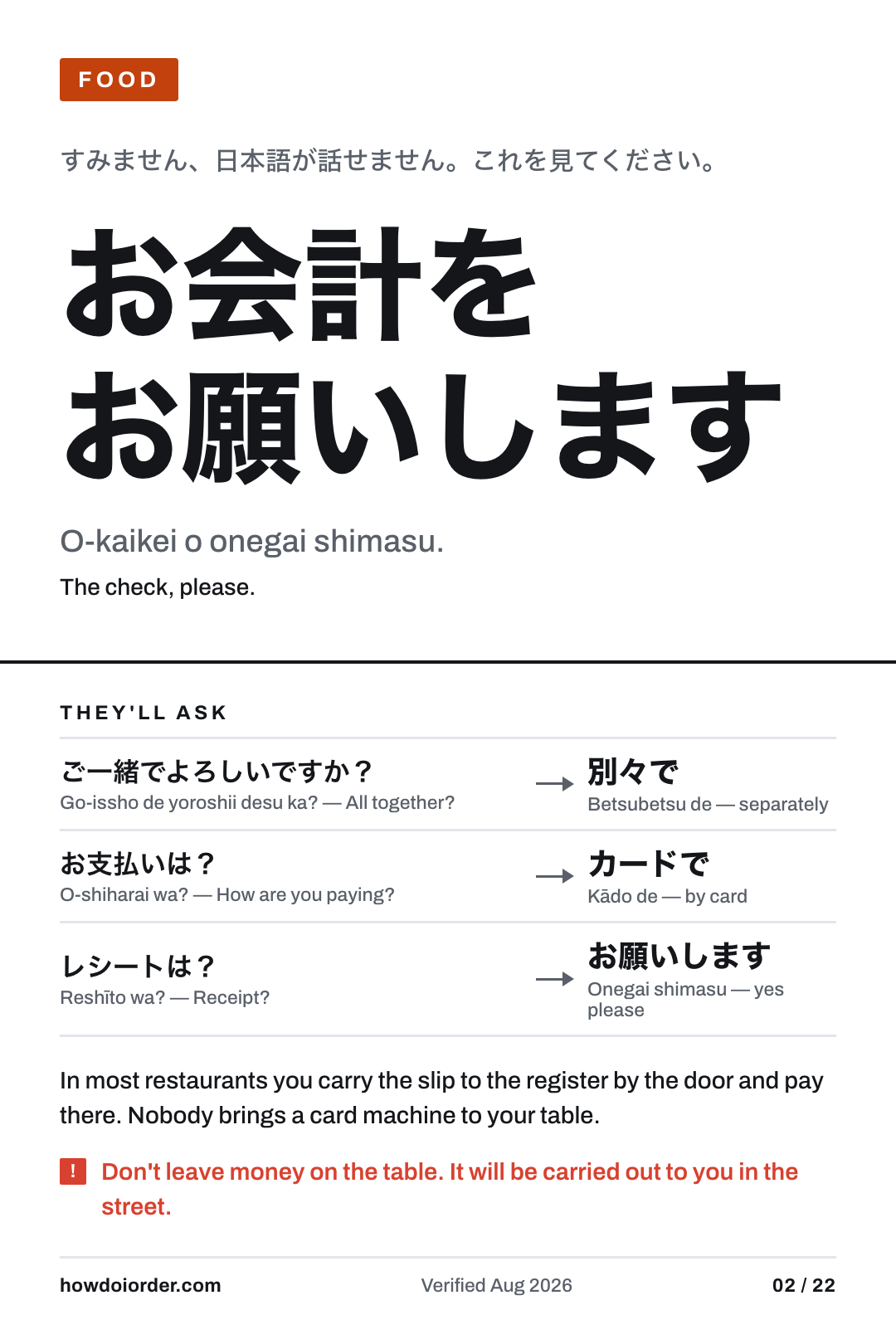
The ritual, in order
What to do instead, and what to do when it goes wrong
Pay exactly what the total says
The figure on the register display is the figure. There is no rounding up and no leaving the coins. Japanese card terminals almost never ask for a tip; if one does, it is usually a foreign-built till system, and you can skip it.
Take all of your change
Every coin, including the ¥3 and ¥7 sort of amounts. Leaving change on the tray is the easiest way to start the chase by accident. Scoop it up even if it feels petty.
Say the thing instead of leaving the money
Gochisōsama deshita after a meal, arigatō gozaimasu anywhere else. That is what gratitude is made of here, and it is worth more to the person in front of you than a ¥500 coin.
If they come after you, stop and take it
A waiter jogging into the street with ¥400 in a small tray is not angry and is not making a point — they think you dropped it. Stop, take it back, say arigatō gozaimasu, and carry on.
Do not push it back
Refusing creates a far bigger scene than accepting. The staff member usually cannot keep it anyway — it becomes a till discrepancy someone has to reconcile at the end of the shift. Taking it back ends it on the spot.
If you genuinely want to give something, use an envelope
In the two situations where a gift is a real custom — a ryokan room attendant, or a private guide or driver you have had for a full day — it is optional, and it goes in a small envelope, handed over with two hands, at the start. Never loose cash, and never on a table.
What they will say to you
The four sentences you will hear about money
None of these need a real answer. Two words closes each one, and the person saying it wants the exchange over as much as you do.
| You’ll hear | It means | Say |
|---|---|---|
| お忘れ物です。O-wasuremono desu. | You've forgotten something. | ありがとうございますArigatō gozaimasu — thank you |
| お釣りです。O-tsuri desu. | Here is your change. | ありがとうございますArigatō gozaimasu — thank you |
| 結構です。Kekkō desu. | No, thank you — that isn't necessary. | わかりましたWakarimashita — understood |
| サービス料込みです。Sābisu-ryō komi desu. | The service charge is already included. | わかりましたWakarimashita — understood |
Why
It is not modesty, and it is not a test
The price is the price. Wages are not built around gratuities, so the person serving you is not short of anything you could make up at the end of the meal. There is no calculation running in their head about what you will leave, which is why service does not change when you are obviously a tourist and obviously not going to tip.
Many workplaces don't let staff accept money from customers at all. Cash that turns up in a till or on a table becomes a discrepancy that has to be explained, so the fastest thing for everybody is to get it back to you. That is the actual mechanism behind the story every visitor hears about being chased down the street. It is real, and it is administrative rather than moral.
You will also see this in places that have no counter at all. A taxi driver will hand you ¥20 in coins rather than keep it, a hotel porter will not take a note pressed into his hand, and a hairdresser will refuse and mean it. None of it is a first refusal you are supposed to overcome.
Don't push the money back or insist. Refusing what is being handed to you makes a far bigger scene than accepting it, and the person cannot keep it either way.
The exceptions, and the fake one
Two real ones, both envelope-only
There is no tipping anywhere in this. Not in restaurants, not in taxis, not for housekeeping. Money left behind is treated as money you forgot, and someone will come after you with it.
There are two situations where a gift is a genuine custom rather than a tourist invention. The first is a traditional ryokan with a nakai-san, the attendant assigned to your room, where a kokorozuke of a few thousand yen may be given in a small envelope when you are first shown the room. The second is a private guide or driver you have had for a full day. Both are optional, both are declining, and both are envelope-only — never loose notes and never left on a surface. If you are not sure, do not, and nothing bad happens.
The fake exception is the service charge that has started appearing on some tourist-facing bills and at hotel restaurants. It is printed on the bill, usually around 10%, and it goes to the business rather than to the person who served you. It is not a tip, it does not replace one, and you add nothing on top of it. If you see it, pay the total shown and walk out — exactly as on the paying the bill page.
Sources
Where these facts come from
- Japan National Tourism Organization — customs and etiquette — tipping is not customary in Japan
- Square Japan — tips in Square for Restaurants (Japanese) — a tip function existing on some card systems sold in Japan
- Boutique Japan — tipping in Japan — the ryokan kokorozuke envelope custom
Prices, rules and procedures on this page were checked against these sources on 5 October 2026. Where no official source exists, the page says the detail varies.
Questions
The things people ask on the way out of the door
A waiter just ran into the street after me with ¥400. What do I do?
Stop, take it, say arigatō gozaimasu, and keep walking. They believe you dropped it and they cannot put it back in the till without creating a discrepancy. The whole exchange is over in a moment if you accept it, and drags on awkwardly if you don't.
Do I tip a taxi driver?
No. The driver will hand you ¥20 in coins rather than keep it, and will wait while you take it. Fares are metered, the rear-left door opens by itself, and nothing extra is expected — see the taxi page for the rest of that exchange.
What about hotel housekeeping or the porter?
No. A ¥1,000 note left on the pillow is likely to be handed in or returned to you, so don't bother. Porters will not take a note pressed into a hand. In a business hotel there is nobody this is even aimed at.
Is there ever a real exception?
Two. A nakai-san at a traditional ryokan may be given a kokorozuke of a few thousand yen in an envelope when you are shown the room, and a private guide or driver you have had all day may accept one. Both are optional, both are fading, and both are envelope-only.
My bill has a 10% service charge. Is that the tip?
No, and it does not mean you should add one. It is printed on the bill, usually at 10% and occasionally 15%, it goes to the business rather than the server, and it appears mostly at hotel restaurants and hotel bars. Pay the total shown at the register, say gochisōsama deshita, and leave nothing behind.
How do I say thank you if not with money?
Gochisōsama deshita (go-chee-soh-sah-mah desh-ta) on the way out of anywhere you have eaten, and arigatō gozaimasu everywhere else. Said at the door on your way past the register, that is the entire closing ritual, and it lands better than a coin.
Are there tip jars anywhere?
Effectively no. You may see one in a specialist coffee bar in Tokyo aimed at foreign customers, and it is an import rather than a custom. A ¥100 coin left on a counter without a jar will be handed back to you, usually before you reach the door, with o-wasuremono desu — you forgot something.
Does this apply in bars and izakaya too?
Yes. The one charge that surprises people at an izakaya is the otōshi — a small dish that arrives with your first drink, usually a few hundred yen a head, listed on the bill as お通し. That is a seat charge, not a tip, and it is paid at the register like everything else.