How do I pay the bill at a restaurant in Japan?
You pay at the front, not at the table. The slip is left on your table or stood up in a little holder next to you — that is not a mistake, it is the bill. When you are done you pick it up, carry it to the register near the door, and pay there. Nobody is coming over with a card machine, and nothing is left behind.

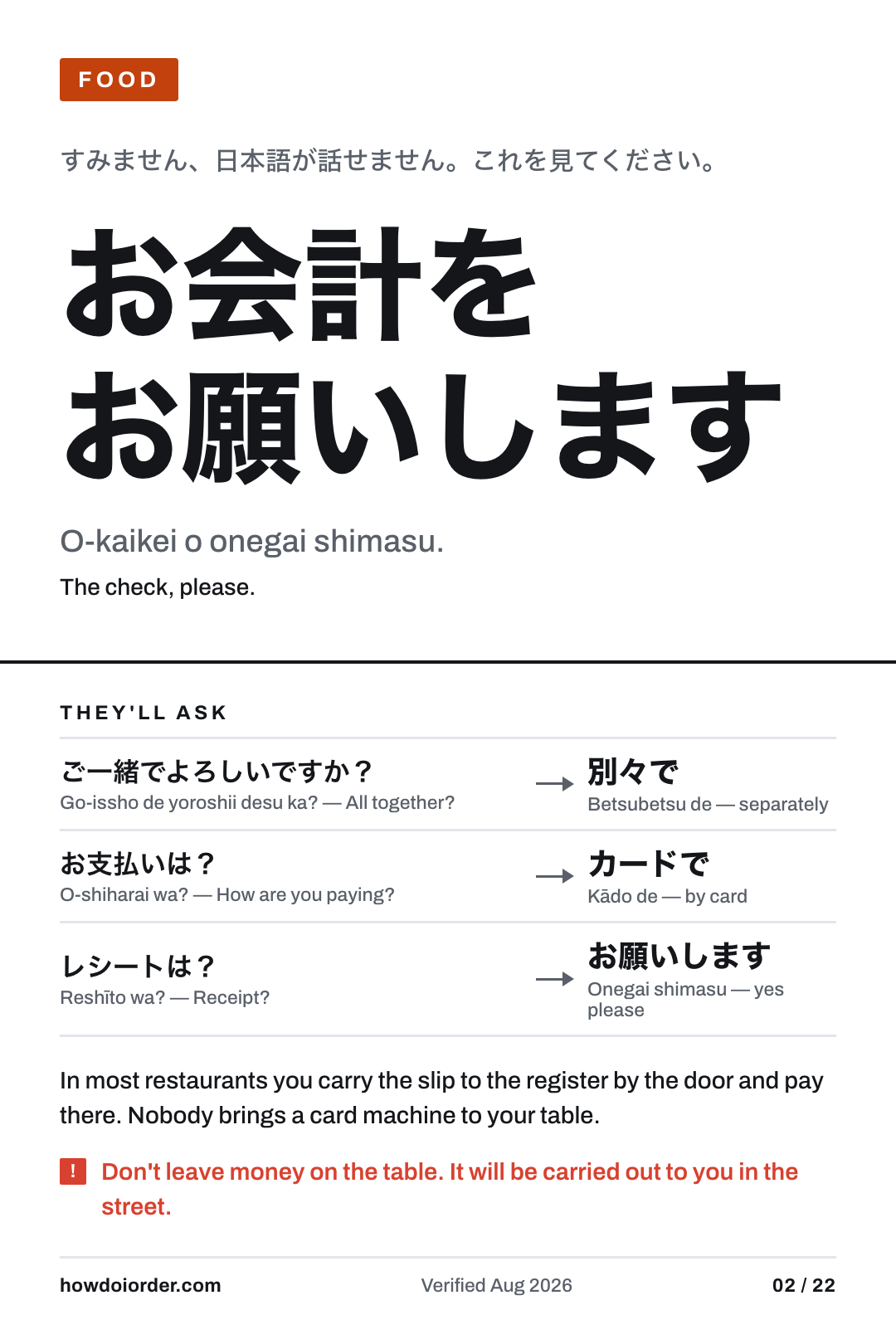
The ritual, in order
From the last mouthful to the street
Find the slip that is already on your table
It usually arrives with the food, face down or clipped into a small wooden or plastic holder. It is not a receipt and it is not a reminder to leave — it is the bill, printed at the moment you ordered.
Ask only if there isn't one
Catch the eye of anyone on the floor and say o-kaikei o onegai shimasu — the check, please. That always works. Some people cross two index fingers into an X instead, but it is old-fashioned, younger staff may not read it, and it can come across as rude in a nice place.
Stand up and take it to the register
The register is almost always near the door, and someone will already be walking towards it as you stand. Take the whole holder, slip and all. Leaving it on the table and walking out is the one move that causes real confusion.
Put the slip down face up
It goes on the counter or in the tray, not into a hand. The clerk reads it, keys it in, and tells you the total out loud — and shows you the figure on the register display, so you never need to catch the number by ear.
Answer two or three short questions
Together or separately? Card or cash? One payment or instalments? Issho de, kādo de, hai. Then the receipt question, which you can answer either way.
Take the change and go
Change and receipt come back in the tray, often handed over with two hands and a small bow. Take all of it. Gochisōsama deshita on the way out is the whole closing ritual, and there is nothing else to leave.
What they will ask you
The register's four questions
These are asked at the till, not at the table, and the answers are one or two words. If you miss one, the clerk will point at the display or at the card reader rather than repeat it.
| You’ll hear | It means | Say |
|---|---|---|
| ご一緒でよろしいですか?Go-issho de yoroshii desu ka? | All together on one bill? | 一緒でIssho de — together |
| お支払いは?O-shiharai wa? | How are you paying? | カードでKādo de — by card |
| 一括払いでよろしいですか?Ikkatsu-barai de yoroshii desu ka? | In one payment, not instalments? | はいHai — yes |
| レシートは?Reshīto wa? | Do you want the receipt? | お願いしますOnegai shimasu — yes please |
Where the bill lives
The slip on your table is not a hint
In most Japanese restaurants the bill is printed when your order goes in, and it sits with you for the whole meal. Visitors read this as being hurried along. It is not — it is there so that you can leave whenever you want without having to summon anyone. The staff have no next step to take; you do.
Because payment happens at the front, nobody has a card machine on the floor and nobody will come to you. If you sit waving at a passing waiter for ten minutes, the waiter will eventually come over and point at the register. Standing up and walking to the door is the correct move, and it is not rude even mid-conversation.
There are exceptions and they announce themselves. Hotel restaurants and some higher-end places will settle at the table or bill the room. Places with a ticket machine at the door take your money before you sit at all — that is the pattern on the ramen shop page. If there is a machine by the entrance, there is nothing to pay at the end.
Don't leave money on the table when you go. It reads as money you forgot, and a member of staff will follow you into the street to give it back.
Splitting, service and the tray
The parts that go wrong
Splitting is betsubetsu de — separately — and whether it happens depends entirely on the till. Chain restaurants and cafés do it without blinking. Small izakaya, counters and family-run places often cannot, and will say so; the normal solution is that one person pays and the group settles up outside, which is what Japanese groups do anyway. Asking is fine. Insisting after a no is not.
Money goes in the small tray or into the payment machine, never into a hand. Restaurants and small shops still use the tray; the big convenience-store chains increasingly have you feed a machine facing you yourself.
A service charge is essentially never added to a normal restaurant bill in Japan. Where you do see one — some hotel restaurants, a few hotel bars, occasionally a tourist-facing place — it is printed on the bill as a percentage, it goes to the house, and it is not a tip. It does not change what you do at the register, and it does not mean you should add anything on top. Nothing you add is a tip: see why there is no tipping in Japan.
Sources
Where these facts come from
- Japan National Tourism Organization — customs and etiquette — tipping is not customary, and some small shops and cafés are cash-only
- DIME — on the crossed-finger bill sign (Japanese) — the X sign being old shorthand that can read as rude
- Hint-Pot — on the crossed-finger bill sign (Japanese) — younger staff not always reading the X sign
Prices, rules and procedures on this page were checked against these sources on 5 October 2026. Where no official source exists, the page says the detail varies.
Questions
The things people ask before the bill comes
How do I ask for the bill?
O-kaikei o onegai shimasu (oh-kai-kei oh oh-neh-gai shee-mas) — the check, please — said once you have caught someone's eye. You will see some customers cross two index fingers into an X, but that is old bar shorthand and can read as rude in a nicer restaurant, so the words are the safer choice. Coming the other way, staff may ask o-kaikei de yoroshii desu ka? (oh-kai-kei deh yo-roh-shee des-ka) — is that everything, shall I ring it up? — to which a nod or hai is the whole answer.
Can we split the bill?
Say betsubetsu de — separately. Chains and cafés will do it; small izakaya and counter places often genuinely cannot and will tell you so. In that case one person pays and the group settles up outside. At an izakaya expect the per-head split to include the seat charge, usually a few hundred yen a head and sometimes more in Tokyo.
Do I tip?
No. Not the waiter, not the driver, not housekeeping. Leave ¥500 on the table and someone will chase you down the street with it. The only exceptions are a ryokan room attendant or a private guide or driver you have had all day, both optional and envelope-only. Gochisōsama deshita is how thanks is expressed here; the full picture is on the tipping page.
Is a service charge added?
Almost never in an ordinary restaurant. Where it exists — mainly hotel restaurants and hotel bars — it is printed on the bill, usually around 10%, and it goes to the business. It is not a tip and you add nothing on top of it.
There is no slip on my table. What now?
Go to the register and say o-kaikei o onegai shimasu. At an izakaya or a place with table-side ordering the staff tally your table at the till from the order screen. Some places ask which table you were at, so remember the number on the little stand.
Can I pay by card?
In cities, usually yes, and the register will ask ikkatsu-barai de yoroshii desu ka — one payment? Say hai. Small counters, older shops and anywhere with a ticket machine at the door are still cash-only, so keep a ¥1,000 note or two on you.
What is the difference between a reshīto and a ryōshūsho?
A reshīto is the itemised till roll and is what you get by default. A ryōshūsho is a formal receipt made out to a name, which you need only for expenses; ask for it by name. Chains print it at once; a small place may write it out by hand.
Do I pay before or after in a café?
It depends on the counter, and you can tell from the door. If there is a machine or a till you order at, you pay then — a ¥500 coffee settled before you sit, the pattern on the coffee shop page. If someone takes your order at the table, you pay at the front afterwards, exactly as here. Either way, nothing is settled at the table.