How do I pay at a Japanese convenience store?
The konbini till is a short run of yes/no questions, fired fast and usually in the same order: warm it up, chopsticks, bag, point card. None of them need a sentence in reply. At most chains you then pay at a small machine facing you; where there isn't one, your money goes in the small tray, not into the clerk's hand. The whole thing takes well under a minute.

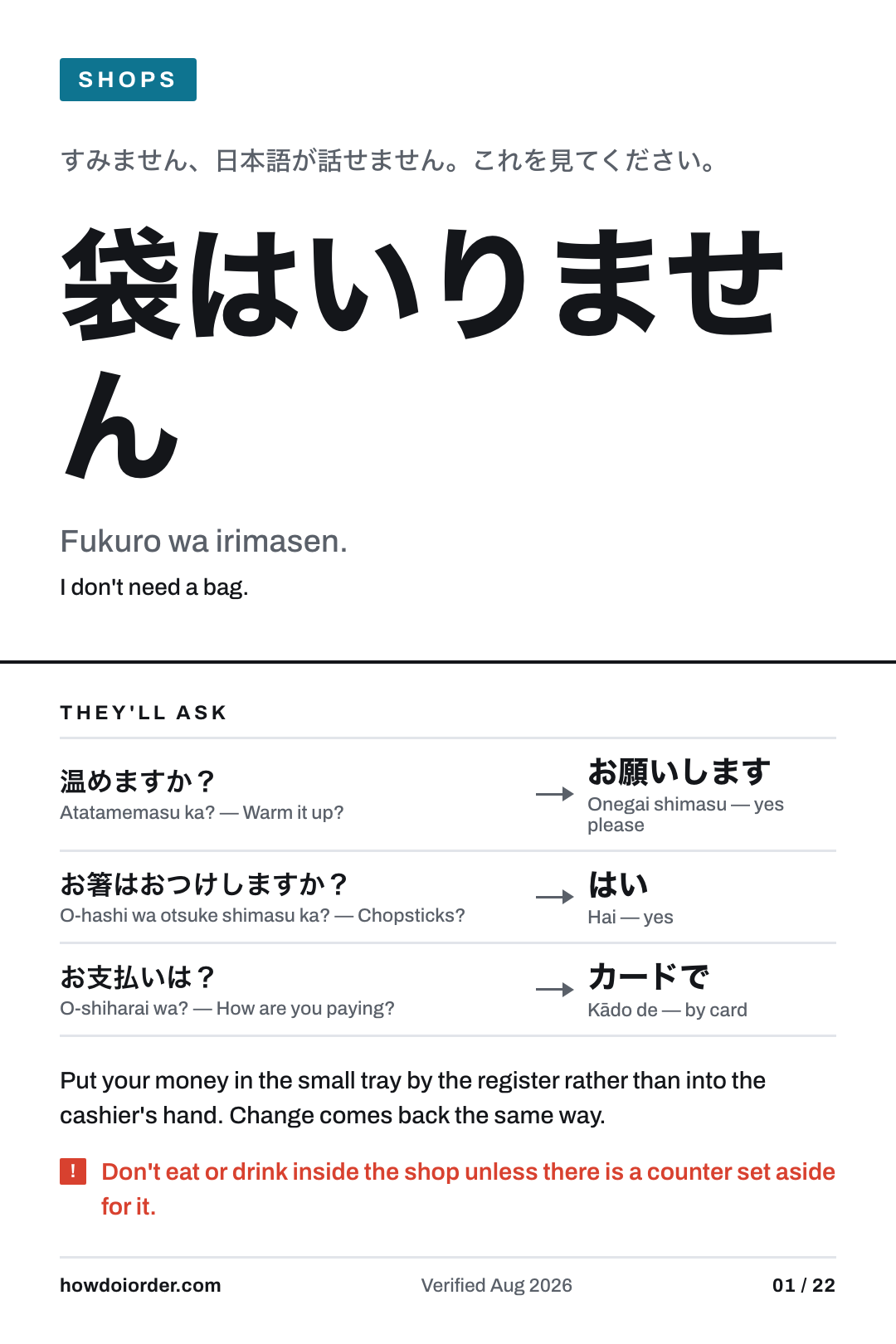
The ritual, in order
What happens from the shelf to the door
Take a basket only if you need one
Baskets are stacked at the door or at the end of an aisle. Two or three items go straight to the counter in your hands. There is no queue rope in most shops — you stand behind the person paying, and if two registers are open the clerk will wave you at one.
Ask for anything in the hot case
The fried chicken, the steamed buns and the oden sit in cases behind or beside the register and are not self-service. You have to point and ask, and if you do not, you will walk out without them. Pointing and saying kore o hitotsu — one of these — is enough.
Put your things on the counter
Goods go on the counter, not into the clerk's hands. The clerk scans, then starts the run of questions. This is the moment people freeze, so know that the questions are short and almost all of them take a one-word answer.
Answer the questions
Warm it up? Chopsticks or a spoon? A bag? A point card? Onegai shimasu means yes to any of them and irimasen means no thanks to any of them. Sometimes there is a fifth: how you are paying, or a touch-screen asking you to confirm you are over 20 if you bought alcohol. Tap the button and you are done.
Pay at the machine, or in the tray
At most konbini now, the clerk scans and you pay at a small machine facing you: notes and coins go into its slots and your change drops out at the bottom. If there is no machine, cash goes in the small tray, not into the clerk's hand. Cards, Suica and QR codes go on the reader, and the clerk will point at it. Contactless works at every major chain.
Leave before you eat it
The clerk will put a straw, a wet wipe or chopsticks in the bag and hand it over with two hands. Unless the shop has a marked eat-in counter, you take the food out with you.
What they will ask you
The usual four questions, and the one-word answer to each
They usually come in roughly this order, at speed, while the clerk is still scanning. You are not expected to reply in a sentence — a single word is the normal answer for a Japanese customer too.
| You’ll hear | It means | Say |
|---|---|---|
| 温めますか?Atatamemasu ka? | Shall I warm it up? | お願いしますOnegai shimasu — yes please |
| お箸はおつけしますか?O-hashi wa otsuke shimasu ka? | Would you like chopsticks? | はいHai — yes |
| 袋はご利用ですか?Fukuro wa go-riyō desu ka? | Do you want a bag? | いりませんIrimasen — no thanks |
| ポイントカードはお持ちですか?Pointo kādo wa o-mochi desu ka? | Do you have a point card? | ありませんArimasen — I don't have one |
The counter
Why it feels faster than it is
A konbini clerk is working to a script, and the script is the same in Tokyo, Sapporo and a car park on a national route. That is the good news: once you have heard the usual questions once, you have heard almost every konbini transaction you will have on the trip. The speed is not impatience, it is a trained sequence.
Bags stopped being free in July 2020 and now cost a few yen, ¥3 to ¥7 depending on size and chain. That is why the bag question exists at all, and why the clerk waits for an answer rather than bagging automatically. If you say no, the sticker they put on the item is the shop's proof you paid — leave it on until you are outside.
The hot case is the part visitors miss for a whole trip. Oden in winter, fried chicken all year, steamed buns by the till: roughly ¥150 to ¥300 a piece, all of it behind glass at the counter, none of it reachable without asking. Prices and line-ups change by chain and by season, so read the case rather than trusting a number here.
Don't eat or drink what you bought inside the shop unless there is a marked eat-in counter. Standing in the aisle with an open drink is the one thing that will get you spoken to.
Money, and everything else it does
The konbini is a utility, not a snack shop
Money goes in the small tray or into the payment machine, never into a hand. Restaurants and small shops still use the tray; the big convenience-store chains increasingly have you feed a machine facing you yourself.
The ATMs inside 7-Eleven, Lawson and FamilyMart are the reliable ones for foreign cards, and they have an English option on the first screen. FamilyMart is swapping its ATMs for Seven Bank machines through 2030, so you may find any of three brands there; all three take foreign cards. They are inside the shop, so you can usually reach one late, but don't plan a 3am withdrawal around it. Bank ATMs on the street often refuse foreign cards outright; the exception is the Japan Post (ゆうちょ) ATM at a post office. The withdrawal fee is stated on screen before you confirm — it has moved more than once and is typically a few hundred yen on top of whatever your own bank charges.
You can also drop off and collect luggage forwarding parcels, print documents from a USB stick (about ¥10 a black-and-white A4 sheet) or from your phone (about ¥20), buy concert and bus tickets from the terminal by the door, pay utility and tax bills, and post letters. If you need a passport photo, a printout of a booking, or a way to get a suitcase to your next hotel, this is the building you want.
Sources
Where these facts come from
- Seven-Eleven Japan — self-payment register release (Japanese) — customers feeding cash into the payment machine themselves
- Ministry of Economy, Trade and Industry — plastic bag charging (Japanese) — bags charged since 1 July 2020, with the price set by each retailer
- National Tax Agency — reduced tax rate Q&A (Japanese) — 10% eating in against 8% taking away, and shops checking by posted sign
- Seven Bank — international cards — foreign cards accepted at 7-Eleven ATMs
- FamilyMart — ATM changeover release (Japanese) — FamilyMart ATMs moving to Seven Bank machines from June 2026
- Japan Post Bank — International ATM Service — foreign cards at Japan Post ATMs
Prices, rules and procedures on this page were checked against these sources on 5 October 2026. Where no official source exists, the page says the detail varies.
Questions
The things people ask before they go in
What are they actually asking me at the till?
Usually four things, in roughly this order: atatamemasu ka (warm it up), o-hashi wa otsuke shimasu ka (chopsticks), fukuro wa go-riyō desu ka (a bag), and pointo kādo wa o-mochi desu ka (a point card). Sometimes a fifth: o-shiharai wa? (how are you paying), or an over-20 confirmation on the screen if you bought alcohol. Onegai shimasu answers yes to any of the four and irimasen answers no.
How much is a plastic bag?
A few yen, ¥3 to ¥7 depending on size and chain, charged since July 2020, and it appears as its own line on the receipt. Say fukuro wa irimasen if you have a bag already. If you take one, it is small — a bento and a drink fill it.
Can I use my foreign card in a konbini ATM?
Yes, and these are the ones to use. The machines in 7-Eleven, Lawson and FamilyMart take Visa, Mastercard and most overseas debit cards, and offer English on the first screen. FamilyMart is part-way through switching to Seven Bank machines, and Japan Post (ゆうちょ) ATMs at post offices take foreign cards too. The fee appears on screen before you confirm, so read it there rather than trusting a figure written months ago. Carry the cash — ramen ticket machines and small counters still do not take cards.
Can I eat inside the shop?
Only where there is a marked eat-in counter, which is common in station and office-district branches and rare elsewhere. If you plan to eat at the counter, say so at the till — tennai de, eating in. The tax is 10% eating in and 8% taking away, and most konbini expect you to tell them rather than asking. Otherwise, take it out.
Do I have to answer the point card question?
No. Arimasen — I don't have one — closes it in one word, and the clerk moves straight to payment. Foreign visitors on a two-week trip get nothing useful from the loyalty schemes, so this is the one question you can always answer the same way.
Can I pay by card or with Suica?
Yes, at every major chain, for any amount — a ¥140 coffee on a card is normal and nobody will react. Say kādo de for card or Suica de for the IC card, or just hold it over the reader when the clerk points at it. Cash goes into the payment machine, or the tray where there isn't one.
What is in the hot case, and how do I get it?
Fried chicken, steamed buns, croquettes, and oden in winter — typically ¥150 to ¥300 a piece. It sits behind the register and is not self-service, so point and say kore o hitotsu (one of these). For anything you can't identify, the allergy and vegetarian page covers how to ask what is in it.
The clerk scanned everything and pointed at a machine. What now?
That is the payment machine, and you pay it yourself. Feed your notes and coins into its slots — a ¥1,000 note goes in the long thin one — and your change comes out at the bottom. Paying by card or Suica instead? Say kādo de and the clerk will point you at the reader. Medicine is a different problem: see the pharmacy page.