How do I take a taxi in Japan?
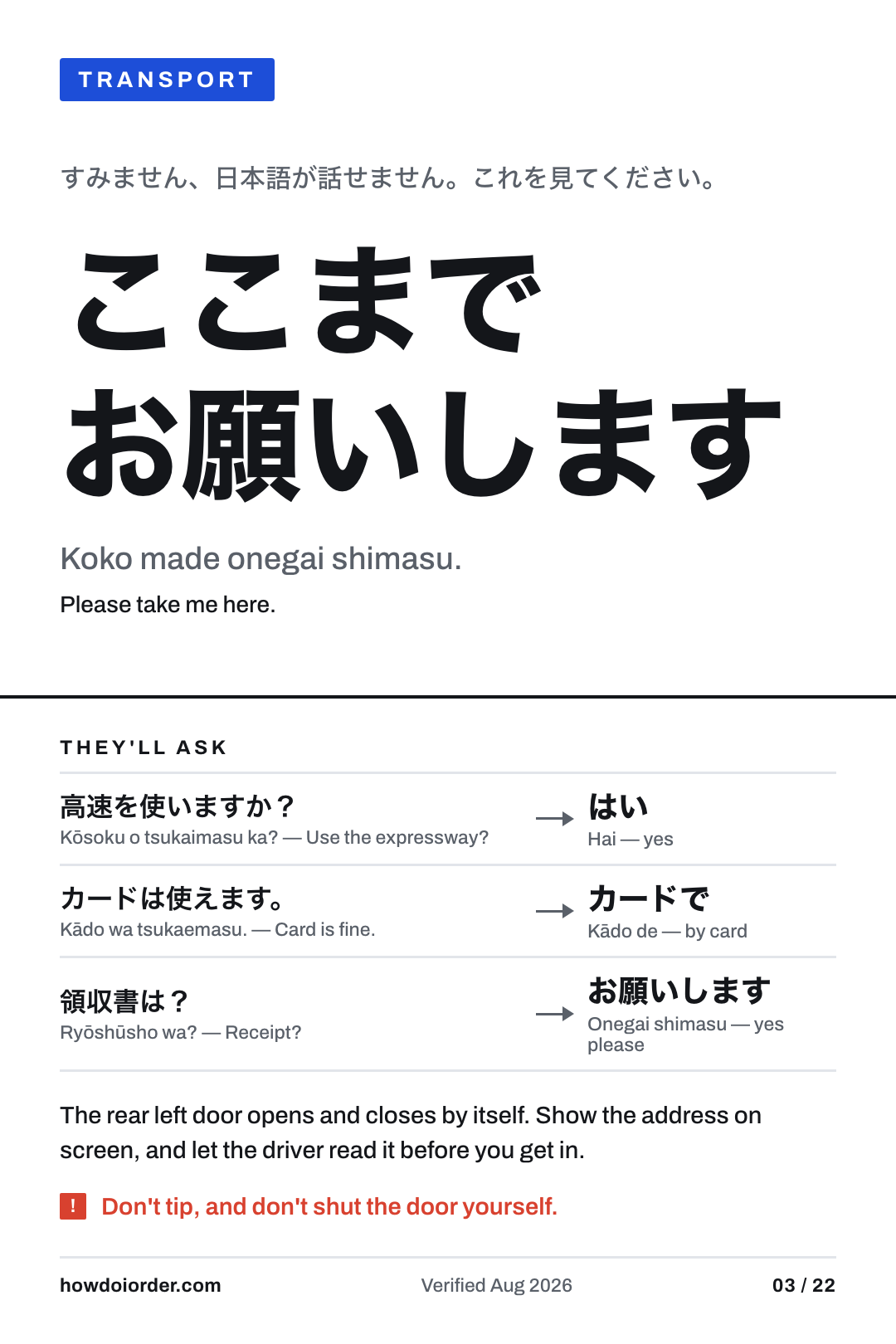
The rear left door opens by itself and closes by itself. Stand back and let it. Have the address on your phone screen before you get in, hold it up for the driver to read, and let the driver pick the route. You pay at the end, by card or IC card in most cities, and you never tip.

The ritual, in order
From the kerb to the receipt, in the order it happens
Read the sign in the windscreen, not the colour
A lit 空車 (kūsha) means empty and available. 賃走 or 実車 means someone is already in it, 迎車 means it is on its way to a booking, and 回送 means off duty. Vacant is usually red and hired usually green, but companies differ — read the characters.
Stand back from the door
The rear left door is opened by the driver. On an older saloon it swings out towards you on a lever; on the tall black JPN Taxi it slides back electrically. Either way, stand clear and keep your hands off it. Reaching for the handle is the one thing every visitor does once.
Have the address on screen before you sit down
A dropped pin in a maps app beats an address read aloud, and beats a street name outright — most Japanese streets have no name. Hold the phone up, let the driver read it, and say koko made onegai shimasu — please take me here.
Answer the expressway question
高速を使いますか (kōsoku o tsukaimasu ka) means “shall I use the expressway?” It is faster and the toll goes on your fare. From an airport or across a big city, hai is usually the right answer.
Settle how you are paying before you set off
Card and IC cards are accepted in most Tokyo and Osaka taxis now, and the reader is on the back of the front seat. Ask first anyway — kādo wa tsukaemasu ka — because a rural or late-night car can still be cash only.
Pay, take the receipt, and get out without touching anything
Money goes in the tray, not the hand. Ryōshūsho o onegai shimasu gets you a printed receipt, which is worth having if you leave something behind. Step out, stand clear, and let the door shut itself.
What they will ask you
Four questions, and the answer that works
Drivers are polite and formal and will not slow down for you. These four cover almost every ride.
| You’ll hear | It means | Say |
|---|---|---|
| 高速を使いますか?Kōsoku o tsukaimasu ka? | Shall I take the expressway? | はいHai — yes |
| お支払いは?O-shiharai wa? | How are you paying? | カードでKādo de — by card |
| ここでいいですか?Koko de ii desu ka? | Is here alright to stop? | はい、お願いしますHai, onegai shimasu — yes, please |
| 領収書は?Ryōshūsho wa? | Do you want a receipt? | お願いしますOnegai shimasu — yes please |
The address
Why saying the address out loud does not work
Japanese addresses are not a street and a number. They are a ward, a district, a block and then a building, counted in an order that makes sense on a map and none at all spoken aloud by someone who has never said those syllables before. Almost no street has a name. A driver who cannot place your pronunciation of a district is not being difficult.
So show, don't say. A pin dropped in a maps app, the hotel's own address card, or a screenshot of the booking confirmation all work, and all work better than your best attempt at the address. Hand the phone over the seat back or hold it steady where the driver can read it, and give it a few seconds. Booking through a taxi app skips the problem entirely, because the driver gets your pin before you get in.
Landmarks are the other currency. Station names, big hotels, department stores and intersections are how drivers navigate, and “the Hilton, then I will point” gets you within two minutes' walk of most things. If you have a phone number for the destination, that is better still — many taxi navigation systems take a phone number as a destination.
Don't touch the door. The rear left door is opened and closed by the driver, by lever or by switch, and pulling it shut behind you is the one thing that will get you spoken to sharply in a language you do not speak.
Money
What a taxi actually costs you
There is no tipping anywhere in this. Not in restaurants, not in taxis, not for housekeeping. Money left behind is treated as money you forgot, and someone will come after you with it.
Fares are set region by region, and Tokyo's went up in November 2022 and again on 20 April 2026, so read the meter rather than any article. In Tokyo the meter now starts at ¥500 for the first kilometre and adds ¥100 every 232 metres, plus ¥100 for every 85 seconds spent crawling in traffic. A 20 per cent late-night surcharge runs from 22:00 to 05:00, and the meter adds it on its own. Other regions set their own figures.
That maths is why the answer to “taxi or train?” is almost always the train. Narita to central Tokyo is roughly ¥3,000 and an hour on the train, against ¥21,000 to ¥30,000 on a Tokyo taxi company's fixed airport fare, and ask whether tolls are on top. The taxi becomes the right answer at about half past midnight, when the trains have stopped, and at that point it is the only answer.
Sources
Where these facts come from
- km taxi — Tokyo fare revision notice (Japanese) — the Tokyo fare from 20 April 2026: ¥500 for 1 km, ¥100 per 232 m, ¥100 per 85 seconds, 20 per cent from 22:00 to 05:00, fixed Narita fares
- Toyota — JPN TAXI usability (Japanese) — the power sliding rear door on the passenger side
- GO — taxi app — booking in English with a foreign card or Apple Pay
Prices, rules and procedures on this page were checked against these sources on 5 October 2026. Where no official source exists, the page says the detail varies.
Questions
The things people ask before they put a hand out
Does the taxi door really open by itself?
Yes, the rear left one. The driver works it: on an older saloon it swings out on a lever, on the tall JPN Taxi it slides back at the press of a switch. Do not open it, do not pull it shut, and stand far enough back that it clears you. Say arigatō gozaimasu and walk away — the driver closes it.
How much will the ride cost?
In Tokyo, since 20 April 2026, the meter starts at ¥500 for the first kilometre and adds ¥100 every 232 metres, plus time charges in traffic. A 15-minute cross-town ride lands somewhere around ¥2,000 to ¥3,000. Other regions set their own fares, so read the meter rather than any article.
Should I take a taxi from the airport?
Almost never. Narita to central Tokyo is ¥21,000 to ¥30,000 on the fixed taxi fares against about ¥3,000 and an hour on the train — see buying a train ticket. The exception is a very early flight, a lot of luggage, or arriving after the last train, which in most cities is between 00:00 and 00:30.
What is the driver asking about the expressway?
Kōsoku o tsukaimasu ka — shall I use the expressway. It is faster, and the toll, usually ¥1,000 to ¥3,000 depending on the run, is added to your fare. From Narita or Kansai it saves half an hour or more, so hai is the normal answer. Iie if you would rather not pay it.
Can I pay by card, or with Suica?
In the big cities, usually yes — the reader is mounted on the back of the front seat and takes credit cards and IC cards alike. Ask before you set off: kādo wa tsukaemasu ka. Carry a ¥5,000 note as backup, and top up at a convenience store ATM if you are short.
Do I tip the driver?
No. Not the driver, not for luggage, not by rounding up. A driver who finds ¥500 on the seat will get out and run after you with it. The whole of it is on the tipping page, and the answer does not change anywhere in the country.
Is there a night surcharge?
Yes. In Tokyo it is 20 per cent from 22:00 to 05:00, applied by the meter automatically. It is not negotiable and it is not a scam. It is the reason a ride that costs ¥2,000 by day costs about ¥2,400 after the last train.
Can I book a taxi with an app?
Yes. GO, a Japanese taxi app, works in English and takes a foreign card or Apple Pay. Uber also books ordinary licensed taxis in the big cities. Either one sends the driver your pin, which solves the address problem, and the car shows 迎車 (geisha, on the way to a booking) while it comes to you.