How do I order at a ramen shop with a ticket machine?
You buy before you sit. The machine by the door takes your money first, prints a small paper ticket, and that ticket is your order. You hand it over or put it on the counter, as the staff indicate, then take a seat — or wait to be pointed at one. Nobody will come to take an order, and there is nothing to pay at the end.

The ritual, in order
What actually happens, from the door to the street
Find the machine before you look for a seat
It is almost always just inside the door, often to the left, and it is lit up. If there is a queue, it forms at the machine and not at the counter.
Put the money in first
The buttons stay dark until the machine has your cash — this is the single most common moment of panic, and nothing is broken. Look for the note slot, usually on the right. A ¥1,000 note almost always works, but some older machines still reject the new notes issued in 2024 — the ¥1,000 with Kitasato on it. If yours comes back out, show it to the staff and they will usually swap it. A ¥10,000 note often does not work at all.
Press the bowl, then any extras
Look for the cheapest ramen on the machine. That is the shop's standard bowl, the thing they are known for, and the safe choice every time. It is often the top-left button — but not reliably any more, and pressing top-left on trust is how people end up with a loaded bowl at nearly twice the price. Extras (egg, extra pork, extra noodles) are the smaller buttons underneath. Take your change from the lever at the bottom.
Hand the ticket over face up
Hand it across or put it on the counter, face up, whichever the staff indicate — some cooks reach for it, some point at the counter. If the shop is full, keep hold of it and wait to be pointed at a seat. Sitting down before you are shown a seat is the thing that causes trouble.
Answer the two questions
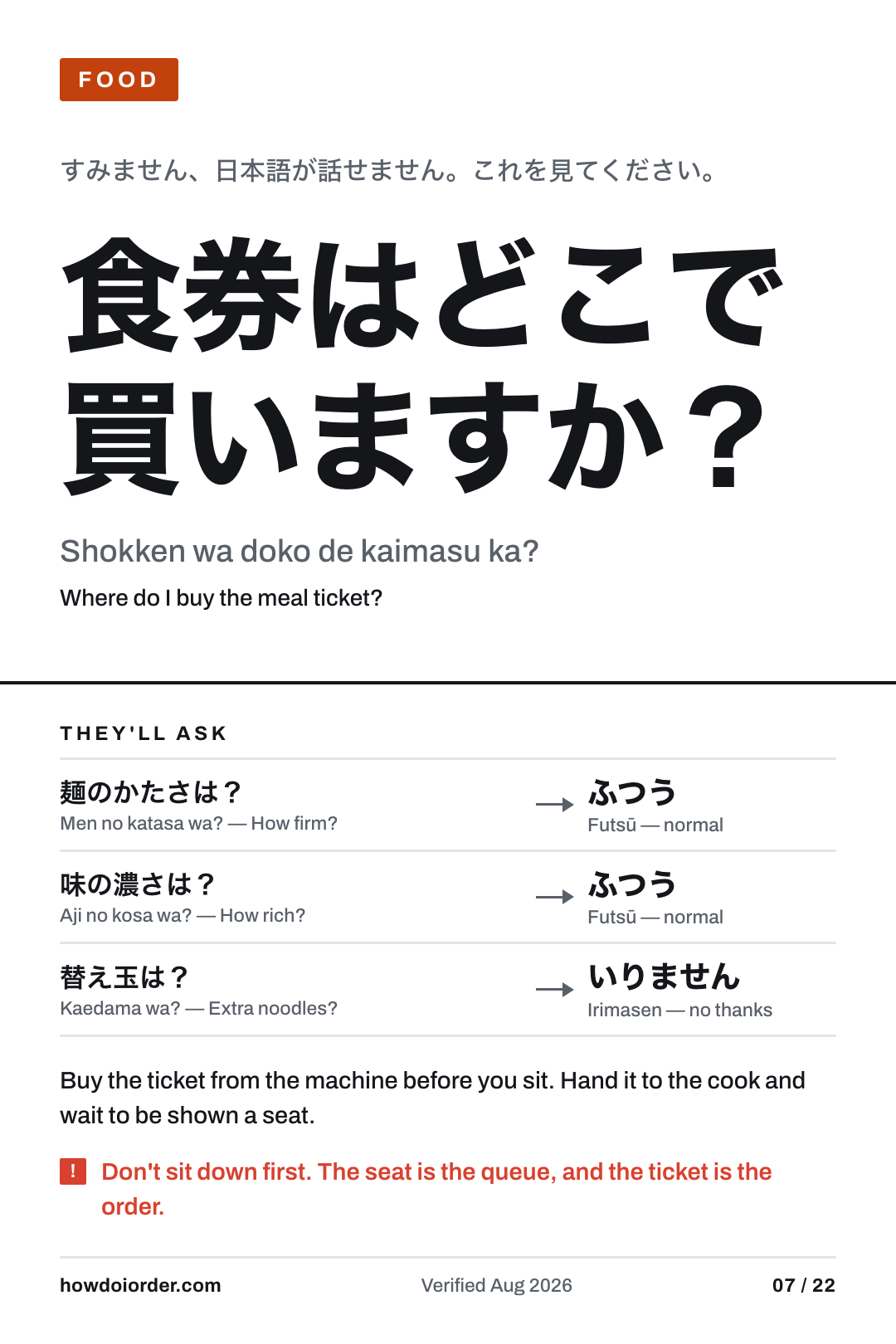
Firmness and richness, in that order, and only in some shops. Futsū — normal — is a correct answer to both, every time, and nobody thinks less of you for it.
Eat, then go
Nothing is paid at the end. Put your bowl and glass back on the counter if there is a return shelf, say gochisōsama deshita if you like, and leave. Lingering over an empty bowl is the one social error here.
What they will ask you
Four questions, and the answer that works for each
You will hear these called across a counter, fast, with no eye contact. That is normal and is not rudeness — the cook is timing noodles.
| You’ll hear | It means | Say |
|---|---|---|
| 麺のかたさは?Men no katasa wa? | How firm should the noodles be? | ふつうFutsū — normal |
| 味の濃さは?Aji no kosa wa? | How strong should the broth be? | ふつうFutsū — normal |
| 油の量は?Abura no ryō wa? | How much back fat? | すくなめSukuname — less |
| 替え玉は?Kaedama wa? | A second helping of noodles? | いりませんIrimasen — no thanks |
The machine
Reading a ticket machine you cannot read
Ticket machines are laid out by what the shop wants pressed, not by category. Japanese eyes land top-left first, the machine makers say so in their own sales material, and shops lay out accordingly. For years that meant the house standard sat top-left, and plenty of shops still do it that way.
It is no longer a rule you can lean on. A shop that knows where your eye lands can put the deluxe everything-on-top version there instead, in the biggest button, with the plain bowl demoted to something small near the bottom. Among newer shops this is now common enough that “press top-left” is no longer safe advice.
The signal that still works is price. The shop's standard bowl is the cheapest ramen on the machine — not the cheapest button, which will be a drink or a side, but the lowest number among the ramen. You can find it without reading a word of Japanese, and it works on both layouts.
The second row is usually the same bowl with something added — egg, extra pork, more noodles. Buttons at the bottom, often in a different colour, are drinks, rice and sides. A button that is dark is either sold out or waiting for your money; a button that is lit is available.
Newer touchscreen machines have an English toggle in a corner, often take Suica and Pasmo, and some take QR-code payments such as PayPay, or credit cards. Look for the logos on the front before you queue. Older ones — which are often the shops worth queueing for — take coins and ¥1,000 notes only, and not every shop paid to upgrade its machine for the 2024 notes, so older-design notes are the safest.
Don't sit down first. The seat is the queue, and the ticket is the order — taking a stool before you are shown one puts you ahead of people who were waiting.
Money
What to have in your hand
Carry more cash than feels reasonable. Card acceptance is far better than it was, but ticket machines, small counters and IC-card top-ups are still routinely cash-only, and the reliable foreign-card ATMs are in convenience stores and post offices.
For a ramen shop specifically: carry two ¥1,000 notes per person, older-design ones if you have them. Ramen had a well-known ceiling in Japan called the thousand-yen wall — above ¥1,000 a bowl read as expensive, so shops held under it. Nationally the average bowl is still under ¥800 (¥746 in the government's Retail Price Survey for August 2026), but in Tokyo and at the shops with queues, ¥1,000–¥1,300 for a standard bowl is now normal. The wall has cracked. The machine gives your change in coins.
Money goes in the small tray or into the payment machine, never into a hand. Restaurants and small shops still use the tray; the big convenience-store chains increasingly have you feed a machine facing you yourself.
Sources
Where these facts come from
- Glory, ticket-machine maker — laying out a ramen shop machine (Japanese) — the top-left rule: customers look at the top-left button first
- Glory, ticket-machine maker — cashless ticket machines (Japanese) — newer machines taking IC cards, QR codes and credit cards
- Tokyo Shimbun — ramen shops and the 2024 banknotes (Japanese) — older machines not accepting the new notes, and the cost of upgrading
- JP Market Conditions — Retail Price Survey figures for ramen (Japanese) — the national average bowl of ¥746 in August 2026
- Nihon Shokuryo Shimbun — the thousand-yen wall breaking (Japanese) — standard bowls now priced above ¥1,000 at popular shops
Prices, rules and procedures on this page were checked against these sources on 5 October 2026. Where no official source exists, the page says the detail varies.
Questions
The things people ask before they go in
What if the machine has no English?
Most do not. Find the cheapest ramen on the machine — that is the shop's standard bowl and the safe choice every time. If you want to be certain, hold up the card at the top of this page — it asks where to buy the ticket, and people will usually point at the button as well as answer.
Can I pay with a card or an IC card?
Assume not. Older machines take cash only, some take ¥1,000 notes but refuse ¥10,000, and a few still reject the new 2024 notes. Newer machines accept Suica and Pasmo, and some take QR payments or credit cards. Carry two older-design ¥1,000 notes and the question all but disappears. The change lever is at the bottom of the machine, not the top.
What is kaedama, and do I have to answer?
It is a second portion of noodles dropped into the broth you already have, for a small extra charge. It belongs to the Hakata tonkotsu tradition and is most common in shops working in that style, and it is often asked only once you are nearly finished. Irimasen ends it politely. If you do want it, say onegai shimasu while you still have broth left — that is the whole point of it.
Do I tip, or say anything when I leave?
No tip, ever — see the tipping page for why money left behind will be chased into the street. Gochisōsama deshita (go-chee-soh-sah-mah desh-ta) is the whole exit ritual, and even that is optional. Put your bowl on the counter if there is a return shelf.
Can I sit with my group?
Often not. Many ramen shops are a single counter, and popular ones seat people one at a time into whatever stool opens. Groups get split without discussion. It is not personal, and it is why ramen is considered a solo meal in Japan.
How long am I expected to stay?
Ten to fifteen minutes. Ramen is built to be eaten fast and the shop's economics assume it. If there is a queue outside, finishing and leaving is the polite act, not lingering to be appreciative.
What if the shop has no machine at all?
Then you sit, order out loud, and pay at the end at the register by the door — the ordinary restaurant pattern covered on paying the bill. The machine is a signal in itself: it means the shop expects volume and speed.
Is it rude to slurp?
No, and it is not compulsory either. The claim that slurping is a compliment to the chef is largely a story told to visitors. People slurp because it cools the noodles and it is normal — nobody is listening.