How do I buy a train ticket in Japan?
Don't. Buy an IC card instead — Suica, Pasmo and ICOCA work in every major city — and stop working out fares altogether. Top it up with cash at the machine, lay it flat on the reader at the gate, tap in and tap out. If you underpay, the fare adjustment machine before the exit gate fixes it on the spot.

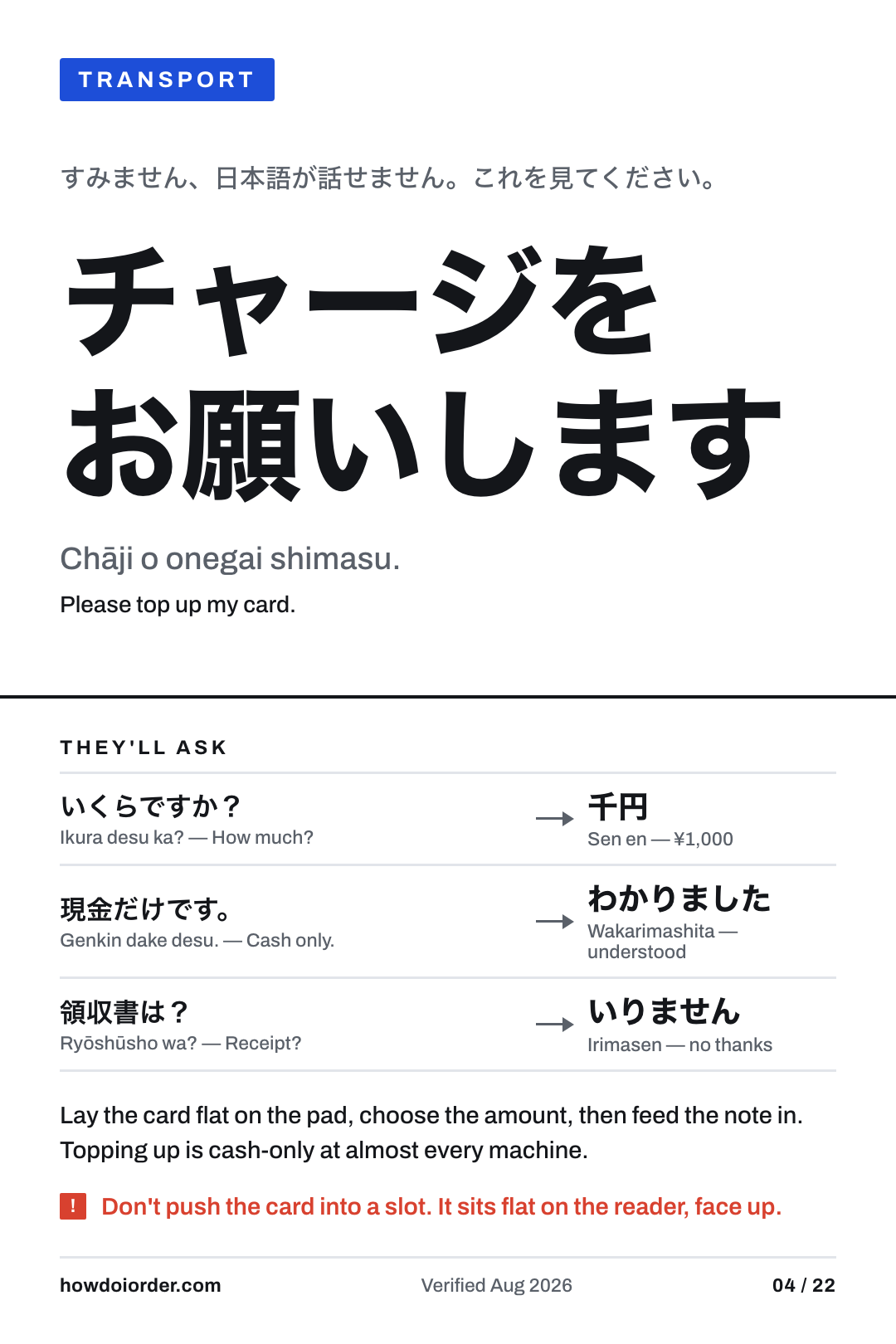
The ritual, in order
What to do at the machine, and what to do at the gate
Buy the card, not the ticket
Suica, Pasmo, ICOCA and the rest work across the major cities — a card bought in Tokyo works in Osaka, Fukuoka and Sapporo. Unregistered Suica and Pasmo have been back on sale since 1 March 2025. Buy one from a ticket machine with an IC logo, or from the staffed office. There is a ¥500 deposit on top of whatever you load.
Charge it with cash — this is the stumble
Almost no machine will top up an IC card with a credit card. At the charge machine the card usually goes into a slot or onto a tray — follow the screen. Press チャージ (chāji), pick an amount, and feed in cash: notes from ¥1,000 to ¥10,000 are taken; foreign cards are not.
At the gate, lay the card flat on the pad
At the gate it never goes into a slot. The reader is the flat panel on top of the gate, on your right as you walk through, and the card sits on it face up for about a second. Your remaining balance flashes up as you pass.
Tap in, and tap out
The fare is worked out at the far end, so an entry with no matching exit means the next gate refuses the card until staff fix it. The gates stand open and slap shut in front of you if something is wrong — that shape of failure is normal and nobody looks up.
If the gate shuts, use the fare adjustment machine
精算機 (seisanki) sits just before the exit gates. Put the card in or on it, as the screen shows, feed in the difference, take the card back. It is the designed path for an underpaid fare, not a penalty.
For the Shinkansen, check which line
On the Tokaido line (Tokyo–Kyoto–Osaka) a tapped IC card is not enough: you need a fare ticket and a limited express ticket from the ticket office or reserved-seat machine, or a smartEX booking linked to the card. On JR East's lines north and west of Tokyo, Suica can ride unreserved after a one-time registration (Touch de Go).
What they will ask you
At the counter, when the machine has beaten you
The staffed window at the end of the gate row is the answer to every problem in this section. These are the questions you get there.
| You’ll hear | It means | Say |
|---|---|---|
| いくらチャージしますか?Ikura chāji shimasu ka? | How much do you want to top up? | 千円Sen en — ¥1,000 |
| 現金だけです。Genkin dake desu. | Cash only. | わかりましたWakarimashita — understood |
| どちらまでですか?Dochira made desu ka? | Where are you travelling to? | 東京までTōkyō made — as far as Tokyo |
| 指定席と自由席、どちらですか?Shiteiseki to jiyūseki, dochira desu ka? | Reserved seat or unreserved? | 自由席でJiyūseki de — unreserved |
The card
One card, every major city, no fares to work out
The reason to skip paper tickets is not convenience, it is that buying one requires you to know the fare before you know the route. A paper ticket machine wants you to find your destination on a wall map written in kanji, read the number next to it, and press that number. An IC card removes the entire problem: you tap in, you tap out, the right amount comes off.
The regional cards are interchangeable in every major city. Suica and Pasmo come from Tokyo, ICOCA from Osaka, and there are half a dozen more; any of them works on trains, subways and buses in the big cities, and at convenience stores, vending machines and coin lockers as well. Two limits: some rural lines take no IC card at all, and one journey cannot cross from one card region into another. Buy whichever card the machine in front of you sells.
Unregistered Suica and Pasmo went back on sale on 1 March 2025, after the chip shortage that had stopped sales from 2023, so machines in Tokyo sell them again. If one is sold out, buy whichever card the next machine sells. On an iPhone, Welcome Suica Mobile runs for 180 days with no physical card, and Suica in Apple Wallet tops up through Apple Pay — a foreign Mastercard or Amex usually works, a foreign Visa often does not, so test it before you fly.
Don't push the card into a slot at the gate. There it lies flat on the pad on top, face up, for about a second, and forcing it into the paper ticket slot is how people jam a gate at rush hour.
Money
Why the top-up machine wants your cash
Carry more cash than feels reasonable. Card acceptance is far better than it was, but ticket machines, small counters and IC-card top-ups are still routinely cash-only, and the reliable foreign-card ATMs are in convenience stores and post offices.
For the station specifically: keep at least one ¥1,000 note for topping up, and load ¥2,000 to ¥3,000 for a day of ordinary city travel — single journeys are mostly ¥150 to ¥400. The maximum an IC card will hold is ¥20,000, and a machine will refuse a top-up that would take you over it.
If you are leaving and want the balance back, refunds are handled by the company that issued the card and only in its own region, and a ¥220 handling fee comes off the remaining balance before the ¥500 deposit is returned. If there is any chance you will come back, keep the card. It only dies if you leave it unused for ten years.
Sources
Where these facts come from
- Tokyu Corporation — unregistered Suica and PASMO back on sale (Japanese) — sales of unregistered cards resuming on 1 March 2025
- JR East — Touch de Go Shinkansen (Japanese) — riding JR East shinkansen unreserved on Suica after registration
- JR East — charging a Suica — inserting the card at the charge machine and topping up with cash
- japan-guide.com — IC cards (secondary, updated 27 July 2026) — the ¥500 deposit, ¥20,000 cap, ¥220 refund fee, ten-year expiry, Welcome Suica 28 and 180 days, and the foreign-card top-up caveat
Prices, rules and procedures on this page were checked against these sources on 5 October 2026. Where no official source exists, the page says the detail varies.
Questions
The things people ask on the concourse
Suica, Pasmo or ICOCA — which one do I need?
Whichever the machine in front of you sells. They are interchangeable for travel across all the major cities, and the ¥500 deposit and the ¥20,000 balance ceiling are the same on each. The only real difference is which company holds your deposit if you ever hand the card back.
Can I top up with a credit card?
Almost never at a machine — topping up is cash only at the overwhelming majority of them, which is the single most common stumble in a Japanese station. Suica in Apple Wallet is the exception: it tops up through Apple Pay, where a foreign Mastercard or Amex usually works and a foreign Visa often does not. Otherwise feed in a ¥1,000 note, or draw cash at a convenience store ATM.
What if the machine has no Suica cards?
Less likely than it was. Unregistered Suica and Pasmo went back on sale on 1 March 2025 after the chip shortage, but if one machine is out, buy whatever IC card the next one sells. The physical Welcome Suica sold to visitors runs for 28 days; Welcome Suica Mobile on an iPhone runs for 180 days and needs no card at all.
The gate closed on me. What do I do?
Step aside, do not tap again. Find the fare adjustment machine — seisanki, 精算機 — just before the exit gates, give it the card and pay the difference. If it will not resolve, the staffed gate at the end of the row fixes it by hand and nobody there is annoyed.
Can I ride the Shinkansen on an IC card?
Depends on the line. Tokyo to Kyoto on the Tokaido line needs tickets — about ¥13,300 unreserved, ¥14,170 for a reserved seat on the Nozomi — or a smartEX booking linked to your card. On JR East's lines out of Tokyo to the north and west, Suica can ride unreserved once you have registered it for Touch de Go.
How much should I load onto the card?
¥2,000 to ¥3,000 covers an ordinary day in a city, where single journeys run ¥150 to ¥400. Top up when the balance flashing at the gate drops under about ¥500, because an insufficient balance is what shuts the gate on you at the far end.
What else does the card pay for?
Convenience stores, vending machines, station coin lockers, most city buses and a growing number of taxis. Say Suica de at a register and put the card on the pad. It is the fastest way to spend ¥180 on a coffee without counting coins.
Do I still need to know how a paper ticket machine works?
Only for the odd private line or a bus that has not joined the IC system. The pattern is the same as every other Japanese vending machine — money in first, then the buttons light — and it is covered on using a ticket vending machine. A ¥1,000 note works in every one of them.