How do I order at a sushi counter without embarrassing myself?
There are two completely different sushi rituals and almost all the anxiety comes from not knowing which room you are in. At a chef's counter you order a few pieces at a time and the price is often not displayed. At a conveyor-belt shop you order from a touch panel, and at the big chains the plates are counted for you.

The ritual, in order
Work out which room you are in, then follow that room
Look for the belt before anything else
A moving belt, a touch panel at each seat and plates in a few colours (or one price for everything) means kaitenzushi — the cheap, fast, self-service version. A short wooden counter, a glass case of fish and a chef facing you means the other thing entirely, and the two have almost no rules in common.
At a belt shop: sit, then use the panel
Almost every chain panel has an English toggle in a corner. You order from the panel and your plates arrive on a separate express lane or a small track above the belt, usually with a chime. At Sushiro, the biggest chain, nothing goes round unless someone ordered it, so the panel is the only way. Where unordered plates still circulate, under clear covers, take only what you will actually eat. Some branches let you scan a QR code and order from your own phone, handy on the aisle side of the booth.
At a counter: order two or three pieces at a time
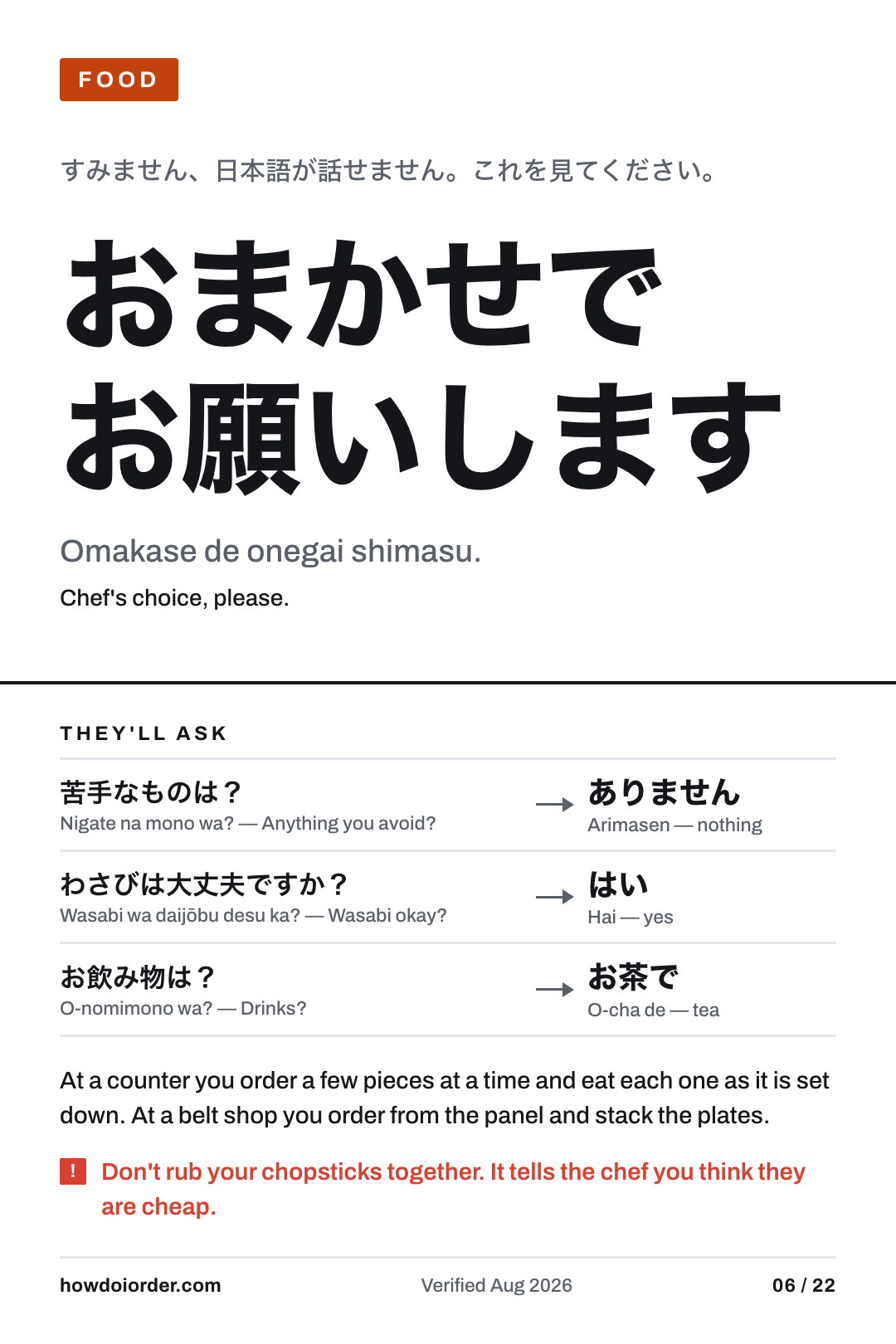
You are not ordering a meal, you are ordering a sequence. Name two or three fish, eat them, then order again. Omakase de onegai shimasu hands the whole decision to the chef, which is the easier and usually better option — but it commits you to whatever comes and to an open-ended price.
Eat each piece as it is set down
At a counter the piece is finished at the moment it reaches you and it is meant to be eaten within about a minute. Photographing the whole row before you start is the one thing that visibly bothers a chef. Fingers are entirely acceptable for nigiri; chopsticks are fine too.
Dip the fish, not the rice
Pour a small amount of soy into the dish, turn the piece over and touch the fish to it. Rice-first soaks up soy, falls apart and over-salts the piece. Wasabi is usually already inside, so adding more before you taste it is a judgement on the chef.
Ask for the bill in the way the room expects
At a big belt chain you press お会計 (o-kaikei, bill) on the panel — a camera or the plate slot has already counted — and take the slip or QR code to a self-checkout by the door. At a counter you say o-kaikei o onegai shimasu and pay at the register. Nothing is paid at the table in either case.
What they will ask you
Four questions, mostly at the counter
A belt shop may ask you nothing at all beyond how many people. A chef's counter will ask these, and each has a one-word answer.
| You’ll hear | It means | Say |
|---|---|---|
| 何名様ですか?Nan-mei sama desu ka? | How many people? | 二人ですFutari desu — two of us |
| 苦手なものは?Nigate na mono wa? | Is there anything you'd rather avoid? | ありませんArimasen — nothing |
| わさびは大丈夫ですか?Wasabi wa daijōbu desu ka? | Is wasabi all right? | はいHai — yes |
| お飲み物は?O-nomimono wa? | What would you like to drink? | お茶でO-cha de — tea |
Two rooms
The same food, two entirely different transactions
Kaitenzushi is a self-service system that happens to serve sushi. Plates are colour-coded by price — roughly ¥110 to ¥400, with city-centre branches charging more — and the price key is on the wall or on the panel. You sit, you tap, plates arrive, and at the big chains a camera or a slot at your table counts the plates. At Kura, push each empty plate into the slot beside you instead of stacking it. Three people can eat well for ¥4,000–¥5,000 and nobody will speak to you beyond hello.
A chef's counter is a conversation with a fixed cost of attention. There may be no menu and no prices. Omakase means you have handed over the choice, and the chef will build a sequence, usually eight to fifteen pieces, that ends when they decide it ends. This is where the money is: a lunch omakase can be ¥3,000–¥5,000, and an evening one runs from about ¥10,000 upward with no ceiling.
If you want the counter experience without the open-ended bill, go at lunch and ask the price before you sit. Ikura desu ka? — how much — is a normal question, and a shop that will not answer it is telling you something. Booking is often required in the evening and sometimes only by phone.
Don't rub your disposable chopsticks together to get the splinters off. At a counter it reads as telling the chef their chopsticks are cheap.
Money and manners
The small things that are actually noticed
Carry more cash than feels reasonable. Card acceptance is far better than it was, but ticket machines, small counters and IC-card top-ups are still routinely cash-only, and the reliable foreign-card ATMs are in convenience stores and post offices.
Ginger is a palate cleanser eaten between pieces, not a topping to put on top of the fish. Green tea is free at a belt shop — there is a hot-water tap at the seat and powdered tea in a pot — and it is included at a counter too. Soy sauce, ginger and a wet towel are the only things at your place setting that are unlimited.
Money goes in the small tray or into the payment machine, never into a hand. Restaurants and small shops still use the tray; the big convenience-store chains increasingly have you feed a machine facing you yourself.
Sources
Where these facts come from
- Kura Sushi — menu and plate prices (Japanese) — base plate prices of ¥110, ¥115, ¥125 or ¥145 depending on the branch
- Sushiro — touchscreen and smartphone ordering (Japanese) — ordering on the big screen or your own phone, and ordered plates on their own lane
- Nikkei — Sushiro will not bring back free-circulating sushi (Japanese) — only ordered items going round at Sushiro since 2023
- Nikkei — Sushiro plate prices (Japanese) — suburban plates at ¥120, ¥180 and ¥260
- Impress DIGITAL X — Sushiro's automatic plate counting (Japanese) — plates counted automatically and paid for at a self-checkout
Prices, rules and procedures on this page were checked against these sources on 5 October 2026. Where no official source exists, the page says the detail varies.
Questions
What people want to know before they sit down
How much does omakase cost?
It is the one number most counters will not print. Lunch omakase is commonly ¥3,000–¥5,000; an evening course typically starts around ¥10,000 and has no upper limit. Asking ikura desu ka? before you sit is normal and not rude, and a shop that dodges the question is answering it.
Do I have to say omakase, or can I order piece by piece?
Either works. Ordering two or three pieces at a time by name — maguro, salmon, ebi — is exactly what the counter is built for. Omakase de onegai shimasu simply hands the choice over, and it is the easier option when you cannot read the wooden slats on the wall.
How does the conveyor belt bill work?
Plates are priced by colour, roughly ¥110 to ¥400 each, with the key on the wall or the panel. At the big chains a camera or a slot at your table counts the plates. You press お会計 (o-kaikei, bill) on the panel, take the slip or QR code to a self-checkout by the door, and pay there. Smaller shops may still count the stack by hand and take payment at the register, as covered on paying the bill.
Can I eat sushi with my hands?
Yes, for nigiri — it is traditional and nobody will react. Sashimi and anything in a bowl needs chopsticks. Use the wet towel — the oshibori — on your hands before you start, not as a napkin during the meal, and eat each piece within a minute of it being set down.
Where does the soy sauce go?
On the fish. Turn the piece over and touch the fish side to the shōyu, then eat it in one or two bites. Rice-first soaks up too much and the piece falls apart. Pour a small amount into the dish — a teaspoon is plenty — because visibly wasting soy sauce is noticed.
Do I need to add wasabi?
Usually not. At a counter the chef has already put a smear between the fish and the rice, which is why they ask wasabi wa daijōbu desu ka? in the first place. If you cannot take it, answering sabi-nuki de asks for it to be left out. Belt shops usually put it in small packets at the seat or let you order it from the panel.
What if I can't eat raw fish, or have an allergy?
Belt shops are the safer room: the panel lists cooked eel, egg, prawn, corn, inari and karaage, usually with pictures. At a counter say it before the sequence starts, because omakase is planned in advance — kore wa taberaremasen means 'I can't eat this'. The allergies page covers the dashi problem, which affects the soup rather than the sushi.
Should I tip the chef, or buy him a drink?
No tip — money left behind gets returned to you, and the tipping page explains the chase. Saying gochisōsama deshita as you leave is the whole thanks ritual and takes two seconds. Buying the chef a beer happens between regulars, not on a first visit.