How do I use an onsen without getting it wrong?
You take your shoes off at the door, pay, and go through the curtain marked with your character — not the one on your usual side. You undress completely in the changing room, carry only the small towel in, and wash sitting down at a low shower until you are properly rinsed. Only then do you get in. The towel never touches the water.

The ritual, in order
From the front door to the water, in the order it happens
Shoes off at the entrance, then pay
There is a step up, a rack of wooden lockers or a shoe cubby, and a line on the floor you are not meant to cross in outdoor shoes. Pay at the desk or at a small ticket machine — the same kind used at ramen counters. A neighbourhood bath costs a few hundred yen; a resort day bath or a big spa complex is ¥1,000 or more. The price is on the machine before you commit.
Read the character on the curtain, not the position
男 is men. 女 is women. The two curtains swap sides at plenty of places, and many swap them daily so both sexes get both baths — so the side means nothing and the colour (often blue and red) is a convention, not a rule. Read the character every single time, including the second morning. From about age 7 (the exact age is set locally), a child goes into the bath for their own sex, not with the other parent.
Undress completely in the changing room
Everything comes off and goes into a basket or a locker — underwear included. You do not wear a swimsuit in an ordinary onsen. The few that want one say so at the entrance. Take nothing through the inner door except the small towel. Phones, watches and the big towel stay in the basket.
Sit at a low shower and wash properly
There is a row of taps at knee height with a plastic stool and a bowl. You sit on the stool — standing up to shower sprays the person next to you. Soap, wash, and then rinse until there is no foam left anywhere, including your feet and the stool. This is the part the whole system depends on.
Get in slowly, and keep the towel out of the water
The small towel goes on your head or on the stone at the edge. Long hair goes up in a tie. Do not swim, do not put your head under, and do not wash in the bath — the water is shared, and at a straight-from-the-spring bath it is not treated the way a pool is. Talk quietly or not at all.
Wring the small towel out and dry off before the curtain
Squeeze the towel, then wipe yourself down standing on the wet side of the door. Walking into the changing room dripping soaks the floor, the baskets and other people's clothes, and it is the thing regulars notice. Some baths rinse off after the water and some do not — mineral-heavy water is often left on the skin on purpose.
What they will ask you
Four things said at the desk, and what to say back
Almost all of this happens at the front desk before you have undressed anything. Once you are through the curtain nobody speaks to you at all.
| You’ll hear | It means | Say |
|---|---|---|
| 入れ墨はありますか?Irezumi wa arimasu ka? | Do you have a tattoo? | ありますArimasu — yes, I do |
| タオルは要りますか?Taoru wa irimasu ka? | Do you need a towel? | お願いしますOnegai shimasu — yes please |
| 何名様ですか?Nanmei-sama desu ka? | How many of you? | 一人ですHitori desu — just me |
| 初めてですか?Hajimete desu ka? | Is this your first time? | はい、初めてですHai, hajimete desu — yes, first time |
Tattoos
The tattoo question, answered honestly
This is why most people are reading this page, so here is the blunt version: a great many onsen still refuse tattooed guests, the refusal is polite and absolute, and it is not aimed at you personally. The rule dates from tattoos being read as organised-crime membership, and although that association has weakened, the sign on the door has often not changed with it. Sizes, styles and your nationality do not reliably change the answer.
In practice there are four outcomes and they are all common. Some places say yes without comment. Some say yes if the tattoo is covered — flesh-coloured cover-up stickers are sold in drugstores and at some front desks and work for anything up to roughly the size of a palm. Some say no. And an increasing number, particularly newer city bathhouses and places used to foreign guests, are explicitly tattoo-friendly and say so on their own website in English.
The reliable way round all of it is a private bath — 貸切風呂 (kashikiri-buro), booked by the hour, or a room at a ryokan with its own bath. Nobody asks about tattoos in a room you have to yourself. At a public bathhouse it is often a few thousand yen for 45 to 60 minutes, though prices vary; at a ryokan it is often free with your stay but has to be reserved at check-in, sometimes the moment you arrive. If you have tattoos and one particular onsen matters to you, ask before you travel rather than at the door.
Don't get into the water before you are washed and rinsed — the bath is for soaking in, not for cleaning yourself in, and everyone shares the same water.
Practicalities
Money, towels, and what the rules actually cost you
Carry more cash than feels reasonable. Card acceptance is far better than it was, but ticket machines, small counters and IC-card top-ups are still routinely cash-only, and the reliable foreign-card ATMs are in convenience stores and post offices.
Budget small: entry to a neighbourhood sento in Tokyo is ¥600 for adults since August 2026 (¥200 for children aged 6–11), a ceiling set by the Tokyo government rather than the owner, while a resort day bath or a large spa complex is ¥1,000 or more, sometimes a lot more. A towel set is usually ¥100–¥300 to rent or ¥200–¥300 to buy, lockers often take a returnable ¥100 coin, and cover-up stickers are a few hundred yen a pack at any drugstore — the same shops covered on buying medicine in Japan. If you forget everything else, a convenience store sells a towel too; see the convenience store page.
Every ritual on this page is dated, and the cards carry the month they were checked. Japan changes these details more often than guidebooks admit — machines get replaced, charges get added, rules get relaxed. Used a card at a counter? Tell us how it went: [email protected].
Sources
Where these facts come from
- Tokyo Metropolitan Government — public bath price ceiling (Japanese) — the ¥600 adult sento price from August 2026 and ¥200 for ages 6–11
- Ministry of the Environment — what counts as an onsen (Japanese) — the Hot Springs Act definition: 25°C or above at source, or listed minerals
- Ministry of the Environment — bathing precautions standard (Japanese) — drinking water after bathing and not bathing after alcohol or a meal
- Ministry of Health, Labour and Welfare — public bath hygiene guideline (Japanese) — chlorinated bath water, children in their own sex's bath from about age 7, drunk bathers refused
- Japan Tourism Agency — ryokan Q&A on tattoos (Japanese) — why many baths refuse tattoos, and the private-bath alternative
Prices, rules and procedures on this page were checked against these sources on 5 October 2026. Where no official source exists, the page says the detail varies.
Questions
The things people ask before they go through the curtain
I have a tattoo. What do I actually say?
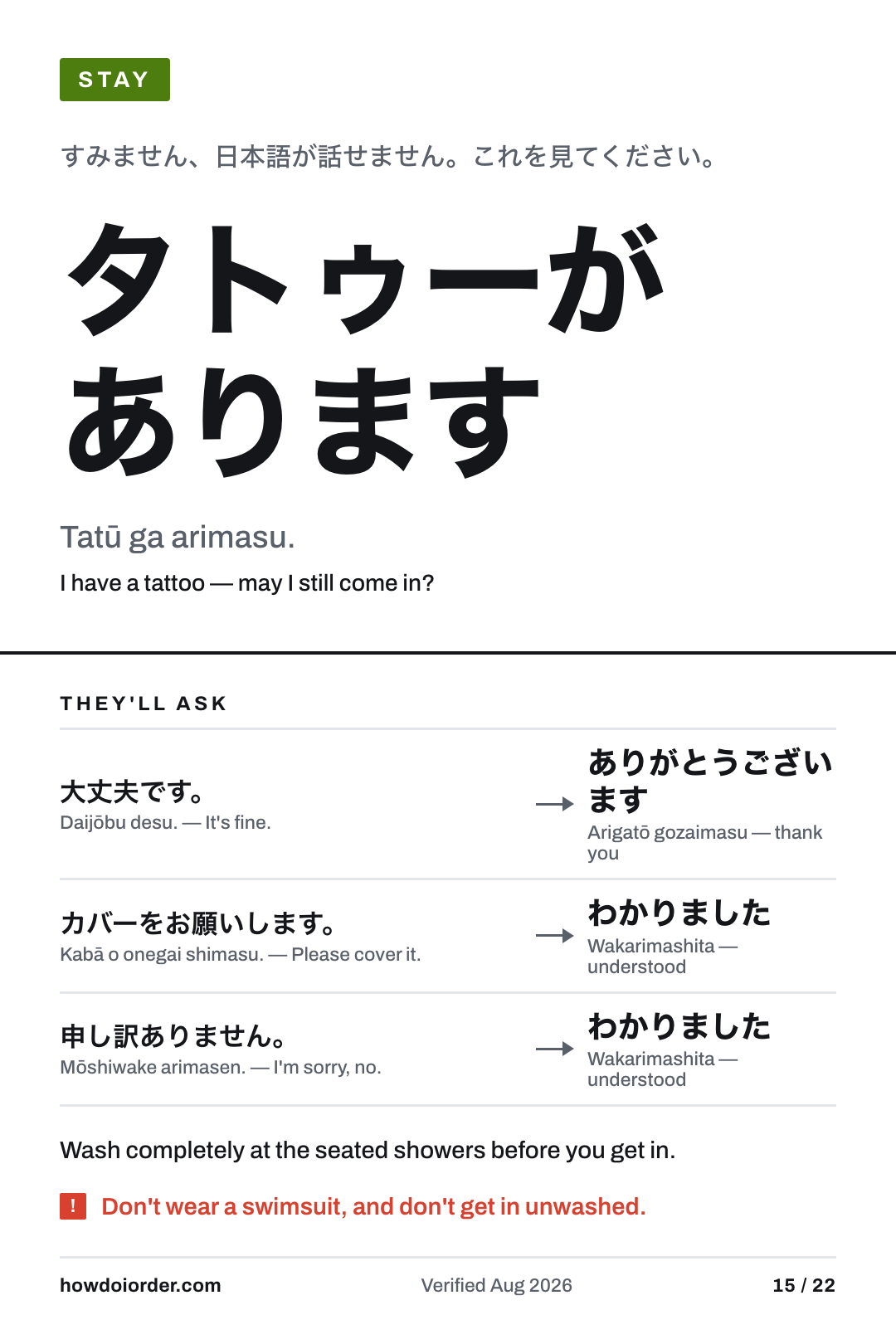
Ask at the desk before you pay, with the card at the top of this page or the phrase tatū ga arimasu (タトゥーがあります) — I have a tattoo. You will get one of three answers: daijōbu desu (it is fine), kabā o onegai shimasu (please cover it), or mōshiwake arimasen (sorry, no). Asking first costs you thirty seconds; being turned round at the changing room costs a lot more.
Do cover-up stickers work?
For small tattoos, usually. They are sold at drugstores in packs for a few hundred yen and come in sheets in a few sizes that you can layer. They do not work for a sleeve or a back piece, and the front desk makes the final call — a place that says kabā o onegai shimasu is telling you a sticker is enough, and a place that says no means no even with one on.
Can I wear a swimsuit if I am uncomfortable?
No. An onsen is bathing, not swimming, and a swimsuit in the water is treated the way outdoor shoes on a tatami floor would be. The exceptions are advertised as such: some mixed-bathing (混浴, konyoku) baths and spa resorts with pool areas require a swimsuit, and they will say so at the entrance. If nudity is the blocker, book a private kashikiri bath for 45 minutes instead.
How do I know which changing room is mine?
Only by the character. 男 (otoko) is men, 女 (onna) is women. Many baths swap the two rooms overnight so guests get both views, so the room you used last night may be the other one in the morning. Blue and red curtains are a common convention and not a rule — read the character.
What is the small towel for?
Modesty while you walk, and drying off afterwards. It is about 34 × 80 cm, costs ¥200–¥300 to buy at the desk, and it goes on your head or on the edge of the bath once you are in. It must never go in the water — that is the one towel rule everybody enforces silently.
How long do I stay in the water?
Five to ten minutes at a time is normal, and most baths run 40–42°C, which is hotter than it looks. Get out, sit on the side, cool down, go back in. A hot bath makes you sweat more than you notice, so drink a glass of water before and after — there is nearly always a vending machine by the exit selling water for around ¥130. Do not get in after drinking alcohol or straight after a big meal: the bathing precautions posted at onsen say so, and staff can refuse a drunk bather.
Is a sento the same thing as an onsen?
No. A sento (銭湯) is a neighbourhood public bath, usually heated well or tap water, though some Tokyo sento run on genuine spring water. An onsen (温泉) is legally any spring water that comes out of the ground at 25°C or above, or carries enough of certain minerals, so it does not even have to be hot. The etiquette in both is identical, but the sento is cheaper — ¥600 for adults in Tokyo since August 2026, capped by the Tokyo government — and is a local facility rather than a destination.
Can I take my phone in for a photo?
No, and this is the one rule with no flexibility: no photos in the changing room or the bath, ever, even of an empty room, even of the view. Leave the phone in the locker with everything else. If you want a picture of a famous open-air bath, buy a postcard or book a private kashikiri bath where you are the only person in it.