How do I buy medicine at a Japanese drugstore?
Basic painkillers, plasters and lozenges sit on open shelves and need no conversation. Since May 2026, cold and cough medicines with codeine or ephedrine-type ingredients sit behind the counter or in sight of staff, who may ask why you want them. The strongest class needs a pharmacist in the building, and the pharmacist is not always on shift. Point at the symptom, not the box.

The ritual, in order
From the door to the register
Work out which kind of shop you are standing in
ドラッグストア — Matsumoto Kiyoshi, Sundrug, Welcia, Cosmos — is a shop that sells cosmetics, snacks, nappies and basic medicine, and it is what you want. A 薬局 (yakkyoku) next door to a clinic is a dispensing pharmacy that mainly fills prescriptions and may not sell you anything without one.
Find the medicine, which is rarely at the front
The front of a drugstore is cosmetics and drinks. Medicine is at the back or upstairs, near a counter with a person behind it. Open shelves are the lower legal classes. Behind the counter, or on a shelf staff can watch, sit the class that needs a pharmacist and, since May 2026, many cold and cough medicines containing codeine or ephedrine-type ingredients.
Point at the symptom rather than naming a drug
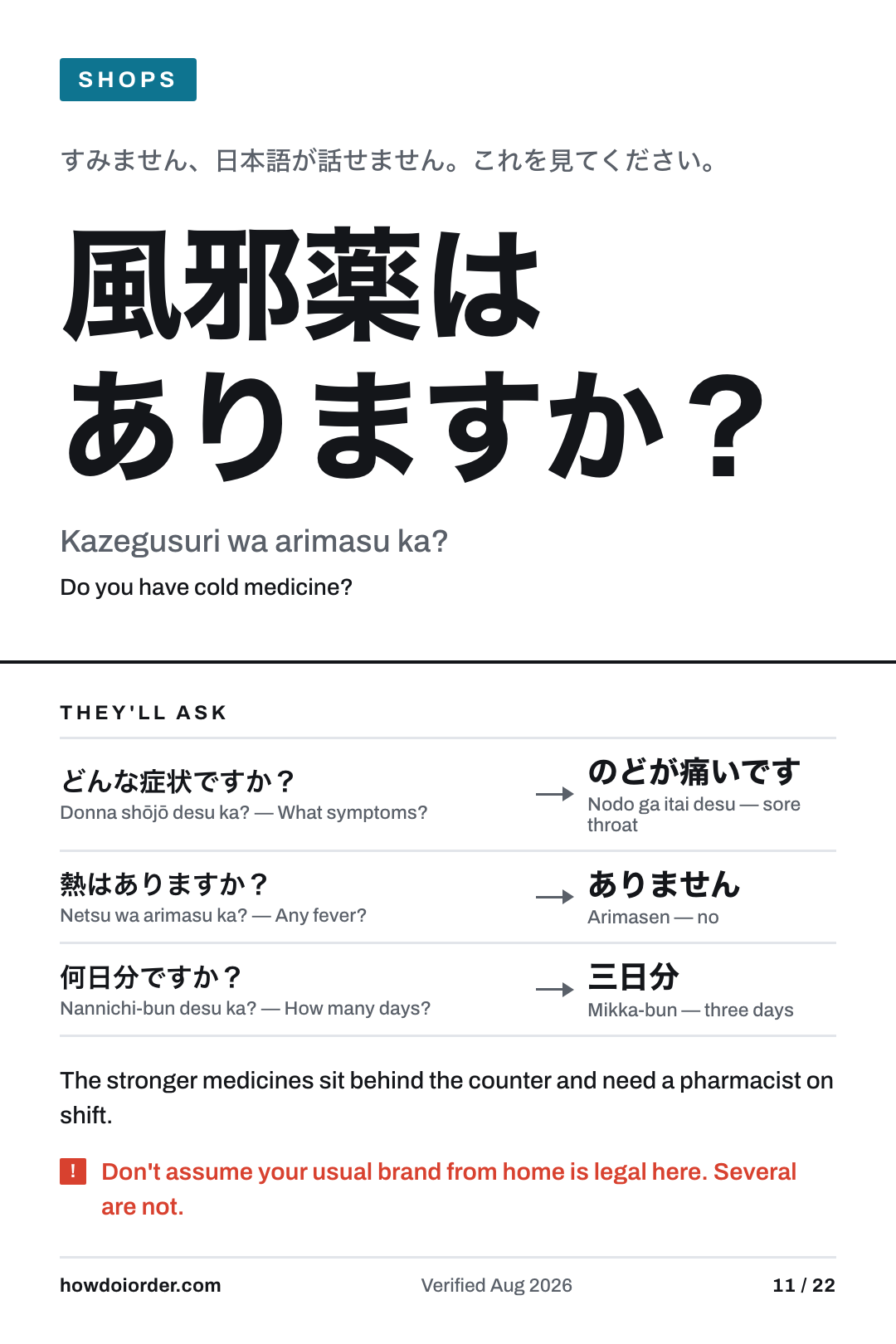
Brand names from home mean nothing here and the active ingredient is printed in Japanese. Point at your throat, your head or your stomach, or hold up the card at the top of this page: 風邪薬はありますか? — kazegusuri wa arimasu ka?, do you have cold medicine?
Answer three short questions
Symptoms, fever, and how many days you want it for. Nodo ga itai desu (my throat hurts), netsu wa arimasen (no fever), mikka-bun (three days' worth) covers most of it. Staff commonly reach for a translation app at this point — let them, it is faster than either of you guessing. If you want more than one box of a cold or cough medicine, expect to be asked why: since May 2026 that is the law, not suspicion of you.
Pay at the front register, not at the counter
The medicine counter hands you the box; the till is at the entrance with everything else. Larger chains take cards and IC cards; small ones may not. Point-card questions at the till (pointo kādo wa?) can be answered with iie.
Read the dose before you take any of it
Japanese doses are often lower per tablet than the equivalent at home and the frequency is different. Photograph the box and the leaflet and translate them before you swallow anything, and check the ingredients against anything you already take.
What they will ask you
Four questions at the medicine counter
These come in the same order almost every time, and the answers are short. Nothing here requires you to name a drug.
| You’ll hear | It means | Say |
|---|---|---|
| どんな症状ですか?Donna shōjō desu ka? | What are your symptoms? | のどが痛いですNodo ga itai desu — my throat hurts |
| 熱はありますか?Netsu wa arimasu ka? | Do you have a fever? | ありませんArimasen — no |
| 何日分ですか?Nannichi-bun desu ka? | How many days' worth? | 三日分Mikka-bun — three days |
| アレルギーはありますか?Arerugī wa arimasu ka? | Do you have any allergies? | ありませんArimasen — none |
The counter
Why the same shop can sell it in the afternoon and not the evening
Over-the-counter medicine in Japan is sorted into legal classes, and the class decides who is allowed to hand it to you. The lower classes can be sold by a registered seller (登録販売者, tōroku hanbaisha) — a qualified staff member, identified by the name badge, not the coat — and most sit on open shelves you can pick from without speaking to anyone. The strongest class can only be sold by a licensed pharmacist (薬剤師, yakuzaishi), and it sits behind or beside the counter where you cannot reach it. Since May 2026 there is a second line: medicines containing codeine, dihydrocodeine, ephedrine, methylephedrine, pseudoephedrine or bromovalerylurea — many cold and cough remedies — are designated abuse-prevention medicines. They are kept behind the counter or in sight of staff, staff must ask why if you want several packs or a large one, and under-18s can buy only one small pack.
The consequence catches people out constantly: the shop can stay open long after its pharmacist has left. The shop is the same, the box is on the same shelf, and once the pharmacist has gone it legally cannot be sold, so the same shop can sell it to you in the afternoon and refuse in the evening. Some shops post a small sign saying when the pharmacist is in. Yakuzaishi wa imasu ka? — is there a pharmacist here? — settles it in one question.
A dispensing pharmacy attached to a clinic works differently again. You go to the clinic, get a prescription (shohōsen), walk it next door, hand it over with your passport or insurance card, and wait ten to twenty minutes. Without a prescription there is usually nothing for you there, which is why the drugstore chain is the right first stop for a cold.
Don't assume the medicine you take at home is legal to bring in — anything with more than 10% pseudoephedrine, and amphetamine medicines such as Adderall, cannot enter Japan at all, anything with more than 1% codeine needs a permit before you fly, and that is decided at the border, not at the pharmacy.
Money and limits
What it costs, and where this page stops
Money goes in the small tray or into the payment machine, never into a hand. Restaurants and small shops still use the tray; the big convenience-store chains increasingly have you feed a machine facing you yourself.
Prices are low and fixed by the shop rather than negotiable: a small box of basic painkillers is roughly ¥600–¥1,200, a course of cold powder or tablets ¥1,000–¥2,000, throat lozenges and plasters a few hundred yen, and a box of masks under ¥500. Drugstores are also one of the biggest tax-free categories for visitors — the rules, which change on 1 November 2026, are on the tax-free page. Convenience stores are not a substitute; only a minority of branches are licensed to sell any medicine at all, which is one of the few things the konbini cannot do for you.
This page is about the shop, not about your health: nothing here is medical advice. For anything beyond a cold, a blister or a hangover — a fever that will not come down, chest pain, a suspected fracture, an allergic reaction — the right answer is a clinic. In an emergency, call 119 for an ambulance or fire and 110 for the police. If you need help explaining, the JNTO Japan Visitor Hotline, 050-3816-2787, is staffed around the clock in English, Chinese and Korean. A drugstore counter is not staffed to make that call for you.
Sources
Where these facts come from
- Ministry of Health, Labour and Welfare — the May 2026 medicine sales changes (Japanese) — designated abuse-prevention medicines, reason checks on several packs, limits for under-18s
- Ministry of Health, Labour and Welfare — bringing medicine for personal use (Japanese) — one month of prescription and two months of over-the-counter medicine, online Import Confirmation
- Ministry of Health, Labour and Welfare regional bureau — Q&A on bringing medicines — codeine over 1% is a narcotic, pseudoephedrine over 10% and amphetamines cannot be brought in
- National Tax Agency — tax-free refund system Q&A (Japanese) — the 1 November 2026 refund system and the ¥5,000 minimum
- JNTO — guide for when you are feeling ill — 119 and 110, registered sales clerks, and full charges for uninsured visitors
- JNTO — Japan Visitor Hotline — 050-3816-2787, in English, Chinese and Korean
Prices, rules and procedures on this page were checked against these sources on 5 October 2026. Where no official source exists, the page says the detail varies.
Questions
The things people ask on the way to the drugstore
What is the difference between a drugstore and a pharmacy?
A doraggu sutoa (ドラッグストア) is a retail chain — Matsumoto Kiyoshi, Sundrug, Welcia — selling cosmetics, snacks and basic medicine. A yakkyoku (薬局) beside a clinic dispenses prescriptions and often little else. For a cold, go to the chain; for a prescription, you need the clinic first.
Why would they refuse to sell me something in the evening?
Because the strongest over-the-counter class legally requires a licensed pharmacist to hand it over, and the shop often stays open after the pharmacist has left. The same shop can sell you the same box in the afternoon and refuse in the evening. Ask yakuzaishi wa imasu ka? (薬剤師はいますか?) — is there a pharmacist here?
What should I expect to pay?
Roughly ¥600–¥1,200 for a small box of painkillers, ¥1,000–¥2,000 for a cold remedy in powder or tablet form, a few hundred yen for lozenges, plasters or eye drops, and under ¥500 for a box of masks. Big chains take cards and Suica; smaller shops may be cash only.
Can I bring my own medication into Japan?
Usually, within limits, and you check before you fly. With no paperwork you can bring up to one month of a prescription medicine and up to two months of ordinary over-the-counter medicine; more than that needs an Import Confirmation (still often called yakkan shōmei), which you apply for online before you travel. Medicine with more than 1% codeine counts as a narcotic and needs written permission from the health ministry in advance; anything with more than 10% pseudoephedrine, and amphetamine medicines such as Adderall, cannot be brought in at all. The health ministry pages are the authority; a website is not.
Nobody at the counter speaks English. Now what?
Point, and let them use a translation app — drugstore staff usually reach for one quickly. Show the card at the top of this page or say the symptom: nodo ga itai desu (throat), atama ga itai desu (head), netsu ga arimasu (I have a fever). Naming a brand from home is the one approach that reliably fails.
Can I buy antibiotics or my usual prescription over the counter?
No. Antibiotics and prescription-only medicines require a Japanese doctor's prescription (処方箋, shohōsen), which means a clinic visit. Without Japanese insurance you pay the full cost yourself, and some hospitals charge visitors more than the standard rate; travel insurance is what that is for. Bring enough of your own regular medication for the whole trip.
Can I get tax-free at a drugstore?
Usually yes — drugstores are one of the heaviest tax-free categories for visitors, and you need your passport in your hand rather than in the hotel safe. From 1 November 2026 you pay the tax at the till and get it back after Customs checks your goods at departure. The minimum is still ¥5,000 in one shop on one day, but medicine and everything else now count together; keep the goods unopened and with you until you leave. See tax-free shopping.
Does anything at the counter depend on my allergies?
Yes, and it is the one question worth answering carefully. Arerugī wa arimasu ka? means do you have any allergies, and it is asked about medicine as well as food. If you have a drug allergy, carry it written in Japanese rather than trying to pronounce it — the same logic as on the allergy page.